Three years after Bahrain erupted in violence, the country's economy remains in fragile condition. The kingdom's latest fiscal budgets of 2013 and 2014 highlight the country's complicated political situation and rising debt, and lack of catalysts that would help the country break the shackles of a moribund economy.
The ruling Al Khalifa family has been unable to secure reconciliation and truce with the restive Shia population, which has been demanding greater social and political participation.
"Deep sectarian divisions keep the medium-term political outlook complex and concerning," wrote Jean-Michel Saliba, analyst at Bank of America Merrill Lynch. "If not addressed through a credible political settlement, grievances seemingly point to another cycle of mild reform and continued repression, in our view."
But little has been done to implement the recommendations of the Bahrain Independent Commission of Inquiry (BICI). The third anniversary of the February 2011 revolt drew protests leading to arrests of dozens of Bahrainis.
The gulf between the government and the Shia-led opposition will threaten progress in reconciliation talks, with the risk that dissidents will revert to violence to further their aims, according to a grim assessment by the Economist Intelligence Unit.
"The king, Hamad bin Isa al-Khalifa, will try to position Bahrain as a moderate and reforming monarchy, but his efforts will be stymied both by hardliners within the ruling Al Khalifa family and by rejectionist political groups opposed to the monarchy," the EIU said.
If the deadlock persists, the opposition group Al-Wefaq will likely boycott - and undermine - the parliamentary elections expected to be held in October.
The political dissent makes Bahrain the weakest of the Gulf Co-operation Council (GCC) states, but it enjoys firm backing from Saudi Arabia, which played a key diplomatic, military and financing role in suppressing the first wave of protests in 2011.
"All [Gulf] countries except for Bahrain have accumulated large official external assets and would be able to comfortably weather temporary declines in oil income," the International Monetary Fund said in its annual report on the region.
ECONOMIC MALAISE
Since then, Bahrain has struggled to restore confidence, and its once robust financial services sector has been surpassed by the UAE and Qatar, as the country has grappled with a crisis of business confidence.
Gulf states were quick to promise a USD 10 billion to Bahrain at the height of the crisis in 2011. Local media reports suggest Bahrain is set to embark on infrastructure projects worth USD 4.3 billion as part of that financing package this year.
Sheikh Khalid bin Abdullah Al Khalifa, the country's deputy prime minister said nearly half of the funds will be allocated to build more than 9,000 housing units over the next three years, apart from investments in water and power projects.
The raft of new investments will help Bahrain maintain a 3% plus GDP growth rate in 2014, after growing by an estimated 4.3% in 2013.
Output from Bahrain's offshore Abu Safa oilfield is expected to have functioned at full capacity for much of 2013, but a further expansion of production from the facility is unlikely at least this year.
Analysts expect the kingdom to increase investment in its hydrocarbon sector and Aluminium Bahrain, which has seen delays to its new potline.
"A plan to build a larger oil pipeline from Saudi Arabia, which is expected to be completed in the third quarter of 2016, and a simultaneous project to expand the capacity of Bahrain's Sitra refinery should mean that overall growth will pick up significant pace in 2016-17, reaching 4.9% in 2017," the EIU said.
Beyond these developments, the services sector is bound to suffer as it has lost ground to Dubai and Doha in recent years. Bahrain's central bank has introduced new takaful and sukuk rules in the hopes to attract new businesses, but such half measures may not be enough to attract investors.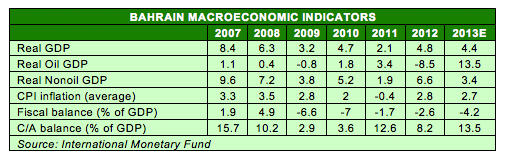
FISCAL BUDGET
The country's 2013-14 budgets have a break even oil price of USD 120 and USD 121 per barrel respectively, according to Bank of America Merrill Lynch forecasts, highlighting the country's fiscal fragile condition.
The budgets were approved in June 2013, but revised to accommodate additional social expenditure, however the government has resisted demands to raise public sector salaries by 15% and hike domestic fuel prices.
The 2013-14 budgets pencil in a 15% increase in current spending, counterbalanced by a 50% cut to capital spending compared to the 2011-2012 budgets.
"In the absence of fiscal consolidation, which is complicated by the socio-political backdrop, debt dynamics are set to remain adverse, in our view." BAML estimates government debt stood at 44% of GDP in 2013, up from 13% of GDP in 2008.
"We believe that Saudi Arabia's support of Bahrain remains strong. However, with financing still available, we do not see further Saudi support in the absence of stress," BAML's Saliba said.
The feature was produced by alifarabia.com exclusively for zawya.com.
© Zawya 2014