Asia Pacific's net oil imports by 2035 are equivalent to the combined production of major OPEC producers such as Saudi Arabia, Iran, Iraq, Kuwait and the UAE, according to the Asian Development Bank.
Asia Pacific's net oil imports (including crude oil and petroleum products) are expected to increase from 15.5 million barrels per day in 2010 to 25.7 million bpd by 2035. The surge in oil demand presents "a major challenges for the members of Asia and the Pacific to find and secure, stable, and affordable supply sources outside the region."
While Asian countries are looking far and wide including North and South America, Russian Arctic and Africa to secure energy supplies, the forecast of Asia's massive demand for oil is good news for the Middle East and North Africa region.
Many recent reports have suggested that Asian countries will be able to choose from Middle Eastern, Russian, Canadian and African crude output - but it seems more likely that Asia will require huge amounts of crude oil to keep all the exporting countries in business.
The report notes that Asia Pacific's energy demand is expected to rise 2.1% per year over the next 25 years - far higher than the global annual average of 1.5%.
Primary energy demand of Asia and the Pacific will reach 8,358.3 million tons of oil equivalent (Mtoe) by 2035, up from 4,985.2 Mtoe in 2010. Among the fossil fuels, oil imports will have the biggest share through 2035. Crude oil demand in the region will rise 1.9% each year over the forecast period to reach 1,973.0 Mtoe - 59.3% higher than the 1,238.2 Mtoe in 2010.
The transportation sector will lead demand in Asia, making up 60.5% of growth. Countries like the People's Republic of China, India, Indonesia, Japan, the Republic of Korea and Thailand will dominate the demand for oil in Asia and the Pacific and account for 81% of the demand for oil in the region by 2035.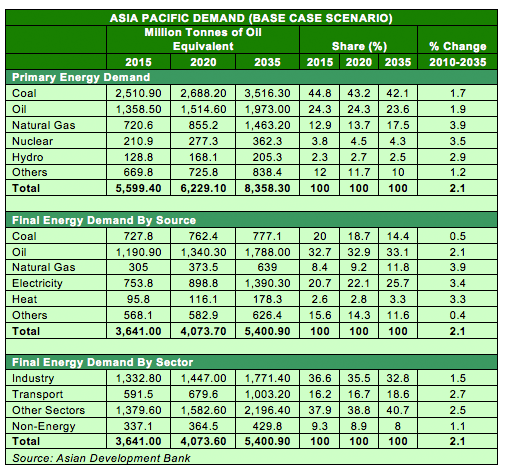
IMPORTS TO RISE
In one of ADB's main scenarios labeled "business-as-usual scenarios", nearly 65% of Asia's demand for oil will have to be met by imports by 2035.
The report notes that East Asia will be the biggest importer (14.8 million barrels per day (bpd) in 2035), followed by South Asia (6.3 million bpd) and Southeast Asia (4.4 million bpd).
The ADB forecast may allay fears that Middle East oil is slowly being marginalized by the arrival of unconventional production from North America and the rise of new players from Africa and Central Asia, as some analysts have suggested.
"At the very least, rising shale production in North America will reduce US demand for Middle Eastern crude oil and LNG, accelerating a trend that has already seen Asian consumers displace those in the West as a prime source of demand," HSBC said in a recent report on the impact of US shale production on the global energy market.
"Technically, this will require changes in shipping routes and transport infrastructure and could lead to a change in the benchmark crude against which Middle East oil is priced."
The growth in non-conventional oil supplies could also put a cap on demand for Middle Eastern crude, weakening the power that regional OPEC members have to influence prices, HSBC said.
"This could lead to additional price volatility, complicating considerably regional governments' fiscal planning process," the bank warned, noting that an era of flat USD 100 could lead to budget shortfalls for many of the Middle East countries, except Kuwait, the UAE and Qatar.
The region has unconventional and tight oil resources but extracting tight oil from remote desert locations, where transport links and water supplies are limited, is costly and difficult to effect, HSBC said.
"Underscoring the limited commercial value that the resources are seen as having, much of the region's non-conventional resources have not been fully surveyed and explored."
MIDEAST WIDENS ASIAN CLOUT
Middle East states are also moving to fend off shale's challenge.
Saudi Aramco president and chief executive officer is looking to extend the life of its fields and invest heavily in its energy infrastructure to ensure its dominance over global oil markets.
"We are on track to increase the average of our conventional oil recoveries to 70%, which is more than double the current world average," Khalid Al Faleh, president and CEO of Saudi Aramco told delegates at a conference in Daegu in South Korea on October 14.
"In fact, demand for oil in absolute terms is likely to rise by about 20 MMBD during the next two decades. That's equal to the current production of the world's two largest oil producers, Russia and Saudi Arabia, combined!"
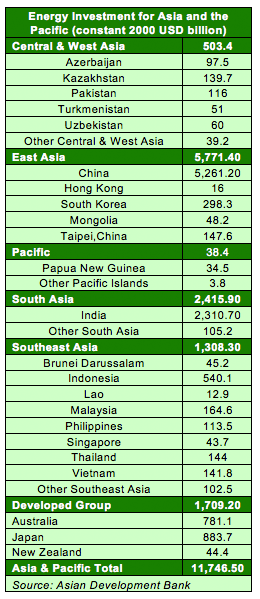
Oil and gas-rich Middle East countries can also participate in building Asia's energy infrastructure. The ADB report notes that a business-as-usual scenario envisions USD 11.7 trillion investments over the next 25 years, with electricity and heat sector taking up 72% of investment.
China will need investments of USD 5.7 trillion to develop its energy infrastructure, while India will require USD 2.4 trillion during the period, offering plenty of opportunities for Middle East countries to embed themselves in Asia's energy infrastructure.
In short, Asia's insatiable appetite for oil and natural gas and energy infrastructure could ensure continued growth for OPEC economies, regardless of surging shale production.
© alifarabia.com 2013