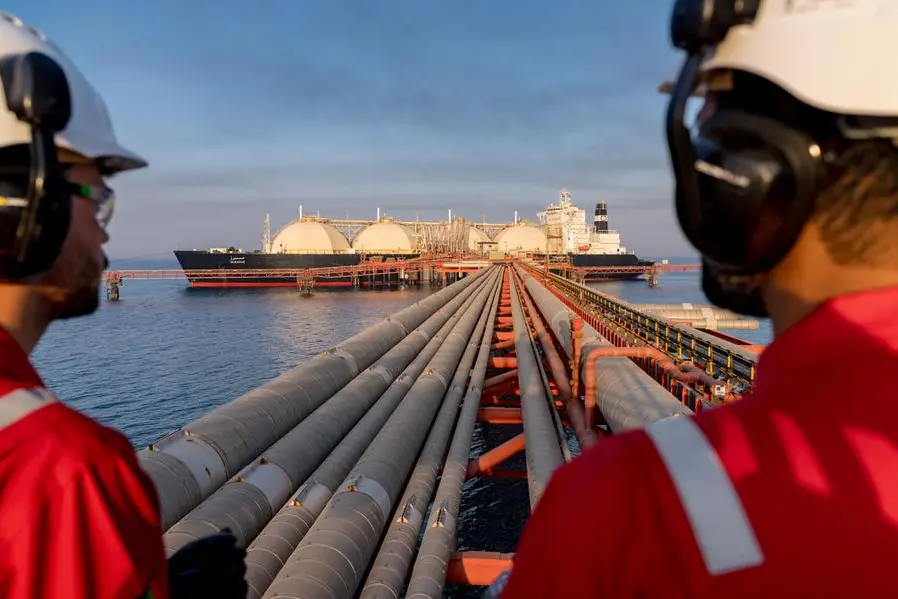
The first Angolan liquefied natural gas (LNG) shipment left the country's shore on June 16 and is headed for Brazil, as the African nation has finally realized its dream of becoming an LNG exporter.
Delayed by as much as 18 months, the LNG shipment is one of several long-term contracts and has planted Angola on the LNG map.
"Angola LNG is entering the market at an exciting time," said Arthur Pereira, CEO, Angola LNG Marketing. "The world LNG market is expected to remain tight over the coming years, with very limited new LNG capacity coming on-stream. We are delighted to be producing and shipping our first LNG cargo."
Angola LNG is venture between state-owned Sonangol, with oil majors Chevron, BP, ENI and Total to produce 5.2 million tons of LNG per year, apart from 63,000 barrels per day of natural gas liquids for export and 125 million cubic feet per day of natural gas for domestic consumption.
The USD10 billion project is considered one of the largest investments in the Angolan hydrocarbon's sector and consists of seven LNG vessels and three loading jetties.
"Angola LNG's vision is to be a reliable and competitive supplier, a strong community partner, and a role model for the economic development of Angola," said António Órfão, chairman of Angola LNG Ltd, in a statement.
"The project provides a solution to minimize flaring and environmental pollution by gathering associated gas from Angola's offshore oil fields to provide clean and reliable energy to our customers and a return on investment for our shareholders."
The ambitious LNG project is just one of the many projects the Angolan government is pursuing to diversify away from its strong oil production capacity of 1.7 million barrels per day.
"The project represents the first LNG project in Angola, and it is expected to contribute to the development of Angola's natural gas industry," said Ali Moshiri, president of Chevron Africa and Latin America exploration and production company.
OIL DEPENDENCY
Revenues from crude make up more than 75% of Angolan government's total revenues in most years, according to the International Monetary Fund (IMF).
"Turning resource wealth into development gains poses great challenges to policymakers," said Christine Richmond, Irene Yackovlev, and Shu-Chun S. Yang, analysts at the IMF, in a June 12 report. "Given a long oil revenue horizon and the possibility of finding more reserves, the main challenge in Angola is to maintain macroeconomic stability and stable spending levels despite volatile oil revenue."
The report notes Angola is the most oil-dependent country in its sample of 16 mainly low and lower-middle income oil producers.
The volatility of natural resource revenue can be damaging when investment is pro-cyclical, moving with revenue flows, the IMF authors note.

GREATER DIVERSIFICATION
Indeed, the boom-bust cycle has characterized the Angolan economy which grew by a mere 2.4% in the aftermath of the global financial crisis in 2009, but is expected to grow at 8.3% this year and another 7.8% in 2014.
"The government has embarked on ambitious reforms to improve governance but the business environment remains challenging in terms of institutions and infrastructure settings," notes the African Development Bank (AfDB). "Nonetheless, the creation of the sovereign wealth fund (SWF) will help insulate the economy from volatile oil prices."
The Angolan National Private Investment Agency (ANPIA) is focusing on a number of sectors in the hope of attracting investments in non-oil sectors.
CONSTRUCTION AND HOUSING PROJECTS: The ANPIA notes that housing shortage is a "chronic problem" in the country with capital Luanda - originally built to accommodate 700,000 people - has a population of four million.
Indeed, Luanda is considered one the most expensive city in the world with rents of GBP 7,500 for a one-bedroom apartment as expatriates pour into the country.
"The housing stock is highly degraded and falls well short of demand," ANPIA notes in How To Invest In Angola report. "The challenge is to address this, and to cope with population growth of 7% per year."
A number of housing projects such as the USD 100 million Nova Vida project, the 20-square kilometer Kilamba project and a USD 108.5 million Agostinho Neto University Development highlight the scale of projects under way, according to ANPIA's latest report.
TRANSPORTATION: Transportation is another major issue in the country that's roughly half the size of Saudi Arabia. The country is planning comprehensive railroad networks across the cities and major urban centers.
Building a new Luanda airport is also on the country's to-do list apart from a plan to revamp the country's national airline TAAG to "increase its offer capacity and lay the groundwork for its inclusion in a global airline alliance."
The transportation ministry notes the airline handled 1.7 million passengers a day in 2012 through 15 destinations. The ministry is planning to double the network and triple the size of the airline by 2020.
Building and upgrading seaports is another key area of focus for the trading nation.
AGRICULTURE & LIVESTOCK: The country has around three million hectares of arable land, and has seen rise in production of cereals, root crops, legume, vegetables and fruits over the past few years. The government is looking for investors in cattle production, fertilizer industries and biofuels production to accelerate development in the key area, especially as Angola is vulnerable to high food prices in previous years.
TELECOMS: Telecommunications is another growth area for the population of 20.9 million. Angola Telecom subsidiary Movicel and Unitel are the country's two mobile companies, apart from four landline service licenses and 10 Internet service providers.
By the government's own admission, the quality of the Internet is poor, but is crucial for the digital development of the country.
PRIVATIZATION: The Angolan government is also looking to privatize a number of companies across tourism, shipyards, drilling and manufacturing. The government has plans to partially privatize Angola Telecom and The Commerce and Industry Bank (BCI), among others.
But investors be warned. Despite its status as Sub-Saharan Africa's third largest economy, it ranks poorly in the World Bank's Doing Business survey. Angola is one of the most difficult places on earth to conduct business as it is ranked a lowly 172nd out of 185 countries in the Doing Business Survey. Investors face major problems enforcing contracts (ranked 183rd out of 185 countries), starting a business (171st) and trading across borders (164th).
"The country continues to face massive developmental policy challenges, including the reduction of the dependency on oil, the diversification of the economy, the rebuilding of the economic and social infrastructure, the improvement of the institutional capacity, governance, public financial management systems, human development and living conditions of the population," said the AfDB.
"These factors are constraining the pace of diversification of the economy and preventing small- and medium-sized enterprise (SME) development and job creation. Unemployment remains significant at about 25%, and the incidence of poverty remains high at 36.6% of the population."
© alifarabia.com 2013