South Africa is expected to move towards more market-oriented economic policies after the ruling African National Congress (ANC) won elections with 62% of the vote, analysts said.
President Jacob Zuma is expected to be re-elected by the ANC-dominated parliament later in the month with a new cabinet being announced soon.
"On balance, we think the new cabinet will tilt to the right, matching our long-held expectation of moderately more market-friendly policies after the election," said Mark Y. Rosenberg, director, Africa at Eurasia Group.
"This adjustment is relative to the raft of negative policies before the election and will be driven by the ANC's desire to create more jobs amid weaker opposition from trade union allies."
The ANC won with a smaller majority than the previous election (when it secured 66% of votes), but retains control of eight out of nine provinces. ANC lost votes in urban areas (it won 45% of votes in Johannesburg, down from 63% in 2009). The Democratic Alliance (DA) increased its vote share from 16.7% in 2009 to 22%.
Unemployment has hit 24% in the emerging market, which is part of the BRICS Club featuring economic powerhouses Brazil, Russia, India and China.
LIMITATIONS TO REFORM
Persistent corruption and weak bureaucracy will likely limit policy upsides and will still impede deep structural reforms to labor markets, producer markets or key state corporations, analysts said.
Fitch Ratings notes that a clearer picture of the administration's ability and willingness to tackle the country's challenges will emerge in coming months.
"Important signals will come from the composition of the cabinet, and whether ministers have prior experience in their field and a track record in government or the private sector," Ed Parker, managing director of Sovereigns at Fitch, said.
"Further considerations will be the speed with which the Medium-Term Strategic Framework, which will make the National Development Plan operational, is implemented, and post-election rhetoric on issues including land reform, mines and small businesses."
ECONOMIC WEAKNESS PERSISTS
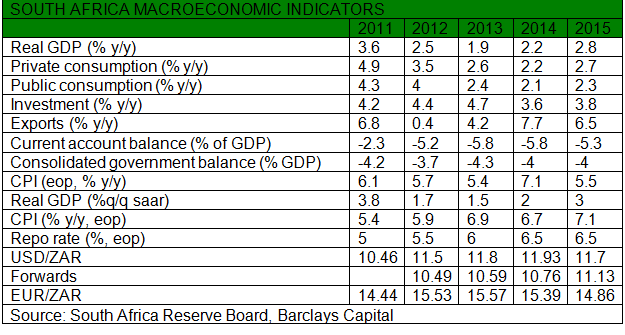
While elections took center stage, the economic situation continued to weaken, partly due to a wage strike that has hit the mining sector.
South Africa's manufacturing sector shrank more than expected in March, by 1.9% month-on-month. South Africa's statistics agency revised down February as well to record a 2.6% month-on-month decline. Worryingly, the March drop was rather broad based across different sectors.
For the first quarter as a whole, manufacturing output contracted 6.1% quarter-on-quarter, with especially sharp declines in the petrochemicals (-10.4%) and iron and steel (-10.7%) sectors, which have a combined weighting of just over 40% in the total manufacturing index.
"Both of these sectors have important linkages to the mining sector, and some of the Q1 weakness could reflect the ongoing strike in the platinum sector, with the three mining houses having declared force majeure on their suppliers," said Barclays Capital in a report.
The platinum strike that has raged over the past few months has also taken its toll on the mining sector.
Mining production decreased by 4.7% year-on-year in March 2014. PGMs decreased by 44.3% and were significant negative contributor to the decline, according to Stats SA. On a quarterly basis, mining production declined by 6.8% in the first quarter of 2014 compared with the previous quarter.
"Meanwhile, domestic demand is subdued, with tepid employment growth and weak confidence levels," Barclays noted. "The biggest downside risks are an intensification of strike action as the wage bargaining season commences and a sharper-than-expected slowdown in China."
OPPOSITION PRESSURE
Economic pressures are exacerbated by persistent political and leadership questions surrounding the presidency of Jacob Zuma, said Danielle Silk, political economy analyst based in South Africa.
"The ANC will move to promote its contentious National Development Plan (NDP) as the cornerstone of its vision for the future," Silk noted. "But, opposition to the plan and a move to establish a more socialist or workers' alternative to the ANC can gain traction and shift the domestic political equation."
ANC needs to move quickly to take advantage of its fresh mandate from its people and shake off the economic malaise that has plagued the country.
The feature was produced by alifarabia.com exclusively for zawya.com.
© Zawya 2014