Gold appears to be on a long-term decline as its cover of a so-called safe-haven is blown.
As the yellow metal hurtles towards its first annual decline in 12 years, some market observers believe there is worse to come.
The US Federal Reserve's decision to cut its asset-purchasing program by USD 10 billion each month is another blow to gold's chance of staging a rally.
The metal has fallen to prices last seen in June and is now up against a firm dollar - with which it traditionally has a strong negative correlation.
"Our FX [foreign exchange] strategists note the announcement strengthens their conviction that 2014 will be the year of the dollar because a key source of uncertainty has been removed while the FOMC [Federal Open Market Committee] has upgraded its US growth and employment outlook," Barclays Capital said.
Gold has been able to defy dollar strength, notably in 2009, when both benefitted from safe-haven flows, but more recently, dollar strength has proven to be a stubborn hurdle for the metal.
"Risks to stimulate investor interest continue to recede for gold," Barclays said.
Overall demand for gold fell 21% in the third quarter to 869 tons, according to the World Gold Council.
Gold-backed ETFs had net outflows of 119 tons this quarter, compared to 402 tons in the second quarter, while major consumer India saw demand decline by 71 tons during the period.
However, some segments are holding up the price of gold.
"For the 11th consecutive quarter, central banks were net buyers of gold, purchasing 93 tons. Meanwhile demand in the technology sector was stable, at 103 tons," said the World Gold Council.
Some analysts such as Canaccord Genuty strategist Martin Roberge believe that gold will stabilize after a depressing year. Data shows that an annual decline of 10% in gold is typically followed by stable prices the next year, Roberge said.
"Very importantly, negative momentum should carry through the first half," Roberge wrote in a note to clients.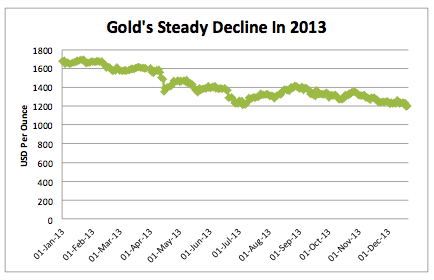
USD750 GOLD?
But Deutsche Bank says it's bearish on the yellow metal.
"We view the US dollar as posing the greatest risk to gold since the adjustment in US real yields and the US equity risk premium has, to a large extent, already occurred."
One could argue that gold's 12-year rally was due for a correction -- a big correction. The metal had been trending up even before the global financial crisis turned yellow metal into every investor's hedge.
Gold exchange-traded funds saw inflows soar and central banks hoarded gold as fears of a massive default or debt crisis gripped the global economy.
But as the economic gloom gives way to a sunnier outlook, there is every reason for gold to recede into the background.
Deutsche Bank's calculations show that gold will have to fall to USD 750 per ounce to return to its historical levels in real terms, adjusting for purchasing power parity. Against per capita income, gold prices would need to drop to USD 800 per ounce.
"Versus physical and financial assets, the downside risks to gold appear less extreme. Indeed if we assume fair value for Brent at around USD 90, it would imply gold prices need to recover to around USD 1,400 per ounce to bring this ratio in line with historical averages," said Michael Lewis, analyst at the German bank.
"Repeating the same exercise for copper would imply gold prices would need to fall to USD 1,050 if one assumes fair value for copper at USD 6,500/tonne.
"In terms of the relationship between gold and the S&P500, since both gold and the S&P500 should rise with inflation, and the S&P500 should rise more as its retained and reinvested earnings should generate real EPS growth, we construct an inflation adjusted gold price to an equity time value adjusted S&P500 price."
CONTRARION CASE
Contrarians like Casey Research say global production headaches will keep price inflated.
The research house points to a slew of major projects such as Fruta del Norte in Ecuador by Kinross Gold, New Prosperity Mine in British Columbia and Pascua-Lama in Argentina and Chile, which are facing resistance and economic challenges.
In addition, South Africa's gold mining sector has seen production fall dramatically. The country was the world's largest producer of gold as recently as 2006, but has now slid to fifth place.
"The net result of this perfect storm is that we should expect gold supply to decline until prices are much higher," said Casey analyst Jeff Clark. "Even when prices do rise, management teams will be reluctant to expand operations, reopen mines, or buy new projects until they feel the new price level is sustainable. As a result, this trend will almost certainly last several years.
© alifarabia.com 2013