Massive interest in the West and Eastern African oil and gas deposits means a significant rise in spending on oil and gas resources in the continent.
"Hundred trillion cubic feet of gas has been discovered to date in East Africa and we estimate yet-to-find reserves could be as much as 80 tcf in Mozambique and 15 tcf in Tanzania," says Martin Kelly, Wood Mackenzie's Head of Sub-Sahara Upstream Research in a report published in late summer this year. "There is clearly plenty of gas to supply the likely commercialisation route of LNG - theoretically enough to support up to 16 LNG trains."
"The Rovuma basin is the most prolific in the region, and one of the hottest conventional gas plays in the world, with 85 tcf discovered so far."
Rovuma Basin of course is the arena where Royal Dutch Shell and its Thai rival PTT fought a hard-fought bidding battle for Cove Energy Plc this year. The Thai company finally outbid the oil major, winning the deal for a whopping USD1.9-billion.
The target company owns an 8.5% stake in a Mozambique licence in the Rovuma that could emerge as a major exporter of liquefied natural gas to Asia, rivalling the likes of Qatar, Indonesia and Australia.
Meanwhile, Italian oil giant Eni and U.S. independent Anadarko have also discovered major gas field in the Rovuma Basin.
Anadarko's discoveries are estimated to be around 2 trillion cubic metres, which will need to be exploited for liquefied natural gas (LNG) to make them economically feasible.
The company has begun FEED (front-end engineering development) work for a two-train project to produce nearly 10 million tonnes annually and is expected to make an investment decision in 2013.
If the plan gets the go-ahead from the company's management, Mozambique may become an LNG exporter, most likely to Asia, by 2018.
"Many challenges will need to be overcome prior to LNG project sanction," says Giles Farrer, senior LNG research analyst for Wood Mackenzie said in a note, citing region's remoteness, lack of skilled force and infrastructure shortages as obstacles to growth.
"Lastly there is the question of finance, we estimate that a two train greenfield development in the region is going to cost at least USD25-billion, and for some of the players involved financing their share of this sort of development cost will certainly prove challenging and could delay development," Farrer noted.
Meanwhile, UK's BG and Ophir Energy and Norway's Statoil have also found some gas fields just over the maritime border in Tanzania, says the IEA.
"Based on tentative initial estimates, these fields could hold a total of 340 bcm. A new licensing round, covering 9 deepwater blocks, is anticipated before the end of 2012. Further up the coast, Kenya has already licensed 30 onshore and offshore blocks, with other deepwater blocks soon to be tendered."
In addition, U.S.-based Apache is also planning to drill in Lamu Basin. The rest of Kenya's deepwater is licensed to Anadarko, France's Total and the UK companies, BG and Ophir Energy.
"We project that production from Mozambique, Tanzania and Kenya will reach about 45 bcm in 2035, from less than 5 bcm today," the IEA estimates.
Africa Oil, a Canadian energy company, has also met with great exploratory success in Kenya's Ngima-1 well, which saw its stock price soar from CAD2 in April to CAD8 by November. The company, along wit its UK partner Tullow Oil has since encountered more oil in its various Kenyan plays.
Spurred by the new discoveries after decades of failure to find oil, the Kenyan Government is planning to changes its taxation rules and demanding signature bonuses for exploration and drilling operations.
"Of notable interest, is the new fractured play opportunity which has been encountered for the first time in East Africa," said Keith Hill, President and CEO of Africa Oil. "We are very pleased with these exciting results to date and have significantly expanded our plans in Kenya and Ethiopia. With over 100 significant prospects and leads identified and an active drilling program with at least 3 drilling rigs operational, there is much to look forward to in 2013 as the exploration campaign and testing program move ahead."
The company has oil and gas assets in Kenya, Ethiopia and Mali as well as Puntland (Somalia) through its 45% equity interest in Horn Petroleum Corporation. Overall, the company has 300,000 square kilometres of land in the region.
CAPITAL SPENDING AMID FRESH DISCOVERIES
The energy consultancy says sub-Saharan Africa has accounted for 15% of fresh global conventional discovered resources in the past decade.
Little wonder then, exploration and production expenditures in Africa are expected to increase by 4.5% in 2013 to US$25-billion from US$23.5-billion in 2012. This follows a strong 2012 which saw investment and upstream spending bounce back in the aftermath of the Arab spring and ensuing political instability in several countries, estimates Barclays Capital.
Moderate growth expectations in Angola (with state-owned Sonangol expected to raise spending by 8%) and in Algeria (Sonatrach up by 5%) is expected to be somewhat offset by a small pullback in spending levels by the Nigerian National Petroleum Corp (NNPC down by 3%).
Barclays believes overall spending for the region is understated, adding that the figure does not include spending by the supermajors in the continent.
Still, Interest remains high in West Africa and the Gulf of Guinea and a number of
smaller north western African nations are opening waters or undergoing increasing activity levels, including Sierra Leone and Liberia, led by Chevron, says the bank.
Barclays figures are in line with the USD20-billion annual investment needed in the continent for the next two decades to sustain growth in the sector, according to the International Energy Agency.
Over the projection period, Nigeria is projected to generate USD105-billion per year in oil and gas revenues on average, while universal access to electricity and clean cooking facilities there would require investment of around USD1-billion per year, says the IEA.
"In the case of Angola, the country would need to invest, on average, only 0.5% of its projected energy-export revenues in modern energy access in order to achieve universal access by 2030," the IEA notes in its latest forecast. "For Mozambique, the story is of future potential, with the exploitation of new natural gas discoveries offering the opportunity to boost significantly efforts to provide modern energy access."
The IEA believes that African natural gas production growth will be second only to Asia-Oceania region over the next two decades (see table below).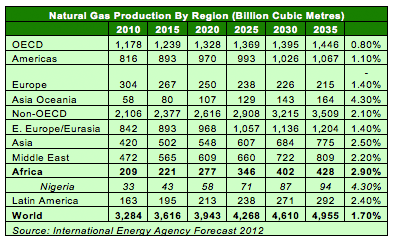
© alifarabia.com 2012