Sub-Saharan Africa may have some of the highest poverty levels in the world, but it is an absolute leader in mobile financing, according to latest research.
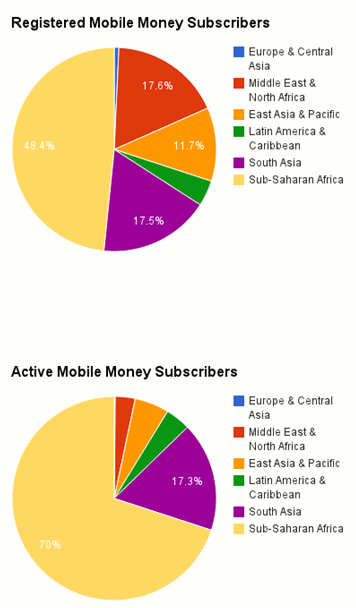
Transferring money via mobile phone services is already available in 36 of 47 countries in Africa, and the continent has 98.3 million registered accounts, of which 42.4 million are active - the highest levels in the world.
South Asia and East Asia, which have much bigger populations, only have 10.5 million and 3.3 million active users, respectively, according to a new report by GSMA, an association that represents 800 of the world's mobile services companies.
East Africa, and particularly Kenya, accounts for a particularly large portion of mobile money accounts globally, representing 34% of total registered accounts.
Today, at least nine markets have more registered mobile money accounts than bank accounts, compared to just four last year: Cameroon, the Democratic Republic of Congo, Gabon, Kenya, Madagascar, Tanzania, Uganda, Zambia and Zimbabwe, GSMA noted in its report.
"In these markets, the mobile money industry has made financial services accessible to more people than the traditional banking industry ever has," GSMA said. "It is also very encouraging to see the number of these markets more than doubling in just 12 months. All these markets are in Sub-Saharan Africa, a sign of the transformational power of mobile money in this region, where banking penetration remains very low."
SUCCESS OF M-PESA
The M-PESA service launched by Vodafone's Kenyan affiliate Safaricom in 2007 is widely seen as the pioneer in mobile money transfer, with 45,000 agents catering to 18 million clients.
M-PESA was originally conceived to make microfinance-loan repayments by phone, in a bid to cut transaction costs and lower interest rates. But the service expanded to become a fully-fledged money transfer service. After registration, any Kenyan with a mobile phone could go to one of the agents (often grocery stores or small supermarkets or kiosks) across the country to pay or withdraw cash.
The service is now widely used by migrant workers, by housewives, farmers and companies.
Three major lessons have emerged from M-PESA, says the World Bank. First, it demonstrates the value of leveraging mobile technology to extend financial services to large segments of unbanked poor people.
Second, it shows the importance of designing usage-based rather than float-based revenue models for reaching poor customers with financial services.
"Unlike a traditional bank, which typically distinguishes between profitable and unprofitable customers based on the likely size of their account balances and ability to absorb credit, M-PESA serves any Safaricom mobile customer who pays for an account. And third, M-PESA reveals the need for a low-cost transactional platform that enables low-income customers to meet a range of payment needs."
ENTREPRENEURIAL SPIRIT
Wide-ranging service has also encouraged many start-ups to incorporate M-Pesa as part of their entrepreneurial business models.
One small business uses it to help parents make more timely school-fee payments, while another uses it to establish informal savings groups, notes McKinsey Global Institute in a new research on the potential of mobile payments.
"Even non-payment organizations are finding ways to use the new payment infrastructure. For instance, Bridge International Academies, a low-cost, for-profit educational franchiser, found that M-Pesa could help it obtain real-time financial data, which enabled it to become more trusting of franchisees and reduce record keeping."
Despite the potential of mobile money, the management consultant believes the concept has not gone viral beyond a few countries, despite efforts by regulators in many markets to pave the way for e-money and the entry of non-bank operators.
"Business models and systems for electronic remittances--both domestic and international--have already been well tested in other markets around the globe. Together, these factors should make it easier for digital payments to leapfrog the costly development of formal banking by introducing advanced mobile systems. Why then have many payment players hesitated to venture into these seemingly high-potential markets?" McKinsey asks.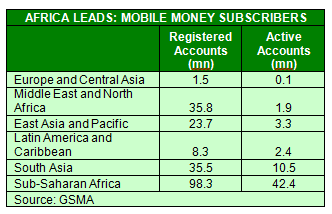
BEYOND CASH TRANSFERS
While some mobile operators have been slow to realize the potential, others are racing ahead.
"Mergers of mobile money services contributed to the emergence of larger mobile money services and intensified competition in some markets," said GSMA. In Uganda, the acquisition of Warid Telecom by Bharti Airtel allowed Airtel Money to consolidate its position in the mobile money market.
With more than 7.4 million GSM subscribers and 39% market share, India's Airtel has emerged as a serious competitor to South-Africa based MTN's mobile money services which counted over 3.5 million registered users at the end of 2012. Soon after Airtel Money and Warid Pesa merged last year, Airtel announced reduced mobile money rates, sparking a price war with MTN, intensifying competition in the market and accelerating subscriber growth.
Around 70% of mobile operators surveyed by GSMA said they plan to increase their investments in mobile money this year, and also add new services. There are 123 mobile insurance, credit and savings services out of which 27 were launched last year alone, suggesting that there is strong interest in leveraging mobile to deepen financial inclusion.
"However, the business case is challenging, particularly because providers must rely on a large sales force and adequate customer education to acquire new customers as customer acquisition is more sophisticated and mobile insurance credit and savings services are currently not sold through mobile money agents," says GSMA.
The market is also figuring out new ways to transform mobile phones into devices that go beyond calling your grandmother.
Airtel Money-Africa, a mobile money service with five million active subscribers, has identified mobile financial services linking with other services, such as healthcare, agriculture, and education.
"In addition to directly benefiting individuals in underserved areas, digital finance also affords great opportunities for reducing the financial inclusion gap for small businesses by providing them with an access to electronic payment systems, secure financial products and an opportunity to build financial history," said Erin Scronce, marketing manager of the Consultative Group to Assist the Poor.
"It also significantly reduces the cost of doing business: studies indicate that a mobile banking transaction can be done at 15% of the branch banking cost."
GSMA also identifies the example of EcoCash in Zimbabwe which is linking the unbanked segment of the population with the formal financial services sector of the country.
"For EcoCash, offering domestic P2P money transfer services is just the first step towards a much bigger goal: becoming the dominant payment system in Zimbabwe for the banked and unbanked alike. EcoCash is currently targeting two pain points with major commercial opportunity: enabling retail payments to merchants and creating a bridge between the informal and formal sectors. To capitaliZe on these opportunities, EcoCash is building two important structures: a merchant acceptance network and full interoperability with Zimbabwe's banks."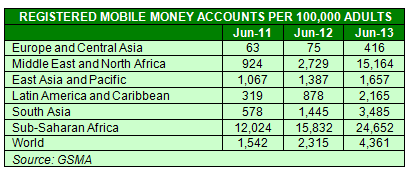
REVENUES FOR MNOs
Mobile network operators have started to see the benefits of the service through direct revenues and indirect benefits such as customer loyalty.
"Mobile money has proven to be rewarding for deployments that have reached scale," GSMA said.
Safaricom and Vodacom of Tanzania, both of which offer the M-PESA service, generated nearly 19% of their revenues from mobile financial services last year.
McKinsey note that launching mobile payments in new markets is seldom easy, but there is "significant latent demand" for digital payments in many markets of Sub-Saharan Africa and widespread consumer acceptance of mobile-communications technology is highly encouraging.
"For players that are able and willing to move in the near future, there are also opportunities to win important first-mover advantages."
The feature was produced by alifarabia.com exclusively for zawya.com.
© Zawya 2014