With the Gulf unveiling a raft of projects worth billions of dollars over the next decade, the regional construction is also going through a very interesting phase.
Here are the key trends emerging in the sector:
TREND 1: GULF CEMENT PROFITS RISING
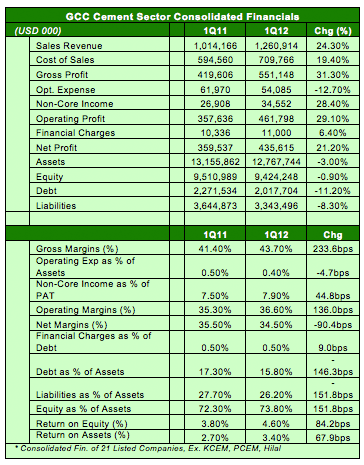
Not surprisingly, Gulf cement sector profits rose in the first quarter as Gulf countries kept the project announcements flowing.
GCC cement companies came out with a strong 24.3% rise in revenues, combined with a 21.2% increase in profits in the first quarter, notes Global Investment House in a report.
"Net profits increased from USD359.9mn in 1Q11 to USD435.6mn in 1Q12. However, net margins witnessed a fall of 90.4bps during the period due to the fact, revenues grew higher than profits. Gross margins, witnessed a 233.6bps increase in 1Q12 to reach 43.7% as compared to 41.4%, which was due to increase in selling price along with drop in prices of fuel."
TREND 2: UAE REBOUND
The UAE cement sector, which had been reporting falling sales since the financial crisis, also appears to have turned a corner.
Sales revenues of listed UAE cement companies rose 7.7% to reach USD258.1-million, bringing gross margin back into double digit at 10.5% in the first quarter.
"In addition, net profit margins which used to average around 5.4% since 1H10, increased to 11.5% due to a 338% increase in profits to USD29.7mn in 1Q12," notes Global Investment House.
The UAE has more than USD560-billion worth of projects under way, with projects valued at USD193-billion in the preliminary stage.
TREND 3: UAE COMPANIES SUFFERING
Omani cement companies are suffering as UAE companies are dumping their excess cement at cost price in their market, igniting a price war and putting pressure on the profits of Omani companies.
Despite the intense competition, Omani companies saw revenues rise 16.7% to USD100.3-million. Net profits rose nearly 40%, although costs rose 27.5% during the first quarter.
Oman Cement saw its best quarterly sales in three years, with total sales rising 558,000 million tonnes in the first quarter.
Indeed, rising demand means local companies will reach full capacity soon.
"We expect Oman Cement and Raysut Cement to operate at 75% and 87% utilization level in 2012," notes a BankMuscat report.
"With an 8-10% volume growth in the coming years, we expect Raysut Cement to reach full output capacity by late 2013. On the back of recent clinker expansion, Oman Cement will be able to ride the volume growth without further capacity expansion till late 2014."
TREND 4: SAUDI CLINKER CAPACITY RISING
NCB Capital expects Saudi Arabia's clinker capacity to rise to 51 million tonnes by the end of 2012, as close to USD700-billion worth of Saudi projects come on line over the next decade. That figure is set to rise to 55 million by 2013 as consumption reaches 53-million.
"With an estimated total of SAR472 billion worth of contracts in the execution and EPC phases, SAR217 billion represent projects that will be completed within 2012, and SAR255 billion represent those that will be completed within 2013," notes NCB Capital.
Meanwhile, Al Rajhi Capital expects Saudi cement capacity to reach 66-million tonnes by 2015, reflecting the explosive growth in the Kingdom's construction activities.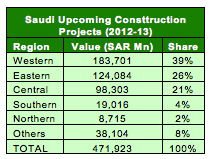
TREND 5: SAUDI FUEL SHORTAGES
Fuel shortages in recent months could also pose challenges.
According to market observers new fuel allocation is causing the delay. The shortages have already delayed Yamama Cement, Yanbu Cement and Southern Cement's new production lines
"Consequently, this will put upward pressure on cement prices, due to the increased reliance on inventory, which lowers stockpile levels, and results in a non-optimal utilization of resources," notes NCB.
TREND 6: SAUDI EXPORT BANS & PRICE MANIPULATION
The Saudi ban on exports means that growth will remain restrained.
The Saudi authorities want to ensure that there is enough supply for domestic needs and also tame inflation. The Saudi export ban has been a boon for the cement sectors of the Gulf countries, which have expanded their operations to meet demand in the absence of supplies from Saudi Arabia.
Despite the ban, rising demand has elevated prices. "Since the start of 2012, the sector is experiencing acute shortage of cement in the western region of Saudi Arabia, particularly the Makkah region, on account of which retail prices touched a record high of SAR25 per bag (SAR500 per ton versus government ceiling of SAR280 a ton)," notes Al-Rajhi Capital.
The government has since arrested manipulators and is pushing cement companies to operate at full capacity.
TREND 7: KUWAIT PRICES DECLINING
While cement prices in the Gulf rose 1.1% on average during the first quarter, Kuwait bucked the trend as material prices fell 4.5% during the same period. This is partly due to the slow of pace of projects and the fact that Kuwait continues to sell the highest average of cement prices among Gulf states.
TREND 8: SHORTAGES IN QATAR
Qatar's focus is shifting from natural gas development to sports development, as the country prepares to host the 2022 FIFA World Cup.
The country has close to USD230-billion projects planned which include sports stadia, airport, ports and numerous leisure and recreational developments.
"Sport will be a key element of the construction industry boom, in the non-oil and gas sector, with investments allocated to hotel, leisure, tourism, sports, recreational and infrastructure projects estimated at US $60-70 billion," says Deloitte in a report.
However, this construction bonanza means Qatar will likely start facing a cement shortfall from 2013, which would reach around three million tonnes by 2015, according to a forecast.
It is also expected to drive up cement prices in the country due to a combination of construction material and labour shortages.
© alifarabia.com 2012