One of the core reasons why Arab youth spilled on to the streets during the Arab Spring was their inability to get decent employment. Joblessness - which is attached to human dignity and viewed as a platform for many to further and better themselves in their country - drove many to orchestrate sweeping political changes in their own countries.
Egyptian, Tunisian, Libyan and Yemeni regimes fell as they had failed to offer this basic service to their citizens, while other countries were compelled to take substantial measures to create jobs or offer short-term perks and benefits to the unemployed or the underemployed.
But the unemployment problem persists as new governments come to grip with structural unemployment.
From oil-rich states such as Saudi Arabia to the dilapidated economy of Yemen, the average Arab citizen still has to search for job opportunities and gainful employment remains a distant dream for far too many, leading to a restive population.
While unemployment is a common thread running through the region, so is the need for infrastructure development.
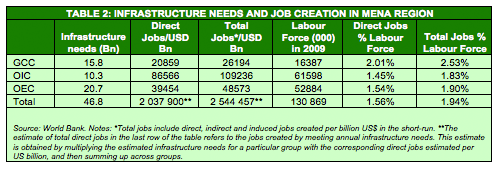
The World Bank believes that the regional infrastructure sector has the potential to create as much as 4.5 million jobs each year over the next ten years - or 45 million in a decade.
"In the next 10 years or so, the infrastructure sector has the potential to generate significant employment.... annual job creation of about 2.0 million in direct jobs and 2.5 million in direct, indirect and induced infrastructure-related jobs just by meeting the infrastructure investment needs of about 6.9% of gross domestic product (about USD106-billion) for the Middle East and North Africa region on average."
While this may still not be sufficient to completely solve the region's huge unemployment challenges, infrastructure development could have a strong ripple effect that reverberate across the economy and lead to employment and opportunities in other sectors as well.
Because effectively directed and fostered, infrastructure investment has a deep and far reaching impact on economic development, it is often also seen as a potential quick source of jobs, wrote World Bank analysts Elena Ianchovichina, Antonio Estache, Renaud Foucart, Grégoire Garsous and Tito Yepes in a paper.
"Moreover, it can potentially be designed to help meet social goals. Indeed, improved provision of high-quality basic infrastructure services, such as hospitals, schools, and water supply and sanitation, raises living standards, improves employability of populations and prospects for inclusive growth."
HIGH UNEMPLOYMENT
The Middle East suffers from the highest youth unemployment in the world, currently recorded at over 25%, with North Africa reporting approximately 24%.
Female youth unemployment is far worse, reaching and exceeding 30% across the Arab world, estimates management consultants McKinsey.
In fact, the region's labour force youth participation rates are among the lowest globally, currently standing at around 35%, compared to the global average of 52%.
"The large number of youth in the Arab world will continue to add pressure on the labour market over the coming years - approximately a third of the total population is currently below the age of 15, and a further third is aged 15-29," notes Mckinsey in a report on Arab youth unemployment. "In consequence, tens of millions of young people will enter the region's work force over the next ten years needing to find jobs either at home or through regional labour mobility."
Tackling the youth unemployment challenge will require a dual focus on creating employment opportunities, including self-employment, and ensuring the youth have the right skills for the jobs being created. To date, governments in the region have not focused sufficiently on the latter."There is wide recognition that if nothing is done, unemployment levels are likely to rise further as a result of a demographic bubble: about one-third of the population is below age 15. As a result, millions of young people will enter the region's workforce over the next ten years," says McKinsey.
KILLING TWO BIRDS WITH ONE STONE: INFRASTRUCTURE DEVELOPMENT & JOB GROWTH
While the MENA region has not been a laggard, having invested more in public spending than any other developing region (with the exception of East Asia) over the past 25 years, much of the development was concentrated in Gulf oil-exporting states.
And while Gulf exporters boast strong infrastructure and rival developing markets elsewhere oil-importing countries in the region and developing oil-exporting countries such as Iraq, Libya, Algeria, Iran, Syria and Yemen offer tremendous potential.
Table 1 shows the huge disparity between the infrastructure needs of the developed Gulf states compared to the developing oil-exporters.
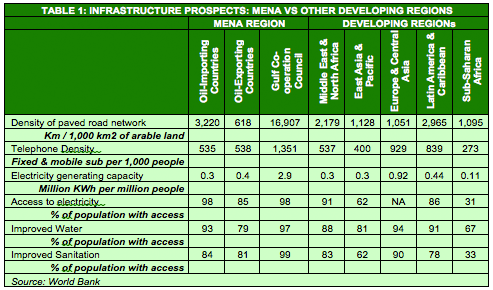
"Developing oil exporting countries (OEC) are expected to have to commit almost 11% of their GDP annually (USD48-billion) on improving and maintaining their national infrastructure endowments, while the oil importing countries (OIC) and the GCC oil exporters will need approximately 6% and 5% of their GDP, respectively, to ensure enough infrastructure to meet their growth and poverty reduction targets," say the World Bank analysts.
Transportation and electricity sectors could account for 43% of the MENA region's total infrastructure needs, while ICT could potentially account for just under 10% and water sanitation around 5%.
"Fulfilling the electricity need alone would require approximately 3% of the annual, regional GDP or USD46-billion, of which USD10-billion will be spent in oil importing countries, and around USD36-billion in the oil exporting countries," notes the World Bank authors. "During the next decade developing oil importers in MENA will need to spend about USD86-billion dollars on upgrading their transport networks, while the developing and GCC oil exporters will need USD225-billion and USD145-billion, respectively."
However, financing these massive infrastructure needs will be especially difficult for oil-importing countries, which could pose tremendous challenges for countries like Tunisia, Morocco, Egypt and Jordan.
But it is worth the effort as oil-importers could find ways by cutting subsidies and making more politically challenging budget cuts to invest more in infrastructure.
World Bank data shows the every USD1-billion invested in infrastructure could generate roughly 110,000 jobs in oil-importing countries, 49,000 in developing oil-exporting countries and 26,000 in Gulf economies.
Of course, infrastructure jobs alone can not completely solve the region's unemployment challenges, but they allow the economy to generate more jobs in the future.
The World Bank study finds that 1% growth induced by infrastructure development could generate around a million jobs per year over 10 years.
REDUCING PUBLIC SECTOR EMPLOYMENT
Investment and job creation in infrastructure could also allow regional governments to push their citizens to the private sector, and reduced their bloated public sector. At the moment, the MENA region has the highest wage bill in the world, accounting for nearly 10% of their collective GDP.
In sharp contrast, public sector wages account for less than 5% in Latin American countries, 6.7% in African states and 4.7% in Asian countries.
"Faced with bloated and often inefficient bureaucracies and excessive wage bills, traditional strategies of utilizing public sector employment as a means to soak up excessive labour demands have reached their tipping point," wrote Lida Bteddini and Guenter Heidenhof, analyst at World Bank in a separate study. "This makes it all the more important to effectively and decisively support the role of the private sector as the main engine for future job creation."
GULF'S UNEMPLOYMENT CHALLENGE
Given the Gulf states' relatively strong infrastructure, it may have to look elsewhere for exponential job creation.
According to NCB Capital research, 4.5 million Gulf nationals are expected to enter the labour force till 2015 - that's close to the 5 million GCC nationals currently employed in the regional workforce.
Absorbing 4.5-million Gulf nationals will be a tall order. According to the International Monetary Fund, Saudi Arabia will need to post a 7.5% growth to halve unemployment over a five-year period.
Clearly, the private sector will have to step and absorb new job seekers.
"The targets involved in this transformation are unprecedented. In Saudi Arabia, the government's ninth five-year plan foresees the creation of 1.2mn new jobs in 2010-14, of which 92% is expected to go to Saudi nationals," notes Dr Jarmo T. Kotilaine, chief economist at NBC Capital research in a report, adding that some projections suggest some three million job opportunities by 2015 and up to a total of six million by 2030.
"This compared to the current total number of Saudis in paid employment of 3.8-million (2009). The overall national labour force stands at 4.3-million," wrote Dr Kotailaine.
[Read the full story here]
CONCLUSION
Greater political and social participation in many Arab countries over the past 18 months have emboldened Arab citizens to demand services and opportunities from their governments. They are no longer pliant and the new generation of citizens are aspirational and are determined to arm themselves with education and skillsets to compete in the new world order.
Regional governments haven't been able to crack the code of employment. Education, training and finding the balance between replacing nationals with expatriates without hurting productivity are not easy to manage.
As the World Bank concludes, governments will have to make crucial decisions on where to spend their finite resources and where to cut spending to achieve a balance between growth and debt.
"In designing country specific solutions, governments will have to take on predictable challenges: the governance of job creation, the proper targeting and fiscal costs assessment of subsidies needed to create jobs, the design and fiscal costs of the (re)training programs needed and the expectations on the job creation effects of infrastructure."
A tough task indeed.
© alifarabia.com 2012