The Middle East's major economies will have 109,000 new millionaires in the next five years, according to a Credit Suisse report, with Egypt - not Saudi - with the highest number of millionaires in the region.
In total, there will be 255,000 millionaires in Egypt, Saudi Arabia, Egypt, UAE and Kuwait by 2016, said the Swiss bank's study on wealth.
Its current troubles not withstanding, Egypt will surpass its Arab neighbours in millionaire creation and have 92,000 millionaires by 2016, compared to Saudi Arabia which will have 64,000 millionaires by that time, the bank estimates.
The UAE, with 54,000 and Kuwait 45,000 millionaire in their midst, will be among the 20 major creators of millionaires in emerging markets.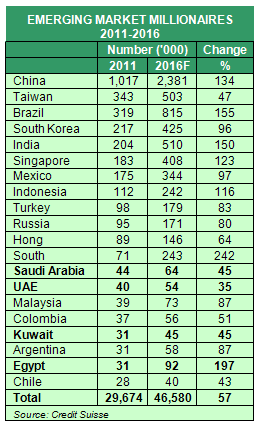
Egypt will also be one of the fastest places in the world for millionaires, rising 197% during the next five years. Only South Africa (242%), Brazil (155%) and India (150%) will produce millionaires faster than the North African country.
While the Credit Suisse came out on October 19, it is possible that it may have missed recent developments in Egypt which casts a shadow over its economic prospects. At the very least, though, it shows the country's great potential as a wealth creator.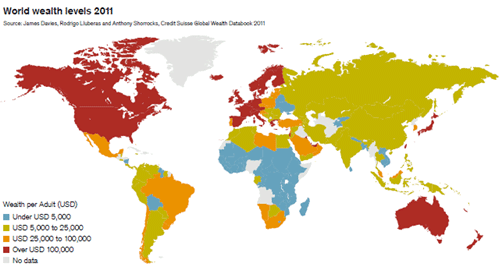
Credit Suisse's Global Wealth Report 2011 flies in the face of bleak prospects facing economies across the world and shrinking asset values across much of the developed and emerging markets.
And if you thought the United States was losing its edge as a place to make fortunes, here's a news flash: the country will remain the place with the highest number of millionaires with $81 trillion in wealth creation by 2016.
And perhaps in a nod to the 'Occupy Wall Street protestors' which have decried how that the 1% rich have gotten richer during one of the worst global crisis the United States ever seen, the country stood out as the largest wealth generator in the world over the 18 months, adding $4.6 trillion to global wealth.
The report also found that 29.7 million adults with household wealth of more than $1 million make up less than 1% of the world's adult population but own 38.5% of global household wealth.
Credit Suisse also estimates that total global wealth increased 14% from $203 trillion in January 2010 to $231 trillion in June 2011 "on the back of continued economic recovery from the global financial crisis."
"Wealth per adult increased 9% from $46,600 in January 2010 to $51,000 in June 2011 with the fastest growth registered in Latin America, Africa and Asia," notes the bank
It is however, China that will lead the wealth creation, adding $18 trillion in the next five years, and add 2.38 millionaires by 2016 - an astonishing 134% improvement in five years.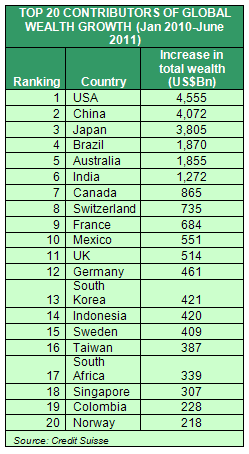
Don't write off the EU
The EU states may be flirting with a debt-driven recession, but they remain a wealth creating magnet. Seven of the ten countries with the highest average wealth per adult in 2011 are European.
Switzerland leads with $540,010 per adult, Australia is a distant second with $396,745. Norway ($355,925 per adult), France ($293,685) and Singapore ($284,692) make up the top five.
The bank projects global wealth to rise by 50% in the next five years to $345 trillion in 2016, equivalent to 8.4% growth per year. Wealth per adult worldwide is expected to reach $70,700 in 2016, an increase of 40% over 2011.
Credit Suisse has excluded children and young people from the report as it believes they could distort the wealth picture and they 'rarely own much wealth in their own account'.
Which is why perhaps Qatar did not make it in the top 10 list, even though it has the highest GDP in the world, with $88,222, according to the IMF.
Brics taking over
"Over the next five years, wealth of emerging economies is expected to leapfrog the developed world, due to their more promising growth prospects," notes Credit Suisse.
"Wealth in China and Africa is projected to rise by over 90% to $39 trillion and $5.8 trillion in 2016 respectively, while wealth in India and Brazil are forecast to more than double by 2016 to $8.9 trillion and $9.2 trillion.
"The report compares the projected increase in wealth in the fastest growing emerging economies in the next five years, against the growth of wealth in the US over the course of the 20th century, forecasting the dramatic leapfrogging of emerging economies," notes the report.
Total wealth in China is currently $20 trillion, equivalent to that of the USA in 1968. In the next five years, it is projected to reach $39 trillion, a level that the USA achieved in 22 years between 1968 and 1990, highlighting the sheer speed of Chinese growth.
Meanwhile, India's total wealth of $4.1 trillion in 2011 is comparable to the USA in 1916. However, it is projected to reach $8.9 trillion in the next five years, equivalent to what USA achieved in 30 years between 1916 and 1946.
Similarly, Brazil's total wealth is expected to grow from USD 4.5 trillion in 2011 to USD 9.2 trillion by 2016, equivalent to level of wealth gained in the USA over 23 years from 1925 to 1948.
Overall, the number of global millionaires are expected to rise by 17 million to reach a total of 47 million by 2016, with emerging economies set to catch up with developed nations and rapidly increase the number of millionaires in their midst, Credit Suisse notes.
© alifarabia.com 2011