High-flying Ghana was dealt a serious blow as Fitch Ratings cut the country's credit rating by one level on concerns that the authorities may not be able to curb the budget deficit and rein in debt.
"Ghana's creditworthiness has been further weakened by the government's failure to fully implement its fiscal consolidation plan in 2013," Carmen Altenkirch, director at the ratings agency, said in a statement.
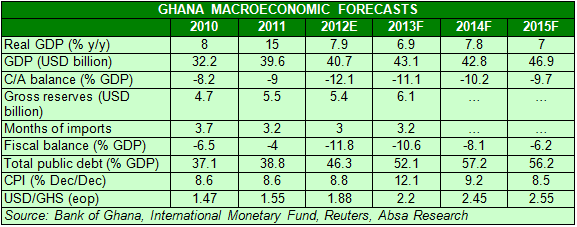
"This follows a sharp widening in the budget deficit to 11.8% of GDP from 4% in 2011 and rising debt levels, which as a percentage of GDP have risen to 48.8% between 2011 and 2012 from 38.3%."
The ratings agency says that the government has failed to rein in wages, interest costs and arrears, which suggest that it will not be able to meet the 9% of GDP fiscal deficit target for this year.
Spending on wages climbed to 72% of tax revenue last year, led by an 18% wage increase for civil servants.
"However, the decision to sharply increase utility tariffs and scrap the fuel subsidy reduces the risk of an overrun in the coming fiscal years."
Ghana's economy is expected to rise 7.9% similar to the strong growth in the past year, but will cool to 6.1% in 2014, according to the International Monetary Fund latest forecast.
Not everybody agrees with that assessment. Barclays Capital expects the country's GDP to grow by 6.9% this year, due to a "less benign macro environment" and as the country's fiscal situation remains challenging.
Data from the Bank of Ghana data suggests that the fiscal deficit was 6.3% of GDP in the first seven months of the year, against a target of 5.6%, due to weaker revenue collection.
Total revenues (including grants) were 17.3% below target at GHS10.3 billion, with both tax and non-tax revenue substantially below budget.
WEAK COMMODITIES
Africa's second-largest producer of gold is also hurt by falling prices of the yellow metal.
"Weaker commodity prices (especially gold, which accounts for about 40% of the country's exports) and a less benign economic environment continue to weigh on government revenues," said Ridley Marcus, analyst at Absa Capital.
"In an effort to boost revenues, the government re-introduced the national fiscal stabilization levy (NFSL) and increased some import duties at mid-year."
The value of exports reached USD 9.8 billion, a 4.1% improvement over the same period last year. However, earnings from gold fell by 12.6% to USD 3.4 billion, while exports of cocoa beans also declined by 21.4% to USD 1.4 billion, Bank of Ghana data shows.
Oil exports, however, rose 46.9% to USD 2.8 billion, as a result of rising production. Earnings from non-traditional exports, including cocoa products, went up by 22.2% to USD 2.2 billion, the Bank of Ghana said.
To address some of the revenue shortages, the authorities raised water and electricity rates and removed fuel subsidies. The government has also introduced four new taxes, including a 5% stabilization levy on earnings of some companies.
INFLATION CONCERNS
Another key concern is the rising inflation.
"Inflation has risen steadily in recent months, which has forced the Bank of Ghana to hike its policy rate 100bp year to date," notes Absa Capital's Marcus.
"Even though we do not expect further monetary policy tightening this year, inflation remains above the 7-11% target range, and the bias for monetary policy is therefore towards further tightening."
The International Monetary Fund reports that the Bank of Ghana is focused on external risks and the challenges of bringing inflation back to single digits. The IMF also said that it agrees with the bank that "monetary policy needs to remain tight until fiscal consolidation is firmly established, and possibly be tightened further if depreciation and inflation pressures heighten."
The government is also taking measures to rein in spending with a sharp retrenchment in other expenditure and the mid-year adoption of revenue measures, such as the reintroduction of the national stabilization and import levies.
"However, it will be difficult for the government to keep the deficit below 10% of GDP."
Ghana is also looking to issue another bond valued of around USD 1 billion next year, according to deputy finance minister Cassiel Ato Forson.
"Ghana's relatively high share of FX debt (about 50% of total debt), means the debt trend may worsen further due to continued FX depreciation," Marcus said. "While refinancing risks are limited in the short term, medium-term fiscal consolidation is essential for Ghana to ensure a sustainable debt path."
While Ghana has taken great strides over the past few years, it is still behind other middle-income peers.
Fitch notes that in comparison to other countries with a 'B' rating, Ghana lags on per capita income and human development indicators.
"Per capita income of USD 1,754 in 2013 is 60% of the 'B' median, while Ghana's UN Human Development Index ranking improved to the 28th percentile from the 17th (2010), it is still below the 'B' median of 41st," Fitch said.
© alifarabia.com 2013