The UAE helps consumers with the lowest level of consumption and sales taxes in the world, according to new research by UHY, the international accounting and consultancy network.
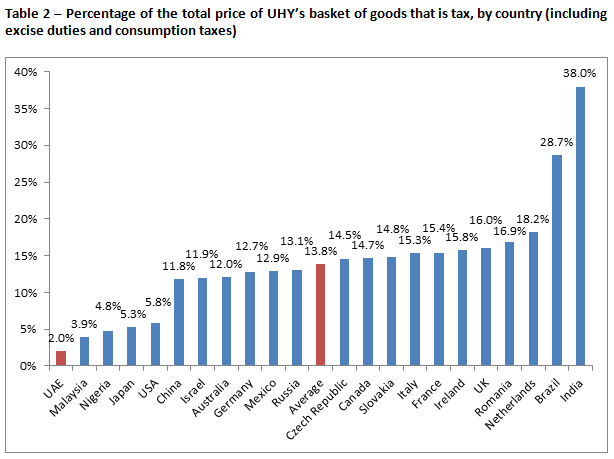
UHY tax professionals studied data from 22 countries* across its international network, including all members of the G8 and the developing BRIC economies. UHY calculated the percentage of the total price of a representative basket of goods and services that was made up of taxes and duties.
The UAE government takes 2% of the total price of the basket of goods through taxes.
Rajiv Saxena of UHY Dubai and member of UHY International, says: "With well below average consumption and sales taxes, the UAE's consumer economy gets a very welcome helping hand from the government. Low consumption and sales taxes provide businesses with plenty of flexibility on price and help keep goods affordable for consumers".
On average, European governments are responsible for 15.5% of the price of UHY's basket of goods and services. This compares to an average of 13.8% for all countries, 12.3% in G8 countries, 8.2% in the Asia-Pacific countries.
Rajiv says: "The UAE is exceptional in its low level of indirect and direct taxation. Normally countries will have low direct taxes or low indirect taxes, but not both. The consumption and sales taxes that are used in the UAE are limited to goods that the government may want to discourage the use of."
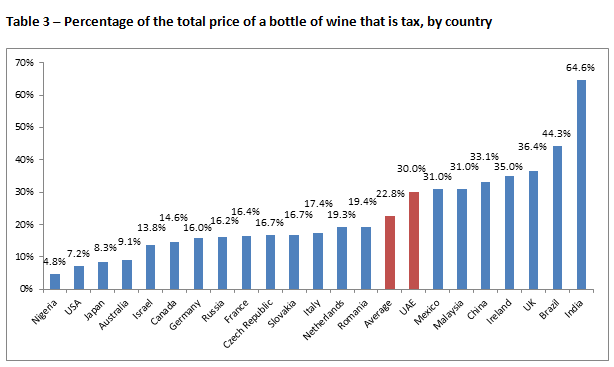
The UAE only charges consumption or sales taxes on two items in UHY's basket of 22 goods and services: international flights and a bottle of wine.
For example, 10.5% of the price of an international flight from the UAE is made up of taxes, just below the global average of 11.1%.
Cigarettes attract the highest consumption taxes in the whole study, with governments being responsible for an average of 48.5% of the total price of a packet, however, the UAE charges no taxes on cigarettes.
UHY says that low levels of indirect taxes will help businesses from the UAE compete in an increasingly international marketplace.
Rajiv says: "Rising sales and consumption taxes put a lot of pressure on business' bottom lines. In order to compete on price and to keep customers shopping, some businesses may opt to absorb sales taxes, especially if they are raised significantly or repeatedly. This hasn't been the case yet in the UAE, which has really helped businesses here."
"With the rising dominance of e-commerce, especially in retail, businesses are competing internationally. Having low levels of sales taxes will help businesses from the UAE compete for customers from countries with high sales taxes."
UHY adds that the study shows that some countries' tax systems have struggled to catch up with the rise of e-commerce.
In several countries, including India, Israel, the US, Italy, and Malaysia,sales taxes were levied on physical CDs but not on the mp3 versions of the same albums.
Rajiv adds: "New technologies and globalisation have caused plenty of problems for unwieldy and complex tax systems. Tax systems can be very slow to react to the rise of new ways of doing business, and can leave traditional businesses - like physical stores - at a disadvantage."
Europe burdened by high direct and indirect taxes
UHY adds that European governments levy some of the highest salesand income taxes in the world.
Rajiv says: "European economies have 'zig-zagged' over the past few years, limping into growth and slumping back into decline. Struggling with huge budget deficits, European governments have raised income and sales taxes. This has severely discouraged the consumer spending that could support a stronger recovery."
The UK, the Netherlands, and France have all increased their sales taxes recently - the UK raised VAT from 15% to 20% with two changes in the space of just two years. France plans further rises in 2013.
At the other end of the scale from the UAE, Brazil's indirect taxes were some of the highest in the study. Brazil's government was responsible for 28.7% of the cost of the basket.
Diego Moreira, Executive Director of UHY Moreira-Auditores in Brazil, and member of UHY, says: "Direct taxes on individuals in Brazil are very low, but this means the tax burden falls heavily on businesses instead, through taxes on employment and sales taxes that can depress consumer spending."
"High indirect taxes can discourage spending and put pressure on business' margins. Indirect taxes in Brazil are also highly complicated, which can make it hard for consumers to understand how the tax system operates. This will add to business compliance costs too."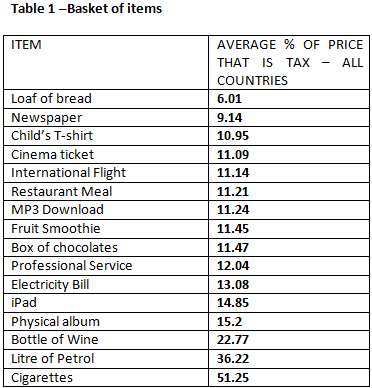
*Taxes may vary between states in some countries. For the US, China, Australia, and Canada, taxes are specific to Michigan, Beijing, Perth, and Toronto
**Nigeria, UAE, Malaysia do not levy taxes on fuel
To learn more about the services and capabilities UHY Chartered Accountant, a UAE Partnership can offer, please contact David Burns at david@uhyuae.
About UHY Chartered Accountant, a UAE Partnership
UHY Chartered Accountants, a UAE Partnership has fee income of over £3.6 million, 4 offices, 9 partners and 100 staff.
About UHY
Established in 1986 and based in London, UK, UHY is a network of independent audit, accounting, tax and consulting firms with offices in over 240 major business centres in 81 countries. Over 6,800 staff generated an aggregate income of USD 625 million in 2011, ranking UHY the 25th largest international accounting and consultancy network. Each member of UHY is a legally separate and independent firm. Each member of UHY is a legally separate and independent firm. For further information on UHY please go to www.uhy.com
UHY is a full member of the Forum of Firms, an association of international networks of accounting firms. For additional information on the Forum of Firms, visit www.forumoffirms.org
For more information on UHY, please contact Dominique Maeremans, Marketing & Business Development Manager, UHY International, Quadrant House, 4 Thomas More Square, London E1W 1YW, UK. Tel: +44 20 7767 2621, or email: d.maeremans@uhy.com
Press Enquiries
David Burns
UHY
Tel. + 971 4 3517007
Mob. +971 509144094
Press enquiries:
For UHY, the international network
Dominique Maeremans
+44 20 7767 2621,
email: d.maeremans@uhy.com
Nick Croysdill or Nick Cosgrove
Mattison Public Relations
+44 20 7645 3636 or +44 7815 823 412 or nick.croysdill@mattison.co.uk
© Press Release 2012