PHOTO
and neuromorphic computing, leading to effective research outcomes and a knowledge-driven ecosystem in Abu Dhabi and the UAE
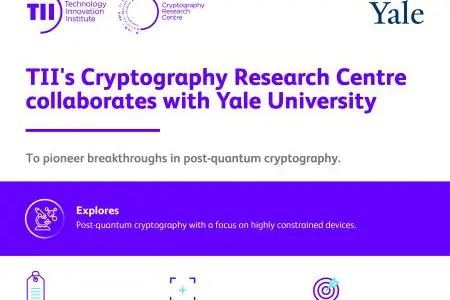
Abu Dhabi-UAE: Abu Dhabi and the UAE are working to pioneer breakthroughs in post quantum cryptography and neuromorphic computing through an international partnership between Technology Innovation Institute’s (TII) Cryptography Research Centre (CRC), and Yale University, an Ivy League research university in Connecticut, United States.
The two institutions will first join forces on ‘Post-Quantum Lightweight Crypto Hardware Accelerators and Trusted Execution Environment Designs’, a project at the intersection of emerging technologies that focuses on developing quantum-resistant crypto schemes within the context of emerging quantum algorithms that can be run on a sufficiently large quantum computer. By leveraging post-quantum cryptographic (PQC) algorithms, the project aims to guarantee the necessary measures of security even as today’s public cryptographic standards, such as RSA and Elliptic Curve Cryptography (ECC), become ineffective when a powerful quantum computer is built and can run Shor’s quantum algorithm. The project is also exploring post quantum lightweight cryptography with a focus on highly constrained devices.
The neuromorphic computing project, ‘Energy-based Probing for Robust and Explainable Spiking Neural Networks’, takes inspiration from the brain to create energy-efficient hardware for information processing and is capable of highly sophisticated tasks. The project examines Spiking Neural Networks (SNNs), which have become popular as an energy-efficient alternative for implementing standard artificial intelligence tasks. Spikes or binary events drive communication and computation in SNNs that are close to biological neuronal processing and offer the benefit of event-driven hardware operations.
The central focus of the collaboration is to explore the design space of the energy-accuracy-robustness-explainability trade-off and to design the hardware/software necessary to create truly functional intelligent systems. To ensure there is no overlap, both entities have been tasked with managing specific areas of the research in both projects.
Speaking on the partnership, Dr Najwa Aaraj, Chief Researcher at Cryptography Research Centre, said: “We are excited to work with peers from Yale University in carrying out groundbreaking research in these two vital fields. At the Cryptography Research Centre, we are creating a knowledge-driven ecosystem powered by like-minded scientists and researchers – all focused on designing breakthrough solutions in different areas of cryptography.”
Jakub Szefer, Associate Professor of Electrical Engineering and Computer Science and Priya Panda, Assistant Professor of Electrical Engineering, from Yale University, said: “By working collaboratively with Cryptography Research Centre, we have an opportunity to apply shared expertise across post-quantum cryptography and neuromorphic computing research. We are optimistic that this partnership will yield effective research outcomes for greater impact.”
Technology Innovation Institute, the ‘applied research’ pillar of Advanced Technology Research Council (ATRC), is a pioneering global research and development centre that focuses on applied research and new-age technology capabilities. The institute has seven initial dedicated research centres in quantum, autonomous robotics, cryptography, advanced materials, digital security, directed energy and secure systems. By working with exceptional talent, universities, research institutions and industry partners from all over the world, the Institute connects an intellectual community and contributes to building an R&D ecosystem in Abu Dhabi and the UAE. The Institute reinforces Abu Dhabi and the UAE’s status as a global hub for innovation and contributes to the broader development of the knowledge- based economy.
About Technology Innovation Institute (TII):
Technology Innovation Institute, the dedicated ‘applied research’ pillar of Advanced Technology Research Council (ATRC), is a pioneering global research and development centre that focuses on applied research and new-age technology capabilities. The Institute has seven initial dedicated research centres in quantum, autonomous robotics, cryptography, advanced materials, digital security, directed energy and secure systems. By working with exceptional talent, universities, research institutions and industry partners from all over the world, the Institute connects an intellectual community and contributes to building an R&D ecosystem in Abu Dhabi and the UAE. The Institute reinforces Abu Dhabi and the UAE’s status as a global hub for innovation and contributes to the broader development of the knowledge-based economy.
For more information, visit www.tii.ae
© Press Release 2021
Disclaimer: The contents of this press release was provided from an external third party provider. This website is not responsible for, and does not control, such external content. This content is provided on an “as is” and “as available” basis and has not been edited in any way. Neither this website nor our affiliates guarantee the accuracy of or endorse the views or opinions expressed in this press release.
The press release is provided for informational purposes only. The content does not provide tax, legal or investment advice or opinion regarding the suitability, value or profitability of any particular security, portfolio or investment strategy. Neither this website nor our affiliates shall be liable for any errors or inaccuracies in the content, or for any actions taken by you in reliance thereon. You expressly agree that your use of the information within this article is at your sole risk.
To the fullest extent permitted by applicable law, this website, its parent company, its subsidiaries, its affiliates and the respective shareholders, directors, officers, employees, agents, advertisers, content providers and licensors will not be liable (jointly or severally) to you for any direct, indirect, consequential, special, incidental, punitive or exemplary damages, including without limitation, lost profits, lost savings and lost revenues, whether in negligence, tort, contract or any other theory of liability, even if the parties have been advised of the possibility or could have foreseen any such damages.