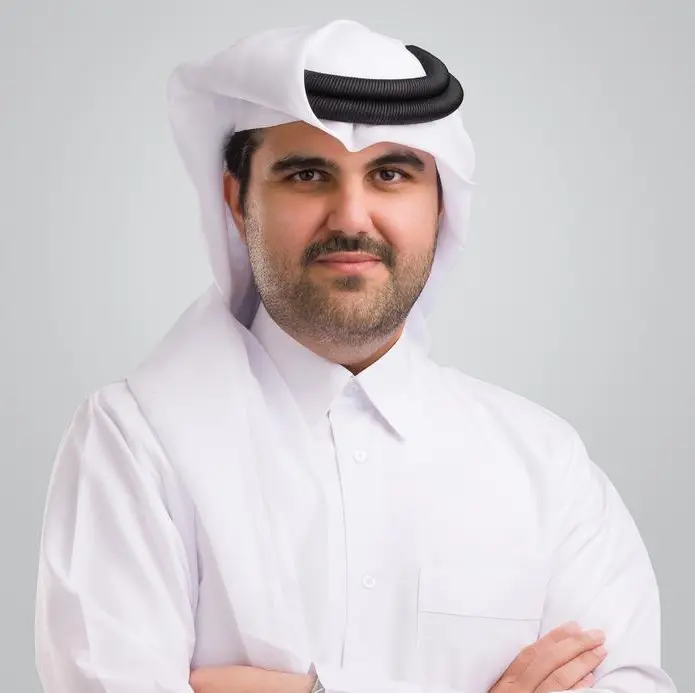
HE Dr Hamad bin Abdulaziz al Kuwari - Minister of Culture, Arts and Heritage - delivers guest lecture at conclusion of Travelling Through Arts and Times exhibition, a collaboration between Sheikh Faisal bin Qassim Al Thani Museum and Carnegie Mellon University Qatar
Doha, Qatar; 14th April 2014
The importance of preserving and promoting Qatari culture and heritage and Arab and Islamic identity was highlighted by HE Dr Hamad bin Abdulaziz Al Kuwari, the Minister of Culture, Arts and Heritage, in a lecture to mark the conclusion of the exhibition Travelling Through Arts and Times - a collaboration between Sheikh Faisal bin Qassim Al Thani Museum and Carnegie Mellon University Qatar (CMU-Q). In his speech, HE Dr Al Kuwari praised Qatari businessman and the Museum founder Sheikh Faisal as a "role model to be followed by others", in his life-long support of heritage and culture.
The exhibition at Carnegie Mellon University Qatar, under the patronage of His Highness the Father Emir Sheikh Hamad bin Khalifa Al Thani, featured more than 160 rare artefacts from Sheikh Faisal bin Qassim Al Thani's extensive private collection and included priceless gold jewellery, vintage cars and 7th Century gold coins all on public display for the first time, along with manuscripts, Islamic art and artefacts of Qatari heritage. The exhibition marked the 10th anniversary of the opening of Carnegie Mellon University in Qatar's campus at Education City and showcased the richness of Qatari and Islamic culture, heritage and civilization.
At the event, also attended by HE Dr Mohammed bin Saleh Al-Sada, Minister of Energy and Industry, and Dr Ilker Baybars, Dean and CEO of CMU-Q as well as leaders of business and academia, HE Dr Al-Kuwari also announced that Qatar had successfully registered falconry on UNESCO's Intangible Cultural Heritage list, and was planning to also add Arabic coffee and Al Majlis to the list, which supports and protects important aspects of culture and heritage across the world.
In his lecture "The role of private museums in the development of culture and the definition of the national and Islamic heritage", HE Dr Al Kuwari said culture and the preservation of national and Islamic identity were crucial as Qatar undergoes significant economic and social development. He said: "development leads to advancement, but not at the expense of identity and heritage. Identity is one of the most important topics in the National Strategy and National Vision."
HE Dr Al- Kuwari stressed the import role played by individuals and the private sector in the promotion of culture and heritage in Qatar and praised Sheikh Faisal bin Qassim Al Thani for his role in this field, saying: "We have to express our gratitude to HE Sheikh Faisal bin Qassim Al Thani - he is a role model to be followed by others - he combined important items of heritage and culture, classified them and preserved them. This is not only a gain to the state of Qatar but also to our Islamic and humanitarian heritage."
He also welcomed the active role played by universities in educating young people about the history and society of Qatar and encouraged further collaboration in the future between society and higher education. He added: "The efforts by the private sector and universities, through their programmes and activities, enables us to present our heritage and reinforces its importance."
In his speech, HE Sheikh Faisal bin Qassim Al Thani spoke of his "passion" for his world-renowned museum in Al Shahaniyah and his life-long commitment to raising awareness of and improving understanding about Qatar's history, culture and heritage. He said: "What makes me happiest is the foundation of this museum. We have developed a real relationship with the people of Qatar. I feel that I am serving the state of Qatar.
"This is a passion very close to my heart. When I was a young man, I was driven by business. Now my greatest passion is the museum."
He described how childhood visits to museums in Europe had greatly impressed him: "The things there are still ingrained in my mind. They are indelible memories. Museums are very important in society - when a person visits a museum, he lives both in the present and the past."
HE Sheikh Faisal bin Qassim Al Thani announced that the success of the temporary exhibition at CMUQ, which has had visitors from across the world, has sparked plans to have mobile exhibitions with key artefacts from the Sheikh Faisal museum travelling to Europe and the USA. He said the aim was to "disseminate our thinking and ideas about Arabs and our society". He added: "We want our exhibits not to stay static in Qatar but to open up to other parts of the world". This would complement existing cultural outreach programmes which the museum runs in schools and universities in Qatar.
He also announced plans to build a lecture theatre at the museum, to host educational sessions on Qatari history.
The Travelling Through Arts and Times exhibition featured a unique 7m wooden model Jalbut - the most common type of pearl fishing boat in Qatari waters. It had been commissioned by a Sheikha and at half real-size, is one of a kind. Ornate solid gold jewellery which was locally made and had belonged to a Qatari noble woman was one of the highlights of the 'Aspects of Qatari heritage' section of the exhibition. The necklace, belt, earrings and bracelets went on public display for the first time.
The exhibition's 'Islamic Art Collection' featured 64 objects of ceramic and metal as well as carpets and rare Islamic coins, dating from the early Islamic period of the 7th Century through to the early 20th century and which had not previously been publicly displayed. Rare manuscripts featuring items from the Arab and Islamic world were also on display, along with four vintage cars - a 1939 Studebaker Champion, a 1939 Ford, a1947 Cadillac and a Ford Crown Victoria from 1955-56.
CMUQ Dean and CEO Dr Ilker Baybars said: "We at Carnegie Mellon University Qatar have been honoured to host Travelling Through Arts and Times - the first special exhibition of the Sheikh Faisal bin Qassim Al Thani Museum which marks our tenth anniversary in Qatar and underscores our commitment to supporting the heritage and culture of Qatar. This exhibition has been made possible through the generosity of Sheikh Faisal and his passion, curiosity and support, and we look forward to strengthening our relationship and working together again in the future."
-Ends-
Media enquiries to:
Allison.jones@aspect.qa: M: +974 3358 9891
Lesley.walker@aspect.qa; M: +974 7779 3546;
Kamal.nasrallah@aspect.qa; M: +974 6656 2779
Bashar.abulail@aspect.qa; M: +974 5598 9795
About Sheikh Faisal bin Qassim Al Thani Museum:
The Sheikh Faisal bin Qassim Al Thani Museum in Al Shahaniya, outside Doha, is a private collection dedicated to collecting, preserving and presenting artefacts to the public. The vast collection includes over 15,000 items related to the national heritage of Qatar, the Islamic world and beyond. The collection covers a broad timeline, from pre-historic times to contemporary events. Guests to the museum can find precious and rare glass from the Abbasid period to fine metalwork from the Mamluk period, and wooden vessels employed in pearl fishing to vintage cars used in Qatar. It is the true diversity of the museum in galleries dedicated to Islamic art, Qatar heritage, vintage cars, fossils and natural history and coins and currency, that attracts visitors both locally and from around the world.
www.fbqmuseum.com
About Carnegie Mellon University in Qatar:
As a global leader in education, Carnegie Mellon University is known for its creativity, collaboration across disciplines and top programs in business, technology and the arts. The university has been home to some of the world's most important thinkers, among them 19 Nobel Laureates and 11 Turing Award winners.
In 2004, Qatar Foundation invited Carnegie Mellon to join Education City, a groundbreaking center for scholarship and research. As Carnegie Mellon Qatar celebrates its 10th anniversary, the campus continues to grow, providing a prestigious education to 400 students from 42 countries. The university offers five undergraduate degree programs in Biological Sciences, Business Administration, Computational Biology, Computer Science and Information Systems.
Students in Qatar join more than 12,000 Carnegie Mellon students across the globe, who will become the next generation of leaders tackling tomorrow's challenges. The university's 95,000 alumni are recruited by some of the world's most innovative organisations.
© Press Release 2014