Half of people in the UAE think that their smart devices are spying on their lives, new YouGov research reveals.
A majority (55%) of residents believe that their devices record personal information without their knowledge. The results shows that men are more likely than women to think like that (58% vs 50%).
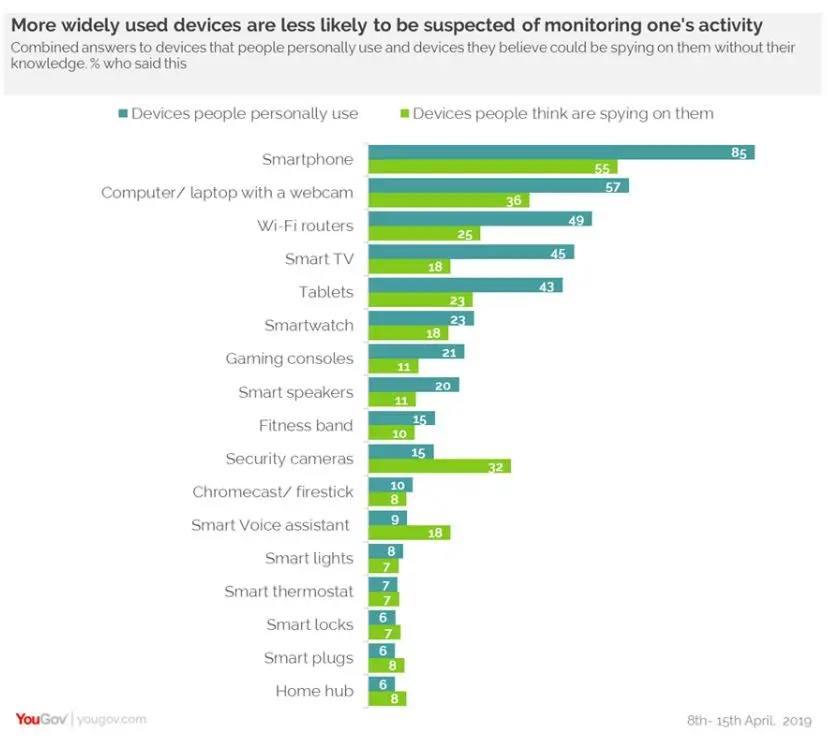
YouGov’s data finds that the most commonly owned devices are also the ones people are most likely to think are monitoring them. While 85% of people own a smartphone, 55% believe the technology is spying on them. Similarly, when it comes to a computer/laptop with a webcam, the figures are 57% (who use) and 36% (who think it is spying on them), respectively.
However, there are a couple of cases where levels of belief that devices are monitoring their lives outstrips ownership. While 15% of UAE residents use security cameras, more than twice this number (32%) believe that they spy on them. It is a similar case with smart voice assistants (18% think they are monitoring their lives and 9% use them).
The research shows that many UAE residents have concerns about their online privacy. Around half find their personal documents or images being automatically uploaded on to the cloud very concerning (49%), and almost as many (48%) consider their personal details getting auto filled during a transaction quite troubling.
A large number also find receiving mailers from brands they are not subscribed to (45%) and getting friend suggestions on the basis of their recent history (41%) as a matter of concern.
Losing private data (such as photos, mails, financial information, etc.) is people’s biggest tech-related fear (with 54% saying it), with women being more likely than men to believe this (60% vs 51%). Cyber terrorism (47%) is the second-biggest fear, followed by social isolation due to excessive use of technology (35%), and human interactions being replaced by artificial intelligence (34%).
Data collected online by YouGov Omnibus among 1,005 respondents in the UAE between 8th and 15th April 2019 using YouGov’s panel of over 6 million people worldwide. Data is representative of the adult online population in the country.
© Press Release 2019Disclaimer: The contents of this press release was provided from an external third party provider. This website is not responsible for, and does not control, such external content. This content is provided on an “as is” and “as available” basis and has not been edited in any way. Neither this website nor our affiliates guarantee the accuracy of or endorse the views or opinions expressed in this press release.
The press release is provided for informational purposes only. The content does not provide tax, legal or investment advice or opinion regarding the suitability, value or profitability of any particular security, portfolio or investment strategy. Neither this website nor our affiliates shall be liable for any errors or inaccuracies in the content, or for any actions taken by you in reliance thereon. You expressly agree that your use of the information within this article is at your sole risk.
To the fullest extent permitted by applicable law, this website, its parent company, its subsidiaries, its affiliates and the respective shareholders, directors, officers, employees, agents, advertisers, content providers and licensors will not be liable (jointly or severally) to you for any direct, indirect, consequential, special, incidental, punitive or exemplary damages, including without limitation, lost profits, lost savings and lost revenues, whether in negligence, tort, contract or any other theory of liability, even if the parties have been advised of the possibility or could have foreseen any such damages.