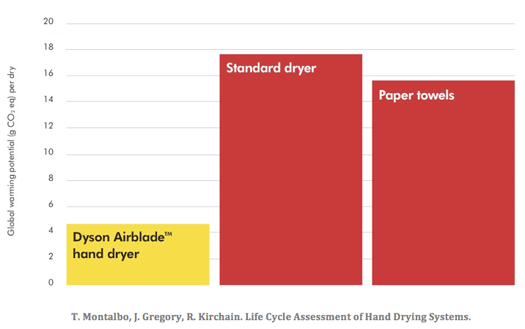
Dubai, UAE. 15 November, 2011. A leading Massachusetts-based research university study has proven that the Dyson Airblade™ hand dryer is the most sustainable way to completely dry hands. Paper towels and warm air hand dryers have the highest environmental toll according to this comprehensive lifecycle analysis (LCA), generating 70% or more carbon emissions than the Dyson Airblade™ hand dryer. Rather than warm air, the Dyson Airblade™ hand dryer uses sheets of cool, clean air to literally scrape water from hands.
James Dyson:
"Paper towels and warm air hand dryers - like vacuum bags - are from a bygone era. Technology has moved on. People want to dry their hands quickly, completely and without damaging the environment."
Virgin or recycled paper?
People perceive recycled paper towels to always be better for the environment. Wrong. The report's researchers found that the environmental impact of recycled towels equals that of virgin paper towels in a number of environmental measures, including CO2 emissions and water consumption. Recycled and virgin towels both generate over three times more carbon emissions than the Dyson Airblade™ hand dryer - creating waste, consuming more energy and using more water.
If every UAE citizen[1] visited the restroom just once a day for a year and used two paper towels each time, there would be enough paper waste to cover the Dubai Mall over 200 times, Abu Dhabi National Exhibition Centre 200 times, ...Twice! Dyson Airblade™ hand dryer creates none.
Yet, paper towels are still the most widely used in America's public restrooms. Waste accounts for only a fraction of recycled paper's carbon footprint: 65% is created during manufacturing due to the energy, chemicals and water used[2]. Rather than innovate, paper towel manufacturers spend millions opposing stricter environmental rules related to paper manufacturing[3].
This comprehensive LCA has helped Dyson pinpoint where engineering improvements can be made to further reduce the environmental impact of its technologies. Creating high-performing machines that use less materials and less energy.
Full of hot, inefficient air
Unlike paper towels - the most resource intensive hand drying method - the environmental impact of warm air hand dryers (and most home appliances) occurs during use. Energy-hungry heating elements and inefficient motors tip the sustainability scales, making warm air dryers up to 80% less energy efficient than the Dyson Airblade™ hand dryer.
To download the Executive Summary of the research visit: http://msl.mit.edu/publications/HandDryingLCA-ExecutiveSummary.pdf
To download the Full Report visit: http://msl.mit.edu/publications/HandDryingLCA-Report.pdf
-Ends-
ABOUT THE REPORT
A leading Massachusetts-based research university used a scientific method known as "life cycle assessment" (LCA) to measure the overall environmental impact of seven hand drying systems including cotton towels, virgin and recycled paper towels and hand dryers - both conventional warm air and high speed dryers. Researchers considered all life cycle stages from manufacturing to end of life and calculated findings based on the system's impact on CO2 emissions, ecosystem quality, land and water use, human health and resource intensity. An increasing number of companies including Apple, Walmart and Google have performed life cycle analysis.
The report - a major step forward for Life Cycle Assessment - could be applied to other industries to help quash inaccurate "green" claims by making it simpler to compare the environmental impact of day-to-day products, helping to answer questions such as paper or plastic.
This LCA report is one of the most robust reports to date and looks beyond all current international standards by considering current and hypothetical scenarios that could impact the environment. It's a first step in developing a gold standard for comparing the environmental impact of products - helping consumers interpret the growing number of environmental claims.
The study was done in accordance with ISO standards 14040 and 14044 and relied upon all available data from current and relevant LCA research by paper towel, hand dryer and roller towel manufacturers to ensure the impartiality and accuracy of the peer-reviewed research.
ABOUT THE DYSON AIRBLADE™ HAND DRYER
The Dyson Airblade™ hand dryer is the only hand dryer that dries hands completely in 12 seconds. Powered by the Dyson digital motor, it is up to 80% more efficient than other hand dryers and is the only hand dryer to use a HEPA filter and be certified hygienic by NSF International. The Dyson Airblade™ hand dryer is now available in 34 countries, with sales growing nearly 70% from 2009 to 2010.
- Each dry using virgin paper towels accounts for up to 15.45g of CO2 - equivalent to driving one-twentieth of a mile or 80 meters in an average diesel car[4].
- The Dyson Airblade™ hand dryer (plastic/Aluminum) generates 4.36g/4.59g of CO2 per dry, almost 50% less than the Excel Xlerator high speed hand dryer studied due to its faster dry time and lack of an energy-hungry heating element
- The research was conducted by researchers at a leading Massachusetts-based Research University.
- Dyson commissioned the research to look at the entire life cycle of a product from cradle to grave - materials, manufacture, use and end of life - including transport, dispensers, waste bins and bin liners.
- The research findings have been independently critically-reviewed by H. Scott Matthews, Professor of Civil and Environmental Engineering/Engineering and Public Policy Research Director, Green Design Institute Carnegie Mellon University; Jeff Morris of Sound Resource Management Group; and Cynthia Manson of Industrial Economics, Inc. The work will soon be submitted to an academic journal.
Further Information:
Susan Parker
susan@fifthring.com
+971 50 101 4403
[1] 2 paper towels per dry, 0.08m2 paper towel size (equivalent to 20x20cm). Calculation: 0.00000008 km2 (as the size of 2 paper towels) x 311,547,149 (the number of people in the US) = 24.92377 km2 * 365 days in a year = 9097.17 km2 total space covered.
[2] Life Cycle Assessment of Hand Drying Systems by Material Systems Laboratory. Carbon emissions created for manufacturing virgin paper towels: 10.03446 grams per dry (64.9%).
[3] http://www.forbes.com/feeds/ap/2011/09/28/business-specialized-consumer-services-us-kimberly-clark-lobbying_8706260.htm
[4] Calculations based on figures from the US Environmental Protection Agency (EPA) - http://www.epa.gov/otaq/climate/420f05004.pdf. Average passenger car creates 8788 g of CO2 per gallon of gasoline. For 2003, MOBILE calculates average values of 23.9miles per gallon (mpg) for passenger cars. 15.45g C02/ 367.7g C02 per mile = .042 miles.
Each dry using virgin paper towels accounts for up to 15.45g of CO2 - equivalent to driving one-twentieth of a mile or 264 feet in an average car.
© Press Release 2011