PHOTO
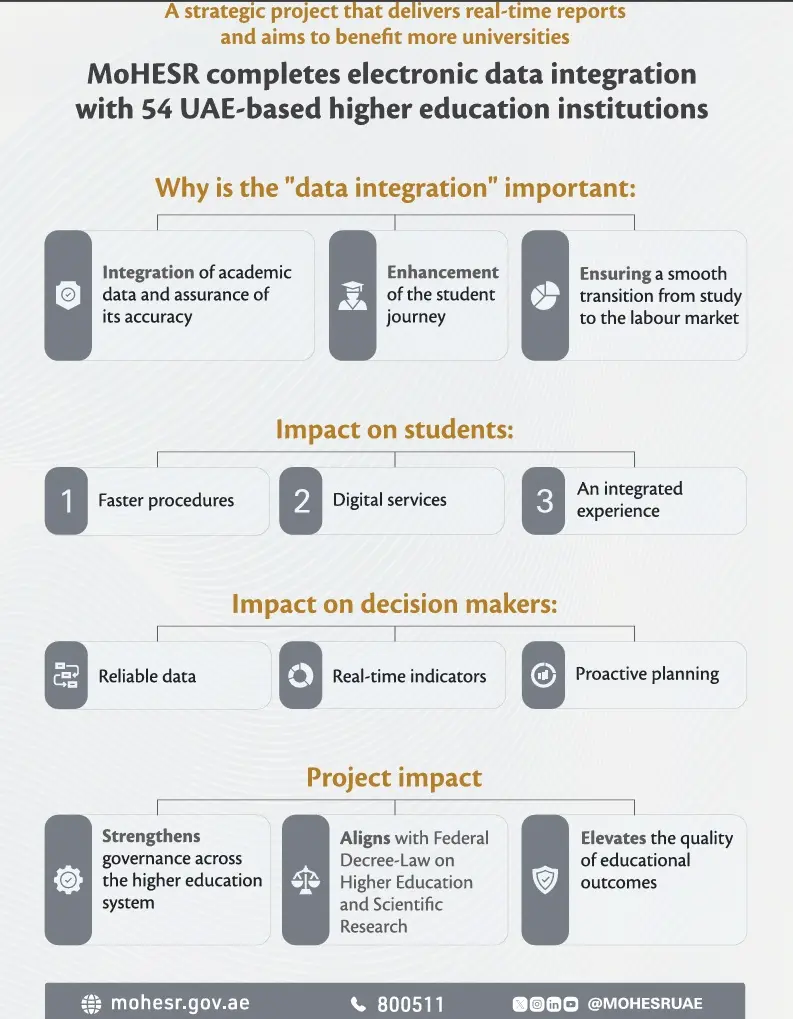
United Arab Emirates: The Ministry of Higher Education and Scientific Research (MoHESR) has completed electronic data integration with 54 higher education institutions (HEIs) across the UAE. The initiative is part of an integrated national digital project, aimed at leveraging educational data to inform policies, enhance student journeys, and boost the quality of educational services in line with the highest standards of efficiency and governance. The Ministry continues to integrate additional HEIs in accordance with an approved phased plan.
This project contributes to improving the student experience by simplifying procedures and accelerating admission and qualification recognition. It supports students’ smooth transition across all stages of education, graduation, and entry into the labour market. The system provides access to accurate, up-to-date data and indicators in real time through smart dashboards, supporting academic planning, monitoring future trends, and enabling data-driven decision-making at institutional and national levels.
The integration represents a transformational step in the approach to monitoring and evaluating HEI performance with a focus on acquired knowledge and skills rather than traditional inputs in line with the recently issued Federal Decree Law on Higher Education and Scientific Research. The Law aims to establish a comprehensive national framework for regulating the sector, strengthening governance and administrative efficiency, and elevating the quality and competitiveness of higher education while ensuring alignment between educational outcomes and labour market requirements.
Higher education institutions: A key step towards quality and governance
Commenting on the initiative, Dr Rawan Ghali, Director of Institutional Effectiveness at the American University in Dubai (AUD), said: “Following the completion of the electronic data integration project with MoHESR, we have observed a positive impact on both academic and administrative performance. The integration has enabled secure, real-time data exchange between the University and the Ministry.”
Dr. Eesa Al Bastaki, President of the University of Dubai, said: “This project reflects the University of Dubai’s commitment to the UAE’s Zero Government Bureaucracy programme and supports the development of a smart, interconnected, and data-driven higher education ecosystem aligned with future requirements.”
Dr. Burton A. Aggabao, Director of Quality Assurance and Institutional Effectiveness Affairs (QA-IEA) at Fujairah University (FU), said: “The completion of the electronic data integration project marks an important advancement in institutional governance, quality assurance, and performance accountability, strengthening alignment with the national outcome-based evaluation framework.”
Professor Manda Venkatramana, Chancellor of Gulf Medical University (GMU), said: “The project has streamlined processes, improved data accuracy, and reduced manual workload. This cooperation has laid a strong foundation for ongoing improvements and digital transformation.”
Professor Ghassan Aouad, Chancellor of Abu Dhabi University (ADU), said: “Through our participation in the project, we reaffirm our commitment to advancing digital transformation in line with the UAE’s national vision to build a more integrated, efficient, and sustainable higher education system.”
James Anthony Morse, President of Rabdan Academy, said: “The electronic data integration represents a key strategic milestone aligned with the ‘We the UAE 2031’ vision. The project supports evidence-based strategic decision-making through the transition from traditional models to a transparent and sustainable digital system.”
A qualitative leap in the digital transformation of the higher education sector
The electronic data integration represents a qualitative leap in the digital transformation of the higher education sector in the UAE, strengthening the sector’s readiness for a future built on knowledge and innovation.
In line with its efforts to advance digital transformation and achieve zero government bureaucracy, MoHESR continues to provide the necessary support to all HEIs to facilitate the integration process and enhance service quality at the technical and logistical levels.
For further information, please contact:
Maher Al Bash
Weber Shandwick
E: MAlbash@webershandwick.com
Sara Abuhassira
Weber Shandwick
E: SAbuhassira@webershandwick.com
Sara Farrah
Weber Shandwick
E: SFarrah@webershandwick.com