PHOTO
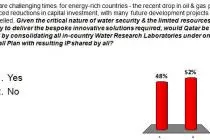
52% of respondents to a Gulf Intelligence (GI) Industry Survey of 150 professionals in Qatar say consolidating the in-country water research laboratories under a single framework would not particularly benefit Qatar's push for water security.
Dubai (Gulf Intelligence) - Qatar would not particularly benefit from consolidating all its in-country water research laboratories under a single framework and share the resulting intellectual property (IP), according to 52% of respondents to a Gulf Intelligence (GI) Industry Survey.
Qatar's natural water resources are essentially depleted and the country only gets seven inches of rain per year. Improving Qatar's water security is one of the country's three Key Challenges outlined in the National Vision 2030, along with energy security and cyber security.
Qatar's strained water resources and the need to ramp up research and development (R&D) to find solutions come against a challenging backdrop. Low oil prices since mid-June 2014, punctuated by a 12-year low in January, have taken a hefty toll on all energy producers' budgets, including Qatar. Low gas prices have had a particular impact, as Qatar is the world's biggest liquefied natural gas (LNG) supplier.
But, adopting a holistic approach - one that incorporates all research entities under a single framework - does not seem the preferred option. Fears over sharing IP, especially as cyber attacks are on the rise, and adding another layer of bureaucracy are the main deterrents.
Nearly half (48%) of respondents said there would be a benefit in collating all of Qatar's water research laboratories under a single framework as it could save money and time for all. Plus, sharing IP under strict guidelines that do not jeopardize research institutions' operations will propel the speed of R&D and ensure that innovative technologies and water management policies are implemented in Qatar's day-to-day operations as soon as possible.
For example, attempts to reduce the cost of desalination, which is needed to feed 99% of Qatar's municipal demand, would benefit from a holistic effort. Cheaper operating costs would make desalination more economically sustainability over the long-term, especially as the country's population is expected to grow eightfold by 2050.
If Qatar's research laboratories opted to align their efforts under a single framework, the country's collectively-sourced knowledge could be exported to other countries with water management issues. Deepening Qatar's R&D environment and finding cost-effective water management solutions would support the country's goal to become a knowledge-based economy, as per the National Vision 2030.
Whether Qatar's water research laboratories pursue isolated mandates, or combine forces, there is little doubt that progress must be accelerated. Industry, Academia and Government's combined water security efforts are not adequately aligned to deal with a national disaster, such as an earthquake or a major oil spill, according to 75% of respondents. Just 2% of respondents said Qatar's water security would be unaffected by a significant and negative event.
Gulf Intelligence:
Gulf Intelligence is a UAE-based strategic communications consultancy that facilitates critical Knowledge Exchange and Networking between stakeholders operating across the South-South Corridor -- connecting Government Related Entities in the Middle East and their International Partners trading across this New Silk-Road passageway from Asia to Africa.
For further details, please contact:
Annette Bontke
Director
Gulf Intelligence FZ LLC
Tel: +971 4 4508980
Fax: +971 4 4508981
Mob: +971 55 757 5014
Office #310, Building 9, Dubai Media City, Dubai, PO Box 502466, UAE
© Press Release 2016