Introduction
Wary of their heavy reliance on oil and gas sectors, all GCC states have embarked on strategies and programs designed to diversify their economies, enhance private sector activity, improve education standards and boost employment for nationals. These efforts include large public spending programs on infrastructure, education and health with supporting investments envisaged from the private sector. Not all are fully costed out, but Saudi Arabia's 9th Development Plan covering 2010-14 envisages spending of USD385bln. Kuwait's development plan meanwhile proposes USD125bln over the same time frame, while Oman's 2011-15 plan envisages USD78bln in expenditure. Meanwhile, Abu Dhabi, Bahrain and Qatar have established Vision 2030 frameworks and national development plans/strategies to achieve those visions. The National Development Strategy (NDS) for Qatar covering 2011-16 envisages spending totalling USD226bln, while Abu Dhabi's Vision 2030 report estimated spending of USD160bln during the five year period 2008-13. All GCC plans highlight investment opportunities in such sectors as transportation, power, water, utilities, health care, housing, ITC, education and training. Spending on infrastructure is expected to be particularly large in the coming years offering large opportunities in the construction sector. Transport projects are particularly prominent, with all GCC states planning to develop new interlinked train networks, as well as boosting roads, airport and port infrastructure.
Kuwait
Development Strategies and Opportunities
Kuwait Five-Year Plan (2010-14) sets out familiar goals
In 2010 the Kuwait national assembly approved a five year (2010-14) development plan aimed at restoring the economy to growth following the economic crisis post 2008. The plan forms the first phase of a larger program known as Kuwait Vision 2035 that will run in five-year blocks over the next 25 years, and includes 1,100 projects with an estimated value of USD125bln focused on both the oil and non-oil sectors. Similar to other GCC development strategies the plan focuses on economic diversification, including turning Kuwait into a regional trade and financial hub.
Implementation constraints are significant
While Kuwait public finances are exceptionally strong, implementation of the development plan has been stalled both by political disagreements and institutional capacity constraints. Kuwait needs to get parliament to approve and execute new laws aimed at supporting private sector engagement. Kuwait are thus likely to remain hostage to political wranglings. The state clearly has the financial resources to push ahead with its major infrastructure projects, but implementation will probably remain halting. State spending has certainly increased and topped USD62bln in 2011, but much of this represents larger government transfers in the form of grants and subsidies to Kuwaiti nationals. This has bolstered consumption, and may offers opportunities in retail and some services, but private sector activity has remained muted in the absence of large development spending.
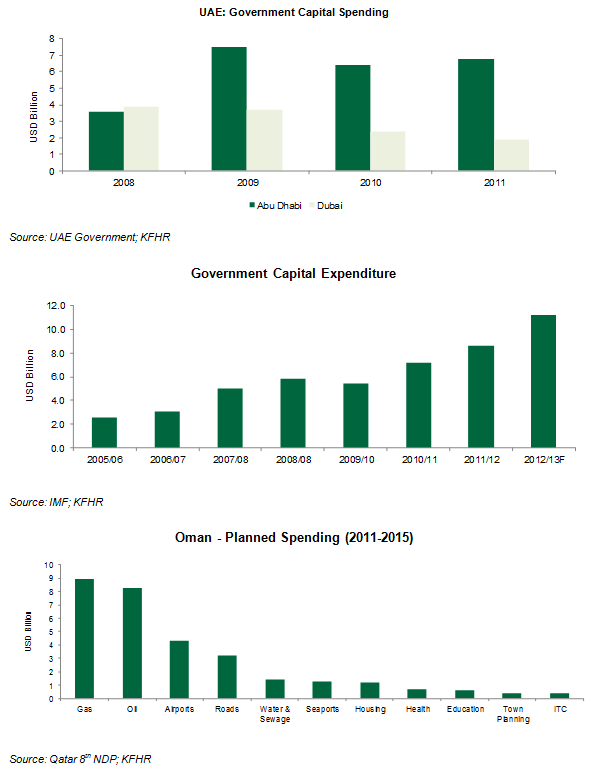
Capital spending is estimated to have been around USD7.3bln in 2011/12 and seems unlikely to rise much more than this in 2012/13. With a small population, vast wealth and extensive oil reserves, the incentive to move quickly ahead with economic reforms and diversification is not so pressing in Kuwait as in other states.
Saudi Arabia
Development Strategies and Opportunities
The government's capital spending will form the basis of opportunities for private business. These in turn will be guided by the country's Ninth Development Plan (NDP), which is worth USD385bln (67% higher than the previous plan) and runs from 2010-14. The NDP, which is prepared by the Ministry of Economy and Planning (MEP), is a general framework for capital spending, and actual capital spending (in terms of the amounts and direction) may well differ from the plan as circumstances change.
Education and health continue to claim large share of spending
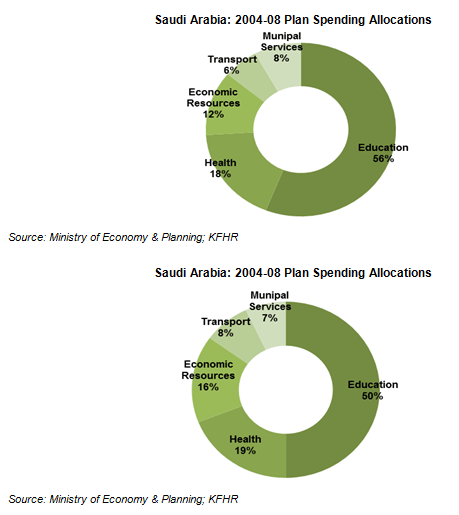
The biggest single allocation is to education ("human resources"). This fits with the demographic challenge outlined above and is aimed at all levels of education, with the overall goal of making school leavers and graduates more likely to secure jobs in the private sector, although it is notable that its share of spending between the two plans declined. Health is another major area of spending. Its share of spending was increased in recognition of the Kingdom's pressing health issues, stemming largely from population growth and the increasing prevalence of "lifestyle" diseases.
UAE
Development Strategies and Opportunities
Abu Dhabi Vision 2030 underway but trimmed down
The Abu Dhabi Economic Vision 2030 report was published in January 2009 and indicated that some USD160bln of development projects were on the table over the next five years, including a major airport expansion, large new port and several mega real estate projects. However, following the global crisis and its knock on effects on the UAE, which prompted a slump in Abu Dhabi's real estate as well as Dubai's, progress has stalled as the authorities looked to review the development program. This review has now been completed and it has been decided to press ahead with many of the planned large scale projects. The emphasis of state spending has shifted more clearly towards social services, housing, health and education. But high profile projects such as the branches of the Guggenheim and Louvre museums, as well as a host of infrastructure developments have also got the go ahead. This decision ends more than a year of uncertainty and stalled projects, and will usher in a new period of heightened construction activity which will have positive multiplier effects throughout the UAE providing numerous opportunities for business. Little information is available on budgets and timings, but official statements note that work on Khalifa port and the Shams solar power plant will proceed this year, and that 7,608 villas will be built over the next 12 months.
Implementation prospects are positive
Abu Dhabi remains committed to its long term strategy of diversifying its economy away from its reliance on oil and gas, and in encouraging the private sector as well as GREs to drive this process. Its healthy public finances will ensure that progress will continue to be made and that it will be able to support its GREs as necessary, although the pace of development is now likely to be more restrained. The government has already risen its spending sharply in the wake of the global crisis and it seems unlikely that further large increases are pending, although current levels should be maintained. Project activity in the UAE as a whole remains large. While likely to be overstated, MEED Projects estimates that the value of projects currently planned and underway stands at around USD560bln.
Qatar
Development Strategies and Opportunities
Qatar embarked on a 5-year National Development Strategy (NDS) covering 2011-16 which aims to deliver on the goals outlined in Qatar's Vision 2020. Having spent the last 20 years building up a world class gas industry, the aim is now to broaden the development focus with an emphasis on four key Pillars: Human, Social, Economic and Environmental Development. Implementation of the NDS will open up numerous opportunities for businesses, perhaps most notably through the sizeable investments planned to improve infrastructure and expand the industrial base by leveraging the available cheap energy and domestic feedstock.
Implementation outlook is positive
Qatar's public finances are extremely healthy and it is not expected to run into problems funding its planned spending, including through its Q (Qatar)-companies. Measures are being put in place to manage direct government spending through adoption of multi-year budgets and a public investment program tied in to the NDS. This bodes well for implementation, although there is also a sense that the authorities are prudently proceeding with some caution, mindful of the boom and bust experienced in Dubai. This may have contributed to the slippages seen in the schedule (the NDS had expected public sector investment to peak in 2011-12), but momentum now seems to be gathering pace with the planned hosting of the 2022 world cup providing added incentive. The latter will also lead to additional investment in stadia and hotels, although some of this is likely to take place beyond the 2016 NDS time frame.
Oman
Development Strategies and Opportunities
Development spending on the rise
Oman suffered some minor disturbances in early 2011 in the wake of Arab Spring movements in North Africa. These did not last long but have had a galvanising effect on the authorities who have moved quickly to accelerate state spending under the 8th National Development Plan covering 2011-15. With oil production and prices at record highs the authorities have boosted both current spending (mainly through wage increases, job creation in the public sector and the introduction of unemployment benefit), and capital spending. The latter rose to an estimated USD7.2bln in 2011 and is expected to rise further this year.
Steady progress expected
Oman's hydrocarbon resources are more limited than other GCC states, but are still sufficient to generate fiscal and current account surpluses (with the exception in 2009 when oil prices crashed) and allow a build-up of external assets. Under our assumptions for future oil prices finances should remain healthy and we expect that the authorities will make good progress in implementing the latest development plan. In terms of amounts to be spent, the oil and gas sectors are expected to account for the lions share during 2011-15 at USD8.3bln and USD8.8bln respectively. Outside oil and gas, the largest expenditures are focused on airports and roads, followed by water and sewage, seaports and housing.
Bahrain
Development Strategies and Opportunities
Bahrain, which has only small oil resources, is already the most diversified economy in the GCC having early on developed an offshore financial sector, tourism, and industries based on gas feedstock. As such its Vision 2030 is primarily focused on ensuring that the economy remains competitive and encouraging further private sector development and job creation to promote sustainable growth. Medium-term prospects will depend on a timely resolution of the current political impasse that has eroded confidence. The economy is reviving following the dislocations in 2011, but growth is expected to remain modest and more reliant on positive developments in raising oil production. Confidence is likely to remain fragile dampening private investment activity.
Conclusion
The GCC states are expected to continue to invest in essential areas such as healthcare, infrastructure, education and training, to build an attractive business environment for international companies seeking access to the growing markets of the Gulf. The robust population growth, together with the region's affluence and its abundant natural resources, point to continued strong market demand, will in turn help to make the GCC countries an attractive prospect for foreign investors. At the same time, the region's long-term economic growth will depend critically on the success of efforts to educate and employ the rapidly expanding young population. Rapid population growth will remain concentrated in cities. This will put pressure on and create needs for public services, infrastructure and housing in urban centres needing more investments. It will also create a large pool of labour. On-going education reforms create further need for education and training co-operation to help solve the mismatches of existing skill sets of local labour. Overall, we believe the development plans and strategies formulated by the respective GCC countries are steps toward the right direction in building a dynamic region moving forward.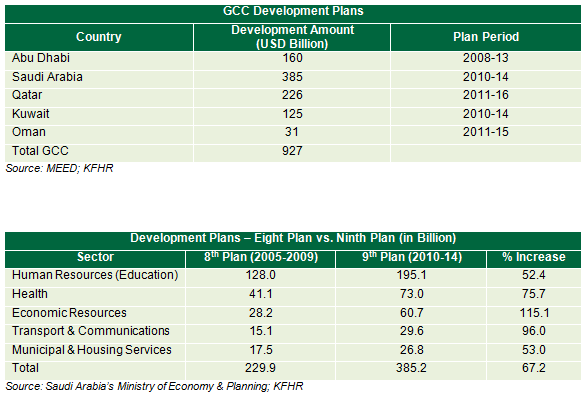
-Ends-
© Press Release 2012