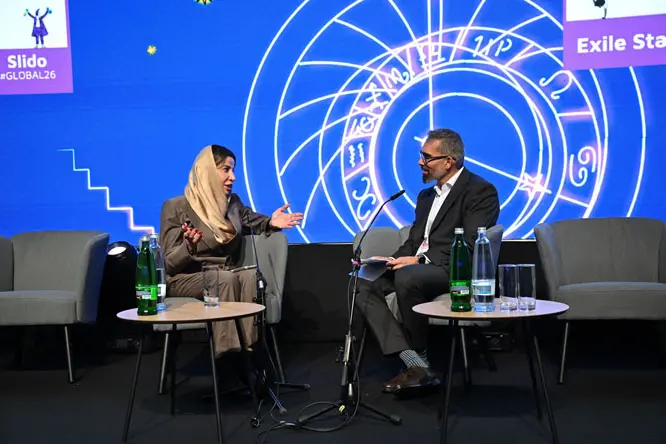
PHOTO
H.E. Raja Al Mazrouei, Chief Executive Officer of Etihad Credit Insurance (ECI), highlighted the UAE’s growing influence as a resilient global trade and investment hub during a high-level panel discussion at TXF Global 2026 in Prague, Czech Republic, one of the world’s leading conferences dedicated to export finance
Addressing global policymakers, export finance leaders, and institutional investors at one of the world’s leading export finance conferences, H.E. Raja outlined how evolving geopolitical and economic dynamics are transforming global trade flows and reshaping the role of export credit agencies in enabling sustainable and diversified economic growth.
H.E. asserted that the changing geopolitical and economic landscape over the past few years has had a profound and direct impact on ECI’s strategy, risk appetite, and operating model. Today, ECI operates in a vastly different global trade environment from the one that existed when it was established in 2018. Supply chain disruptions, geopolitical fragmentation, and shifting trade corridors have all contributed to a more complex and less predictable global system.
Amid these global shifts, the UAE has demonstrated remarkable agility in positioning itself as a trusted connector between developed and high-growth markets. Through strategic investments in logistics infrastructure, the expansion of its Comprehensive Economic Partnership Agreement (CEPA) network, accelerated industrial diversification, and strengthened international partnerships, the UAE continues to reinforce its role as a global trade gateway.
Against this backdrop, ECI has evolved its strategy in line with the UAE’s broader economic transformation agenda. As the UAE’s federal export credit company, ECI’s role extends beyond facilitating trade to enabling strategic economic partnerships that support national diversification and strengthen global competitiveness.
Attendees were informed that one of the most significant shifts has been in ECI’s exposure appetite. ECI has adopted a more forward-looking and calibrated framework that supports UAE exporters and investors pursuing opportunities in high-potential emerging markets aligned with the UAE’s expanding CEPA agenda. Through credit guarantees, risk mitigation solutions, and trade finance instruments, ECI continues to de-risk investments and facilitate greater private-sector participation in strategic sectors including renewable energy, infrastructure, healthcare, digital transformation, and sustainable development.
Currently operating across 30 African countries, ECI has supported projects spanning healthcare infrastructure, hospital construction, emergency response systems, firefighting solutions, technology initiatives, and green energy developments, while also empowering UAE-based SMEs to integrate into regional and global supply chains.
H.E. Raja further emphasised that ECI’s operating model has become increasingly data-driven and responsive through the use of advanced analytics, real-time market intelligence, and enhanced risk monitoring systems, enabling the organisation to assess country exposure, sectoral dynamics, and buyer behaviour with greater precision. She highlighted that SMEs as a central pillar of ECI’s strategic priorities, noting their critical role in driving non-oil exports and innovation-led economic growth in the UAE. Consequently, ECI has enhanced its product offerings and underwriting processes to provide more accessible, flexible, and responsive solutions tailored to growth-oriented exporters.
The audience was also briefed on the growing importance of blended finance structures in enabling transformative projects across sectors including clean energy, advanced manufacturing, sustainable infrastructure, healthcare, logistics, and technology. These projects increasingly depend on partnerships between public and private capital to improve investment viability and unlock long-term development opportunities. Within this ecosystem, ECI plays a complementary role by providing targeted instruments such as credit insurance, guarantees, and trade finance support that help de-risk cross-border transactions and enhance project bankability.