In Mbandaka, the capital of the Democratic Republic of Congo’s Equateur province, the past few months have tested the resolve of health workers at the Mama wa Elikya centre. As cases of mpox -- formerly known as monkeypox-- rose steadily, carers worked under the constant shadow of fear and uncertainty, dreading each new admission to their wards.
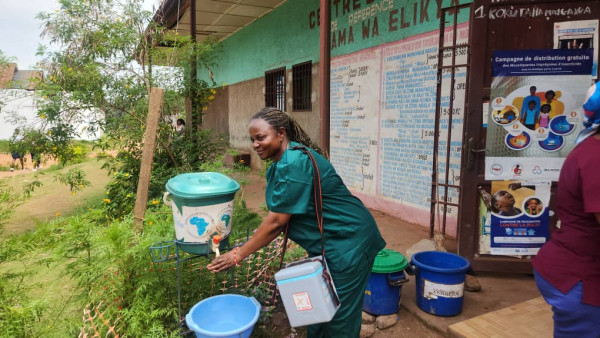
Among them was Monique Mulo Itala, a registered nurse and mother of five, who found herself on the front line of a fast-moving epidemic. For the 50-year-old, the crisis brought a daily struggle between professional duty and the fear of carrying the virus home.
"I was afraid to enter the isolation site,” she recalls. “Even with my protective clothing, I was apprehensive about administering treatment or putting patients on an infusion. When I got home, I was tormented. I feared infecting my family, so I asked them to stay away from me."
On 14 August 2024, the World Health Organisation (WHO) declared mpox a public health emergency of international concern, following a sharp surge in cases in the Democratic Republic of Congo. Between January and November 2024, the country recorded 8,517 suspected cases, 1,439 confirmed infections and 417 deaths.
Equateur province emerged as one of the hardest-hit regions. Over the same period, it reported 1,262 confirmed cases of mpox and 374 deaths, accounting for 36 percent of the national toll.
"We received a large number of cases -- 198 in all,” Monique explains. “We were worried because some patients could be infected without showing obvious symptoms. Despite this, we continued to isolate patients, provide care and advise them on hygiene and prevention, while waiting for vaccines."
Help arrived through a coordinated international response. Between January and July 2025, the African Development Bank and the WHO partnered with the Congolese government to strengthen the fight against mpox in Equateur province. The intervention was carried out under the Emergency Assistance Project to Combat Simian Smallpox (MPOX) (https://apo-opa.co/4qbIs3u), financed by a $1 million grant from the Bank's Special Relief Fund.
The intervention targeted the most vulnerable groups: frontline health workers, high-risk populations, children, veterinarians, hunters and game traders. It focused on four key areas: early diagnosis, vaccination, infection prevention and control, and multi-sectoral coordination.
This collective effort yielded swift results. By October 2025, all newly identified suspected cases had received rapid laboratory confirmation, appropriate treatment and systematic vaccination of contacts. This integrated approach led to a sharp drop in new infections and a significant reduction in deaths. Confirmed mpox cases in Equateur province have fallen by 60 percent, with only 14 deaths so far in 2025, compared with 417 during the same period in 2024.
For Monique, the change has been profound: "We were relieved when the vaccines arrived,” she says. “They enabled us to protect ourselves and our families. We're no longer afraid to see our patients because our bodies have developed antibodies against mpox."
More than 1,406 people have been vaccinated in Equateur province, including 3,718 front-line staff.
Beyond health facilities, outreach teams fanned out across villages and urban neighbourhoods to inform, reassure and protect communities. More than a million people have been reached, helping to dispel rumours and encourage preventive behaviour.
The response also improved the health system itself. Three laboratories in Mbandaka, Ingende and Bikoro were equipped and upgraded to strengthen detection. Thousands of prevention kits have been distributed, and 4,800 GeneXpert cartridges have been deployed to accelerate diagnosis.
"Our centre has received infection prevention and control kits, as well as vaccines to immunise children who had missed earlier vaccinations,” Monique notes. “Out of 100 children identified in our records and traced in the community, we vaccinated 88. The others had left the area at the time of the intervention."
Today, Equateur province has emerged more resilient, with better-equipped facilities, better-trained staff and communities better prepared for future epidemics. The province is not only celebrating the decline of the mpox virus, but also paying tribute to the community’s solidarity and determination that made it possible.
For Monique and many others, fear has given way to hope. "We're telling the community that they need to be vaccinated to protect themselves, that they should be proud to be vaccinated. To vaccinate is to protect yourself. To vaccinate is to love."
Distributed by APO Group on behalf of African Development Bank Group (AfDB).Additional Images:
https://apo-opa.co/4q9QLwD
https://apo-opa.co/3MKs6Ak