PHOTO
Arab Finance: The Ministry of Investment and Foreign Trade denied reports claiming that the government decided to suspend Egyptian exports to Gulf countries, affirming that export movements are operating normally, according to a statement.
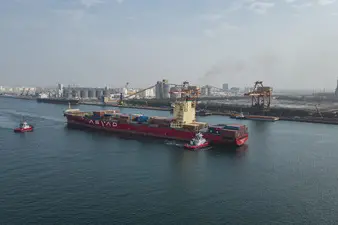
The Safaga Port served as an alternative gateway for Egyptian exports affected by the closure of the Strait of Hormuz, the ministry added.
The ministry noted that global trade movements occasionally experience limited short-term delays for some shipments due to fluctuations in shipping and insurance costs or transportation arrangements amid regional developments.
Nonetheless, it handles these issues swiftly within the framework of the transport and logistics system.
Actual data on export activity through Egyptian ports confirms that flows remain stable, highlighting the resilience of Egypt's foreign trade system in adapting to logistical changes.
Minister of Investment and Foreign Trade Mohamed Farid has directed all relevant authorities to coordinate to secure logistical and procedural facilitation for exporters, maintain the flow of foreign trade, and provide alternatives to bolster Egyptian exports.
On its part, the General Organization for Import and Export Control (GOEIC), chaired by Essam El-Nagar, is working to streamline export inspection procedures and issue conformity certificates in coordination with port authorities and logistics operators. This accelerated the clearance process and improved the efficiency of shipping and transport operations.
During the period between March 1st and March 15th, 2026, the land–sea transport route between the Egyptian port of Safaga and the Saudi port of Duba recorded a 75% year-on-year (YoY) hike in export traffic.
The number of voyages rose to 38 trips carrying about 4,200 shipments totaling 105,000 tons of goods, compared with 25 trips transporting 2,406 shipments totaling 60,150 tons during the same period in 2025.
The main goods transported via this route include fresh Egyptian fruits and vegetables, along with some goods that are re-exported as part of transit trade.
Furthermore, the maritime transport route between the Egyptian port of Nuweiba and the Jordanian port of Aqaba witnessed an increase in shipping activity.
The average number of trucks transported daily increased from about 60–70 to nearly 100 refrigerated containers on some days, which allowed leveraging the Jordanian road network to redistribute Egyptian goods to several regional markets.