PHOTO
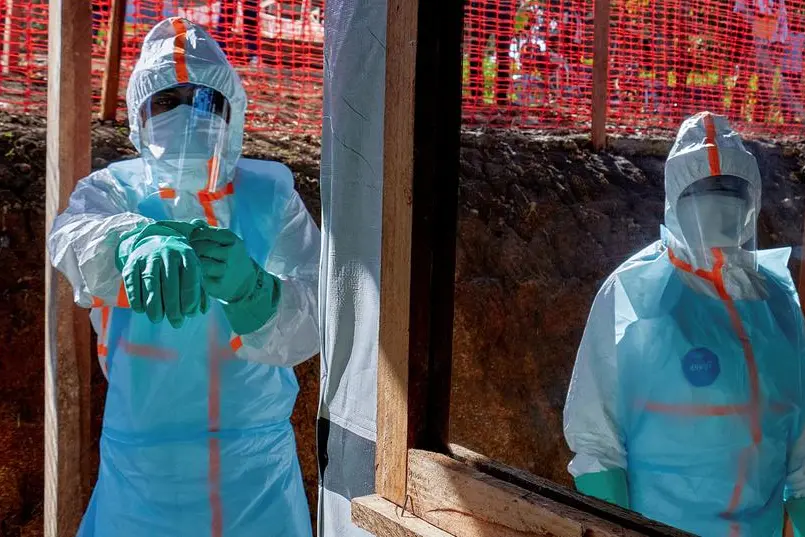
The 17th Ebola outbreak in eastern Democratic Republic of Congo (DRC) has placed the health authorities in a quandary: Containing a deadly virus christened Bundibugyo galloping through a population in an area plagued by armed conflict, impassable roads and massive population movement.
The situation presents a logistical nightmare to healthcare workers and authorities, in the face of financial and security challenges.
Currently, 11 health zones in Ituri, North Kivu and South Kivu provinces are affected by the latest outbreak, as the deathtoll passed 223, with 1,077 reported infections, according to the latest data from the Africa Centres for Disease Control and Prevention (Africa CDC).
The US and its European peers have come through with some aid, as has the United Nations, which provided Ituri with an ambulance, 100 motorcycles and emergency health kits to help track the spread of the deadly virus in the most remote areas.
On May 27, the US Department of State said it was sending in $80 million in bilateral assistance “to key partners on the ground to expand their ongoing response to the Ebola outbreak.”This brings the total assistance from the US to $112 million. The new funding is expected to help procure and deliver protective gear, facilitate border screening and surveillance, contact tracing and diagnostics supplies.
In addition, Washington has committed $50 million to the UN Office for the Coordination of Humanitarian Affairs (Ocha) to fund up to 50 Ebola response clinics in affected areas and another $300 million through Ocha pooled funds to the DRC and Uganda for broader humanitarian efforts in the affected region.
The US is also offering Kenya $13.5 million for Ebola preparedness efforts, including opening a quarantine facility there for Americans exposed to Ebola. But a Nairobi court applied the brakes on the plan after the deal was challenged by civic rights group Katiba Institute.
Vehicles, handed to the military governor Lt-Gen Luboya Kashama Johnny, will enable response teams to reach the most isolated epidemic hotspots, where roads are non-existent.
To curb the spread of the Bundibugyo strain, for which there is neither approved vaccine nor specialised treatment, the authorities are relying on mass testing and the rapid deployment of medical supplies.“We need to carry out as much testing as possible. Today, another 2,000 tests were due to be dispatched, and tomorrow a further 4,000 will be sent,” said Congolese Health Minister Samuel Roger Kamba, during a late-night press conference on Tuesday.
The Congolese government says it has drawn up a response plan in coordination with the Ugandan authorities and several international partners, notably WHO, Africa CDC and the US CDC.
Kinshasa says the response strategy requires the deployment of a large number of nurses, doctors and community outreach workers.
But such a strategy comes at a cost. The response effort represents a major financial challenge for a country already facing multiple humanitarian and security crises, as well as difficulties linked to the ballooning public-sector wage bill.
The DRC is benefiting from an unprecedented wave of international solidarity. While visiting Kinshasa a week ago, Dr Jean Kaseya, Director-General of Africa CDC, stated that his institution had released $1 million to Kinshasa to support the response effort.
Dr Kaseya told a virtual press conference that Africa CDC's partners on Monday had pledged almost $500 million to support the fight against the outbreak.
Since then, the figure has decreased to around $290 million after a number of donors changed their minds, he said, without naming them."People are dying! How can we come and say: we commit X million dollars, and the next day they are calling me to say no, it was a mistake?" Dr Kaseya said."We know some big global health institutions are sitting with billions of dollars... How can you come to say: I want you to focus on this development programme, and I have money for that, but I don't have money for Ebola?"Dr Kaseya hailed the World Bank and African Development Bank (AfDB) for agreeing to repurpose funds in order to support the response.
The European Union announced an additional €15 million ($17.46 million) in humanitarian aid to support the response in both DRC and Uganda.
Belgium organised a humanitarian air bridge with Unicef to deliver nearly 100 tonnes of medical and other supplies while the United Kingdom pledged up to £20 million ($26.83 million), to help contain the outbreak.
The World Health Organisation announced an initial disbursement of $500,000 to support the government response before gradually increasing its contribution to $ 3.9 million.
The DRC minister of Health said Kinshasa has worked on an overall budget of $319 million: “Following discussions with our Ugandan counterparts and international partners, the budget, initially estimated at $240 million, was reassessed at $319 million in order to cover operational needs on the ground.”Dr Kamba said that the government had released $20 million to support the initial operations.“Next week, we will disburse another $30 million, and then more and more, to deal with this situation. You cannot expect assistance from partners if you yourself are not able to lead the way,” said Finance Minister Doudou Fwamba Likunde.
But beyond the funding challenge is an economic pain that is impacting the affected region. Thousands of tonnes of cargo destined for eastern Congo is stuck at various areas on the Northern Corridor, after blockades effected by Uganda and Rwanda on fears of the spread of the deadly disease.
Now, hundreds of trucks are stuck at border points, as cargo piles up in warehouses. Most of the cargo destined for eastern DRC from Mombasa and Dar es Salaam ports passes through Uganda.
While health experts said the move is necessary to contain the deadly virus, transporters and cargo owners across the region say the economic impact is devastating.
At key border points in Rwanda, including Katuna, Rusizi, Kanutumba and Bunagana, hundreds of trucks with cargo from ports of Mombasa and Dar es Salaam remain parked as movement restrictions tighten.
Kenya Transporters Association (KTA) chairman Newton Wang'oo said the situation has become dire, with all warehouses at the border points already full, forcing transporters to put cargo in temporary holding areas.“Transporters are now being forced to dump cargo at borders because the delays have affected truck turnaround time. Warehouses in Katuna, Rusizi, Kanutumba and Bunagana are full,” Mr Wang'oo said.“Cargo owners who do not want their goods dumped at the closed borders are now required to pay at least $500 per day, per truck, for storage and detention charges, without knowing when the borders will reopen,” he said.
Each day a truck remains idle, owners lose money. But the ripple effect goes as far as the cost of goods to consumers and expensive storage fees.
The Kenya Long Distance Truck Drivers Union Secretary-General Roman Waema said the current Ebola outbreak has once again exposed the vulnerability of truck drivers, who are now facing fresh restrictions and mandatory quarantine measures.“Drivers are now not allowed into Rwanda, especially if you are coming from the DRC. You are required to quarantine for at least two days and this delays the ferrying of goods across the region,” Mr Waema said.
But the lack of uniform policies is also worrying. Mr Waema says that while Congo’s neighbours have tightened surveillance and screening, Kenya’s borders remain vulnerable due to what he termed as laxity in enforcement.
Catastrophic collisionIn Mombasa, authorities say emergency preparedness measures have already been activated because of the city’s strategic role as East Africa’s main gateway for cargo imports.
At least 3,000 truck drivers from Kenya, Uganda, Rwanda, South Sudan, Tanzania and the DRC visit the coastal city regularly to pick up cargo at the Port of Mombasa. The high movement of people and goods makes the city exposed to cross-border disease transmission.
Local pump prices have risen to over Ush6,200 ($1.7)-Ush10,000 ($2.6) per litre of petrol, resulting in sharp increases in air ticket prices.
Then the Ebola outbreak scuttled travel plans for tourists.
Overall, tourist arrivals reached 1.6 million in 2025 while total tourism earnings amounted to Ush5.8 trillion ($1.5 billion) in 2025, according to data compiled by the Uganda Tourism Board.
The average visitor staying period stood at 8.8 days in 2025 while average visitor spending amounted to $986 per trip last year. Uganda’s tourism industry contributes 5.9 percent to national output and supports 876,000 jobs in different communities.“The Ebola virus outbreak has complicated matters,” said Edris Kisambira, a local tour agent. “Most of our visitors who travel here during the peak season are from the US. Negative travel advisories issued by the US government have prompted lots of visitor cancellations this month. Tourism is a very volatile business and we somehow recover from such situations over time. Under the circumstances, one is compelled to either utilise alternative income sources, withdraw some of their capital or sell an asset in order to make ends meet in a tough business environment.”Tony Ofungi, who runs a tour company, said he had a single booking comprising 60 visitors whom he is now thinking about shifting to Rwanda.
Still, insecurity, is an obstacle in quickly containing the public health crisis. DRC Health minister has called for “ withdrawal of the M23 and the Rwandan army from Congolese territory in order to allow an adequate response in the affected areas of North Kivu.”The minister said he believes that “the response in Goma is currently difficult, with the airport closed, as are the borders with Rwanda.” Ituri is facing similar security challenges. Although the M23 is not active there, several armed groups – Allied Democratic Forces, Codeco, Zaïre, and the Convention for the Popular Revolution led by warlord Thomas Lubanga, continue to destabilise the region.
Medical teams are struggling to access certain localities. Population displacement further complicates epidemiological surveillance operations.
WHO Director-General, Tedros Adhanom Ghebreyesus, who visited this week, warned of “a catastrophic collision between disease and conflict.”“We cannot build community trust or isolate the sick while bombs are falling,” he said, calling on armed groups to agree to an immediate ceasefire to allow sustainable humanitarian access.
According to WHO, attacks on health facilities make it impossible to rapidly identify patients and their contacts, a process that is nevertheless essential to breaking the chain of transmission.
© Copyright 2026 Nation Media Group. All Rights Reserved. Provided by SyndiGate Media Inc. (Syndigate.info).