PHOTO
Gold charged past $5,000 an ounce for the first time on Monday as an array of geopolitical tensions pounded the dollar, while investors remained on tenterhooks about possible official buying of the yen after a series of surges in the Japanese currency.
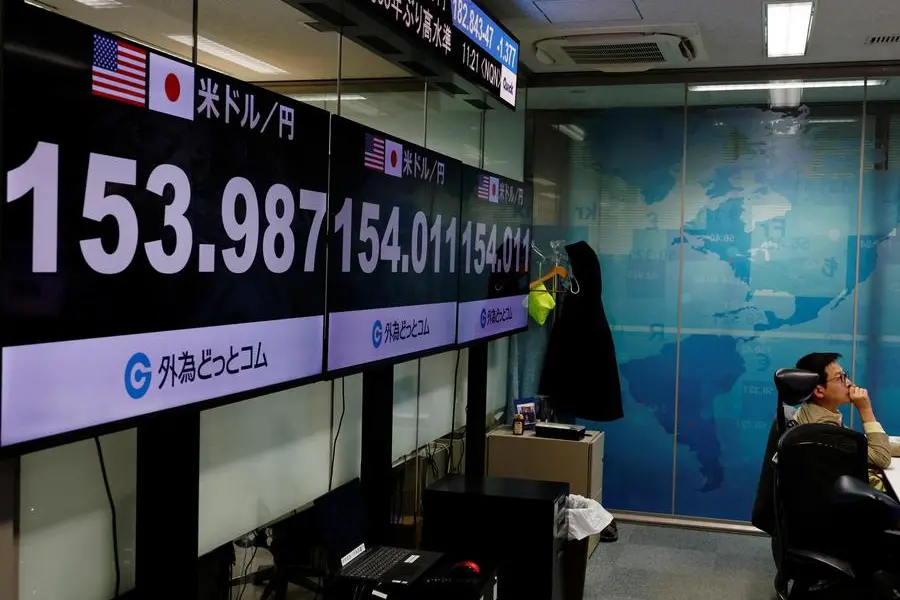
The yen rose as much as 1.5% in Europe, leaving the dollar at its lowest since mid-November at 153.405 yen, after sharp spikes in the Japanese currency on Friday sparked speculation over potential intervention. The New York Federal Reserve conducted rate checks on Friday, sources told Reuters, raising the chance of joint U.S.-Japan intervention - the first in 15 years - to halt the Japanese currency's slide.
"The market's inclination is to short the yen but the possibility of coordination means it no longer is a one-way bet," said Prashant Newnaha, senior rates strategist at TD Securities in Singapore.
The yen has been under relentless pressure since Sanae Takaichi took over as Japan's prime minister in October.
Her campaign promises to ramp up spending and cut taxes ahead of a snap election on February 8 have added to concern that Japan's already stretched finances could become even less manageable, which has pushed government bond yields to record highs, just as the Bank of Japan is slowly raising interest rates to tackle inflation.
As the yen strengthened, Japan's Nikkei dropped 1.75%.
Other equity markets were more stable. Europe's STOXX 600 was steady, while S&P 500 futures fell 0.1%, as traders counted down to a slew of earnings from big tech companies and a Federal Reserve policy meeting later this week.
U.S. President Donald Trump provided temporary relief to markets last week when he appeared to back down from threats to slap tariffs on European allies unless they let him take over Greenland.
However, with the prospect of more sanctions targeting Iran in the offing, there has been no let-up in investor anxiety over geopolitics.
With the dollar plumbing its lowest levels against a basket of major currencies in four months and volatility picking up, gold drew in a fresh wave of capital, hitting yet another record high in what has been a blistering rally over the last six months.
"Gold clearly has a quite compelling story, in terms of central bank reserve diversification, which you would have thought gets reinforced by all of this intervention talk and events in the U.S. more generally," Daiwa Capital Markets economist Chris Scicluna said.
"If the U.S. authorities really are keen to weaken their currency, then that's not just against the yen, but against other Asian currencies as well, whilst you have the broader portfolio diversification theme away from the U.S. also likely to play a role, then I think it's very significant," he said of possible U.S. involvement in the currency market.
Gold was last up 2.5% at $5,089 an ounce, taking its gains in January to more than 17%, while silver rose 6.2% to $109.35 an ounce, up over 50% this month.
INTERVENTION CHATTER KEEPS YEN ALOFT
Top Japanese authorities said on Monday they have been in close coordination with the United States on foreign exchange, leaving traders on edge at the prospect of an intervention that could come any time.
Charu Chanana, chief investment strategist at Saxo, said the rate-check style warning could help reset positioning and remind the market there’s a line near 159–160.
"With the dollar starting to look softer, this is actually a cleaner window for Japan to lean against yen weakness. Intervention works better when it’s going with the broader USD tide, not fighting it."
BOJ money market data released on Monday suggested there had been no intervention on Friday.
The yen rallied across the board on Monday, lifting off record lows against the euro and Swiss franc and multi-decade lows against sterling.
The euro was up 0.2% at $1.185, just a whisker away from September's 4-1/2-year highs.
Investors' focus this week will also be on the
Federal Reserve, which is expected to hold rates steady at the first meeting since the Trump administration's criminal investigation of Chair Jerome Powell, whose term ends in May.
Oil prices, meanwhile, edged up on Monday, having risen about 3% on Friday, as traders worried about the impact on global supply from possible U.S. sanctions on Iranian oil shipments, while a cold front in the United States hit production in the key shale basin.
Brent crude futures were up 0.15% at $65.98 a barrel, while U.S. West Texas Intermediate crude was up 0.1% at $61.13 per barrel.
(Additional reporting by Ankur Banerjee in Singapore; Editing by Jacqueline Wong and Gareth Jones)