Arab countries that have recently been liberated from the clutches of their dictators are searching for a path to prosperity. For many, the political and social and economic achievements of Turkey is worthy of emulation. Indeed, the Prime Minister Recep Tayyip Erdogan is somewhat seen as a rock star among the youth of the Arab world.
But a new study by Legatum Institute, focused on the prosperity of nations, wonders whether Arab countries could consider alternative growth models.
"If our focus is on effective democratic governance, then Turkey, may be to some extent, a good model among Muslim countries," notes the study by the think tank based in London. "In other areas, though, notably the economy, the post-Arab Spring countries could just as usefully look to other countries like Indonesia and Malaysia."
The Legatum Prosperity Index 2011, now in its third year, gleans data from a Gallup survey of 1,200 people from each of the 110 nations to determine the true prosperity and well being of nations.
The survey looks to go beyond economic indicators such as gross domestic product and measures the performance of countries based on their financial well being, entrepreneurship, governance, education, health, security, personal freedom and social capital.
The report argues that countries impacted by Arab Spring may also want to consider Indonesia and Malaysia rather than Turkey as a model.
"Indonesia outperforms Turkey on the Economy sub-index, ranking 44th while Turkey places 78th. Indonesia's success partly comes from having the 19th largest market in the world. Indonesia's market recovered well from the 1997 Asian financial crisis, and this has enabled that country to reduce poverty levels and maintain robust economic growth even during the recent global downturn," the report notes.
In terms of economic prosperity, Malaysia looks like a model, ranking 17th globally on the Economy sub-index. This economic success is largely due to export-led industrialisation, fuelled by foreign direct investment. In addition, the country has low unemployment and high public confidence in financial institutions at 87%.
"The power of example - the need for a model to inspire positive change - should not be underestimated. But because no model can ever be perfect, it is prudent to hold up more than one, and to keep in mind what the Prosperity Index continues to demonstrate: that the world changes, regions and countries change, but the foundations of national prosperity remain the same," the report notes.
THE UAE AS A MODEL?
While the study examines the various models for Arab states like Egypt, Libya and Tunisia, it misses a perfectly good model closer to home: the UAE.
According to the Prosperity Index, the UAE is the 27th most prosperous nation in the world, and 27th globally - higher than Malaysia (43rd), Indonesia (70th) and Turkey (75th).
Moreover, the UAE beats the Indonesia and Turkey on all the eight individual criteria. Against Malaysia, the UAE fares better on five of the eight criteria.
It can be argued that Libya could emulate Abu Dhabi's prudent hydrocarbon-leaning approach, while Egypt and Tunisia could benefit from importing some of Dubai's entrepreneurial flair. However, it is important to note that the Gallup survey only interviewed Emiratis in the UAE and not expatriates, which make up a sizable portion of the population.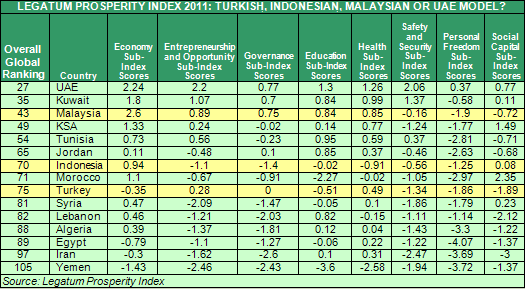
MIDDLE EAST IN THE PROSPERITY INDEX
Middle East countries showed a mixed performance in the 2011 index. While the UAE, Kuwait and Saudi Arabia found themselves among the 50 most prosperous nations, Yemen, Iran and Egypt languished right at the bottom. Qatar is curiously missing from the report.
Throughout the region, overall prosperity is driven down by persistently low scores on the Personal Freedom and (to a lesser extent) Governance sub-indices, the report notes.
"For example, in Egypt, a moderately strong performance on the Education and Health sub-indices (ranked 68th and 65th, respectively), is offset by an extremely low score on the Personal Freedom sub-index (109th), placing Egypt in the bottom 30 on overall prosperity. A similar pattern can be observed in Algeria, Syria, Tunisia, and Iran."
The United Arab Emirates and Kuwait have the highest Personal Freedom scores in the region. Notably, Gallup is not allowed to survey the large non-Arab, expatriate population, which is roughly 50% in the UAE and 20% in Kuwait. It is therefore hard to draw firm conclusions from the survey data in these two countries, the report notes.
GLOBAL PROSPERITY
As is often the case in such surveys, Nordic countries dominate the top half of the survey, apart from two Oceanic nations. Norway (1), Denmark (2), Australia (3), New Zealand (4), Sweden (5) make up the top five most prosperous nations.
Canada (6), Finland (7), Switzerland (8), Netherlands (9) and the United States (10) make up the top 10.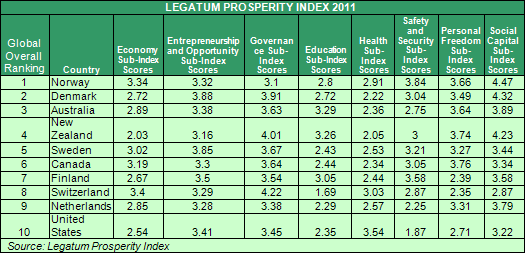
Overall, the index shows prosperity has increased in every region between 2009 and 2011, with decreases appearing in only 23 countries: seven in Western Europe, five in Eastern Europe, four in sub-Saharan Africa, three in Asia, two in the Americas, and two in the MENA (Middle East and North Africa) region (the largest decreases have been experienced by Latvia and India), the report notes. "What this regional picture suggests is that prosperity is sometimes found in unexpected places - and that its true measure goes beyond GDP," Legatum concludes.
© alifarabia.com 2011