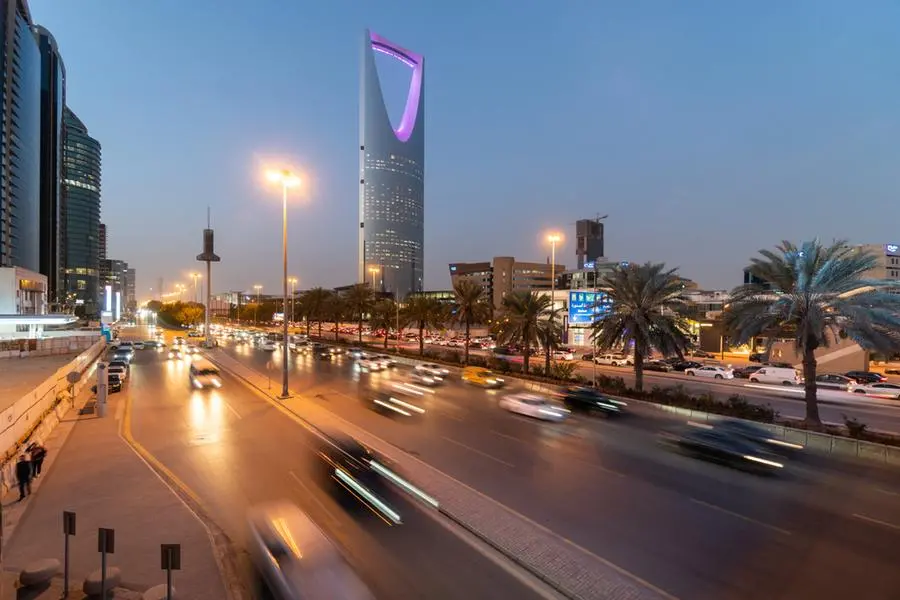
The Saudi economy, the largest in the Middle East, is going through a purple patch. High oil revenues and a generous spending programme has meant that the domestic economy has remained insulated from the doom and gloom of the global economy and even shut out regional unrest for the most part.
It appears that the regional giant has awoken and moving with lightening speed on multiple fronts: as a strong political player, a diplomatic force, a stabiliser of sorts in a volatile region and an economic powerhouse.
Saudi Arabia's GDP growth keeps getting revised upwards as the full impact of its stimulus spending becomes more evident.
In fact, the Kingdom Arabia is set for the strongest rate of economic growth since 2003, rising 6.9% in 2011, or USD544 billion (SAR2 trillion), driven by double digit growth in crude oil output and sizeable gains in government spending, according to SAMBA estimates.
By 2013, the nominal GDP figure should hit USD587 billion (SAR2.2 trillion), after a small pull back in 2012.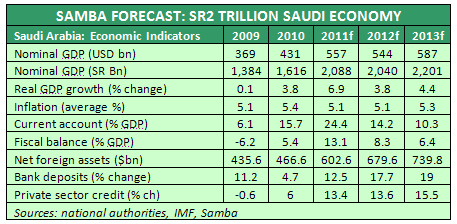
Not surprisingly, oil revenues have been leading the growth. Saudi Arabia has been pumping oil at record levels to make up for the lack of Libyan output and to ensure that the global oil market does not get nervous on account of regional tensions.
According to PFC Energy, average crude oil production was running at 9.2 million barrels/day (b/d) in the first nine months of 2011, around 12% higher than the corresponding period of 2010.
"Domestic demand for fuel is also a driver of oil demand. Official figures are only available to 2009, but these show that domestic consumption of premium gasoline has been increasing at an annual average rate of 7.5% since 2005," says SAMBA chief economist. "Prices are heavily subsidised by the government, with gasoline retailing at just 19 percent of the average global retail price in 2010."
Much of this is driven by the USD130-billion announced by the Saudi Government earlier this year to keep civil unrest at bay.
The programme appears to be working on multiple levels. Not only have there been no large-scale incidences of domestic unrest, but it has also stimulated the domestic economy at a time of regional turmoil and gloomy global economic outlook.
Samba notes that the economy has worked its way through only a portion of that stimulus, suggesting that the economy will keep ticking over nicely over the medium term.
"We believe that the authorities will spend around a third of the estimated SR459 billion package announced by King Abdullah in February and March of this year. At around SR140 billion this is still a sizeable addition to outlays, and should boost overall spending this year by around 23% to some 40% of GDP," says SAMBA.
Much of this is in current spending commitments, principally public sector salaries and additional subsidy spending. Samba notes that the capital spending, mainly housing, will only be felt after a few years, as projects get off the ground.
Not that there is shortage of projects right now, as Samba reports that project activity has picked noticeably over the past few months.
"Saudi banks have been sitting on significant excess liquidity for some time now, and seem intent to put it to good use, while many public sector contracts announced last year are now being rolled out. Most sectors are experiencing a surge in financing activity--not just utilities, which has been the mainstay of much of the project market during the past few years," says Samba.
Petrochemicals, mining, real estate and telecoms are among the sectors in focus with government ministries also keeping local contractors engaged.
The massive oversubscription for the Islamic financing of the SR3.75 billion Saudi Aramco/Total joint venture highlights the appetite for Saudi projects.
"There has also been a pick-up in other, smaller corporate issuance as Saudi firms look to rationalise and restructure bilateral debt taken on in previous years. Beyond this, it is understood that the Ministry of Finance might be planning to issue its own paper for project finance purposes, largely in an effort to better anchor the yield curve for domestic debt," says Samba.
In a sea of sovereign debt troubles, Saudi debt is much desired and is viewed as one of the ten safest sovereigns in the world by investors, according to CMA Data Vision data.
Not surprisingly, there is also considerable activity in the secondary market. High quality corporate credits--including public sector and government-supported IPPs -- are being sold and bought at extremely competitive prices.
Samba notes that the Kingdom is still playing 'catch up' on the infrastructure and for political reasons it will continue to support spending.
"The surge in spending this year is by any measure exceptional, and represents the largest annual increase since 2000 (which followed two years of spending contraction). The economy would probably find it difficult to digest a further increase in 2012, and we think spending will contract slightly next year. Yet spending will still amount to around 38% of GDP, and in general we feel that spending has moved on to a higher plane from around the 305 of GDP in the previous decade to around 40% of GDP going forward."
Inflation, which had been a scourge in much of the noughties has been contained and should remain capped at around 5% over the next two years. Though rental inflation has risen 8% over the past ten months, the rest of the economy is benefiting from much lower prices than the previous boom.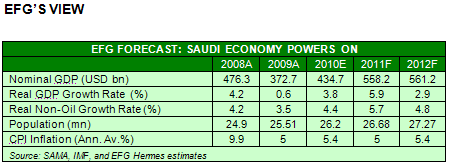
EFG-Hermes also offers a similar prognosis for Saudi Arabia. The Egyptian investment bank has revised its growth outlook for the Kingdom to 5.9% for the year on rising oil income.
"We now forecast real oil growth of 6.3% in 2011 after EIA data showed Saudi's oil production had remained strong, albeit decelerating, in September and in October," says EFG, noting that the return of Libyan oil would mean oil exports from Saudi Arabia may reduce, but will remain at historically high levels.
"We raise our non-oil GDP growth forecast to 5.7%, on the back of strengthening project activity from September."
"Project awards rebounded in 3Q2011, after a relatively weak 2Q2011. Importantly, there are signs pointing to domestic funding sources (government credit agencies and commercial banks) stepping in to compensate for loss in external financing. Consequently, we do not expect to see any delays in project implementation at this point, although external funding risks remain."
Like SAMBA, EFG expects capital expenditure to carry on the good work of consumption spending in the new year to ensure Saudi economy remains robust.
"We see investment activity driving growth in 2012, with government commitment and resources. Project awards look to remain robust in 4Q2011, which should lead to strong project activity into 2012. Planned projects are also set to increase in 2012, although we see some spread into 2013 and 2014," says EFG.
The bank expects real non-oil growth to remain robust in 2012 at 4.8%. Private consumption growth is normalising after the spending measures in early-2011, in line with our expectations.
Clearly, analysts do not expect to see the one-off measures in the 2011 additional spending packages in 2012 (notably the two-month public sector wage bonus), although government spending is forecast to remain expansionary, increasing by 13%. Headline real GDP growth of 2.9% in 2012, according to EFG.
Samba's real GDP growth expectations are higher at 3.8% next year, as it expects the private sector to benefit from a revival in projects. In addition, majority of the Kingdom's oil exports are to the energy-hungry Asian markets, which should keep the economic momentum intact.
"Overall, we see real GDP growth reaching just shy of 7 percent this year, well above the average for large emerging markets, and higher than all GCC peers bar Qatar," says Samba.
In 2012-13 growth is expected to ease back to an average of 4.1%, as oil production eases and the pace of government spending moderates somewhat, with non-oil growth is still expected to average 5%.
Saudi economy has much going for it at the moment, but there are political tensions that are going to hold sentiment in check. The death of Crown Prince Sultan Bin Abdulaziz Al-Saud highlights the long-term succession issues facing Saudi Arabia, although King Abdullah was quick to move away and install the Interior Minister Prince Nayef Bin Abdulaziz Al Saud as the new Crown Prince.
Another key risk could well be a turn for the worse in the global economic outlook, which could subdue oil prices, but that would take a while for the effect to trickle down in the Saudi economy.
Saudi Arabia's economic dynamism should also reflect well on Bahrain, the UAE and other Gulf countries, as many regional institutions and corporates are well-positioned to take advantage of the new business on offer in the Kingdom.
CONCLUSION
The Saudi economy is weathering the global economic downturn with considerable tenacity, and by ensuring that its own domestic economy does not freeze as was the case during the last global financial crisis of 2008.
However, it is still not clear what the economic growth means for long-term unemployment, especially in the private sector. With the private sector still adjusting to the new Saudization policy under the Nitaqat programme, which penalises companies for not meeting their quota of Saudi employees, the overall impact on the job market remains unclear.
After all, a jobless recovery would pretty much defeat the purpose of the stimulus package.
© alifarabia.com 2011