The Industry's Revenues to reach USD 2 Billion if properly exploited
Egypt will witness an investments boom in the marble and granite industry in the coming years. It seeks to increase its exports to the Arab countries, including Kuwait, one of the main importers of Egypt. The volume of marble investments is of EGP 17 billion, and their growth rate varies between 30% and 40% annually. Egypt ranks sixth among the world's main exporters of marble, as the exports this year reached around USD 330 million, compared to around USD 220 million in 2005. What about the most difficult obstacles facing this industry? And how do the manufacturers see its future?
Ahmed Abdel Hamid, Head of Marble and Granite Division at the Chamber of Building Materials Industries - Federation of Egyptian Industries, believes that the marble industry is facing many problems, such as the lack of financing by the banks, in addition to the insecurity suffered by the plants and quarries, as well as the roads being unprotected from Bedouin attacks.
He added that there are 350 marble plants and 800 workshops, with an average direct and indirect manpower of 700 to 800 workers. The export volume amounts to EGP 500 million, 5% of which for granite; the industry's growth rate varies between 5% and 6%.
Bedouins' "Royalties"
The Head of Marble Division mentioned that the industry is facing also the problem of Bedouins' "royalties" and the robbery of quarries, as well as the insecurity of roads, high manpower cost, in addition to the cancellation of the exports' support, as being discussed.
Kadri Abu Hussein, Governor of Helwan, said in a statement that Shaq el-Thuban region will soon jump from the fourth place to the first place worldwide in the production of marble, adding that this region is under extensive development operations to provide it with all the services, establish a business hotel and a permanent products exhibition, in order to improve the positions of the plants' and workshops' owners after a long period of lack of interest in this important industrial area that contains more than 700 plants, 2,000 workshops and 20,000 employment opportunities, where around 80% of Egyptian marble is manufactured.
Quarries Division
The Chamber of Building Materials Industries at the Federation of Egyptian Industries sent last month a memorandum to the Egyptian Minister of Industry and Trade, Dr. Mahmoud Essa, asking him to solve the problems of the marble sector that represents 95% of the building materials industry in Egypt. It also required to repeal the decision of the former Minister of Industry to increase the export duty of marble and granite blocks from EGP 80 to 150 per ton, and return to the previous decision stipulating the imposition of an EGP 80 export duty, provided that the collection of these duties is used for the advancement of the quarries' sector on all levels and for solving the sector's problems. The requirements included as well the re-implementation of the equipment development grant program, by refunding 50% of the value of equipment, up to a maximum of EGP 100,000, and that the grant should be given once for each quarry. The latter should be registered at the Industrial Modernization Center (IMC) while facilitating their registration requirements and they should be licensed at least two years before the date of request of the grant.
The quarries should also be redeveloped by attracting foreign experts and dispatching an expert to each quarry from countries with similar quarries' environmental and social conditions, such as India, China and Turkey, while specifying a limit for the experts' salaries in these countries. The quarries' owners should bear 30% of the contract amount, provided that the maximum contribution of the Center does not exceed EGP 50,000. A company specialized in quarries' products marketing should be established with the support of the IMC.
The memorandum requested the Industrial Development Authority to plan and create a new and alternative industrial area at Arab Abu Saed, El Tebbin, Cairo, for the creation of new and developed investments in the marble and granite industry, leading to the increase of demand on quarries' products, in addition to the establishment of Egyptian raw materials' exhibitions abroad, in Arab and foreign countries. It also demanded the Ministry of Transport to develop and pave the Sheikh Fadl and Al-Jalalah Roads, and make another road for Shaq el-Thuban to reduce traffic in the current exit and limit cars' accidents. The Division asked the Ministry of Defense and Military Production to cancel the decision of increasing the prices of explosives used in quarries and reduce them to EGP 5.5 before the 25th of January instead of EGP 35.
Dr. Mahmoud Essa, Minister of Industry and Foreign Trade, during a meeting with the Quarries Division at the Chamber of Building Materials, called for the promotion of marble and granite industry by setting a group of measures to upgrade the marble industry, in order to achieve the producers and investors' benefit in this sector, increase the operational capacity, create additional employment opportunities for more youth and increase the added value of this vital sector. This would necessitate the non-exporting of products based on natural resources in order to increase the rates of local manufacturing and increase the added value of Egyptian products, which will contribute in providing more employment opportunities as well as the opportunity to operate the small workshops in the production of marble and granite. 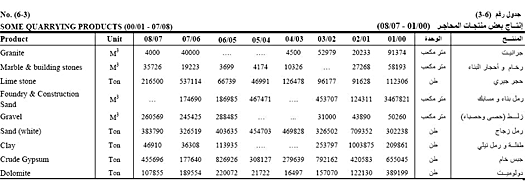
Production Fluctuation
A study by the Central Agency for Public Mobilization and Statistics indicates that the production of granite witnessed some fluctuation during the period from 2000/2001 to 2007/2008, where the production in the financial year 2000/2001 amounted to around 91,374 m3 and decreased in the following year to 20,233 m3. However, it increased significantly during the financial year 2002/2003 to reach 52,979 m3, then dropped to 4,400 m3 and then there was no production during the following two years. During the financial year 2007/2008, production reached 40,000 m3 but then decreased in the following financial year to reach 4,000 m3. Furthermore, the marble and building stones production witnessed some fluctuation in the financial year 2000/2001 where it reached 58,193 m3, and decreased in the following year to 27,268 m3. It reached its lowest level in the financial year 2005/2006 at 3,699 m3, then increased to 35,726 m3 in 2007/2008.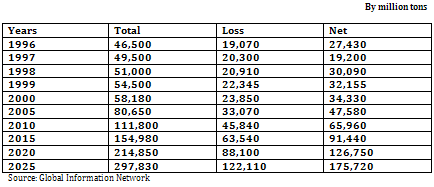
Two Billion US Dollars
A study by the Council of Ministers' Information Center concerning the development of Egyptian marble and granite exports, stated that the world consumes annually around USD 8 billion of marble and granite, and the Egyptian companies are able to produce USD 2 billion if the local quarries are properly used. The study shows that China is the first world consumer of natural stones, with an estimated share of 13% of global consumption, followed by Italy, Germany, Spain, France and Greece.
Egyptian marble and granite is characterized by their colors, as there is the beige marble (of El-Galalah) at the El-Galalah Mountains in Suez, rose and yellow marble at Khashm El-Raqaba area in the Red Sea Governorate, red and rose marble at Aswan mountains, as well as white and dark red granite at Wadi Allaqui. According to the study, Egypt has the largest marble and granite warehouse, for instance that of Khashm El-Raqaba is of 70 km, El-Galalah 80 km, Sinai 50 km and Aswan, Sohag, Minya and the New Valley have large quantities as well.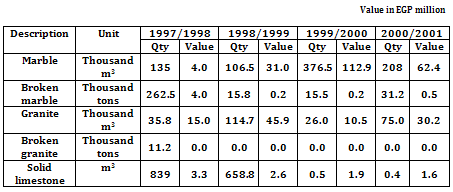
Ahmed Haggag, Chairman of Al Hassana Marble Co. and Head of Marble and Granite Division, confirms that the marble and granite industry has a bright future despite the losses suffered because of the insecurity following the January 25th revolution, justifying his reasoning by the increase of exports of 20% during the last period.
He added that banks have a positive impact on the future of this industry but it is not sufficient, as more financing is required, especially for the new investments in order to accelerate the growth pace of this industry and increase the exports volume, particularly that it is a low-risk sector that attracts investments.
He stated as well that Egypt is the sixth marble exporter worldwide, as the exports reached around USD 330 million in 2010, compared to USD 220 million in 2005. He anticipates an increase in the marble investments to EGP 17 billion during 2011, while they are of EGP 12 billion at present, where the investments growth rate in the marble and granite sector varies between 30% and 40% annually.
He pointed out that this industry is run by families and the merger between the companies in order to create large economic entities require an economic awareness that is as large as these entities, adding that the future may see an industry free from the control of families.
Zawya 2011