Dubai's debt problems refuse to go away, as the IMF warns that the emirate's debt will rise to 53% of GDP by 2016 if it does not act. Plus, sanctions on Iran could shave as much as 0.7% of UAE's GDP.
Dubai's debt may become unsustainable in the absence of policy change, according to the International Monetary Fund (IMF) in its periodic report on the UAE.
The IMF blames debt piled on by government-related entities (GREs) for raising Dubai' fiscal vulnerability.
"Dubai's gross government debt, including guarantees, increased from 1.6% of Dubai GDP in 2007 to 10.3% in 2008 and 34% as of end-2010. This was mainly due to the bailout of GREs," the IMF notes.
The Fund argues that the UAE government data does not paint a true picture of public sector debt, adding that GREs in the emirate's real estate sector are especially vulnerable.
"Assuming that the debt of these entities is a contingent liability for the government, at least US$11-billion of contingent risk can be foreseen for the government of Dubai by end-2016, with more than 70% of these liabilities coming due in 2011-12. This would raise the total debt-to-GDP ratio to 47.4% in 2012, compared to 34.6% for the government alone."
If the emirate does not act, Dubai's government debt is estimated to increase to 41% of GDP by the end of 2016.
In the absence of fiscal consolidation, however, it is projected to reach 53% by 2016, the IMF warns. "Furthermore, including the potential contingent liabilities as estimated above and with the baseline profile for fiscal adjustment, the total debt-to-GDP ratio would increase to 54.3% by the end of 2016, and to 62.5 percent without fiscal consolidation."
Overall, the UAE has $60-billion of debt due in 2011-12 and the country faces a short-term rollover risks that need to be managed. For Dubai, close to $20-billion of debt is due by 2014-15, mostly for real estate-related GREs.
"The overhang in the real estate sector means that these risks can affect the sovereign balance sheet as contingent liabilities may materialize, affect banks holding GRE debt, and have broader implications for capital markets through higher cost of borrowing and bailouts."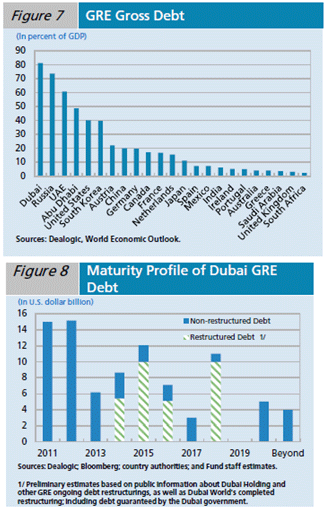
Abu Dhabi is not immune either with its own GREs in a spot of bother, especially in the property sector.
The UAE already appears to be paying heed to the IMF. A UAE Ministry of Finance official recently noted that a federal debt body will co-ordinate with the UAE Central Bank to ensure that various quasi-government entities co-ordinate their debt needs and borrowing does not exceed a certain level.
Separately, Abu Dhabi is also preparing a public debt policy framework to limit the borrowings of its GREs.
Cost-cutting has begun in earnest, too. While the emirate has been pruning costs since the crisis in 2008, its public admission of cost-cutting suggests it is sending a signal to the market. Dubai intends to cut spending by 20 to 25% to reduce its funding gap, according to Ahmed Humaid Al-Tayer, a member of the Dubai Supreme Fiscal Committee.
The Dubai Government had approved a 2011 budget with a $1-billion budget deficit, or 1.3% of GDP. "To fill the resulting financing gap, expenditure by government bodies in Dubai should be cut by 20 to 25 percent until 2013," Mr Al Tayer told the media.
Nakheel, the troubled real estate developer, is also planning a Dh4.8-billion sukuk by June to pay for 60% of its debt and as part of a restructuring exercise, according to media reports. [Read full story here]
Cleaning up the GRE balance sheet needs to be the government's "top priority", along with greater transparency of the fiscal position of each GRE to improve investor confidence.
"Containing GRE borrowing is key for fiscal sustainability at the emirate level and requires a strong institutional framework," says the IMF, adding that the planned federal debt management office (DMO) needs to have close co-operation with emirate-level DMOs.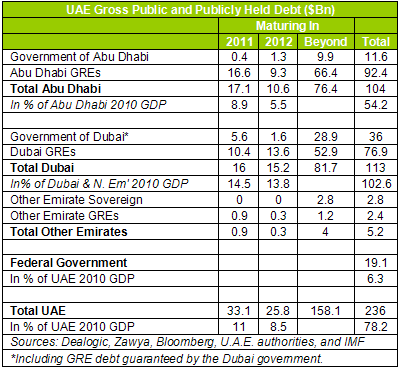
The GRE debt levels are not the only cause for concern. The IMF thinks that the unfolding turmoil in the Middle East and North Africa poses downside risks for the UAE.
Still, the regional turmoil has somewhat helped the Dubai economy, the IMF notes. The boost will help the UAE post a 3.3% rise in GDP this year, compared to the languid 2.1% last year, led by strong tourism, logistics, and trade in Dubai; and large public investment spending in Abu Dhabi.
Iran Connection
The other interesting aspect of the IMF report is the impact of international sanctions on Iran to the UAE economy.
Continued sanctions on the Islamic Republic could shave off anywhere between 0.2% to 0.7% of UAE GDP, given its strong trade ties with Iran.
"The sanctions do not target the types of goods that make up the bulk of the trade between the two countries," says the IMF. However, the financial restrictions imposed by these sanctions are making U.A.E. banks reluctant to take on transactions involving Iranian banks or companies.
This complicates and increases costs of securing trade finance, executing payments, and obtaining insurance for trading companies, and thus hurts trade with Iran, says the IMF.
According to the data, Iran accounts for 6% of UAE trade and 12% of non-hydrocarbon exports of the UAE - of which 90% are re-exports.
Dubai's total trade with Iran in the third quarter of 2010 - when the sanctions were imposed - declined by 15% compared to the same period of 2009, as Iran's share in re-exports from Dubai fell to 13%, from 18% in 2009.
The IMF research suggests that a 30% fall in exports to Iran would reduce the U.A.E. GDP by 0.2%. "Such a decline in exports would represent adversely impact the U.A.E.'s economy. Losses from disruptions in strong trade links between the U.A.E. and Iran could reach 0.2 to 0.7% of GDP almost 4% of U.A.E.'s non-hydrocarbon exports."
The IMF also notes that Iranians are the fourth biggest buyers of Dubai real estate after the Indians, British and Pakistanis. Sanctions on Iranian citizens will certainly hurt the emirate's property sector, which benefits from being a safe-haven property investment for citizens of troubled countries in the region.
While the IMF report is grim, the federal and Abu Dhabi governments will ensure that the risk is contained. Given the troubles in the rest of the region, the government will try to nip problems in the bud to ensure that any economic crisis will not have a political or social fallout.
This was evident with the bailout of the small Dubai Bank by the Dubai Government last week, which was seen as a signal to the market that the governments will step in when needed.
(Don't Miss: Is Dubai Back?)
Also Read: UAE economy grows 3.3% amid regional uncertainty
UAE Economic Growth Seen Higher in 2011, Despite Risks - IMF
alifarabia.com 2011