PHOTO
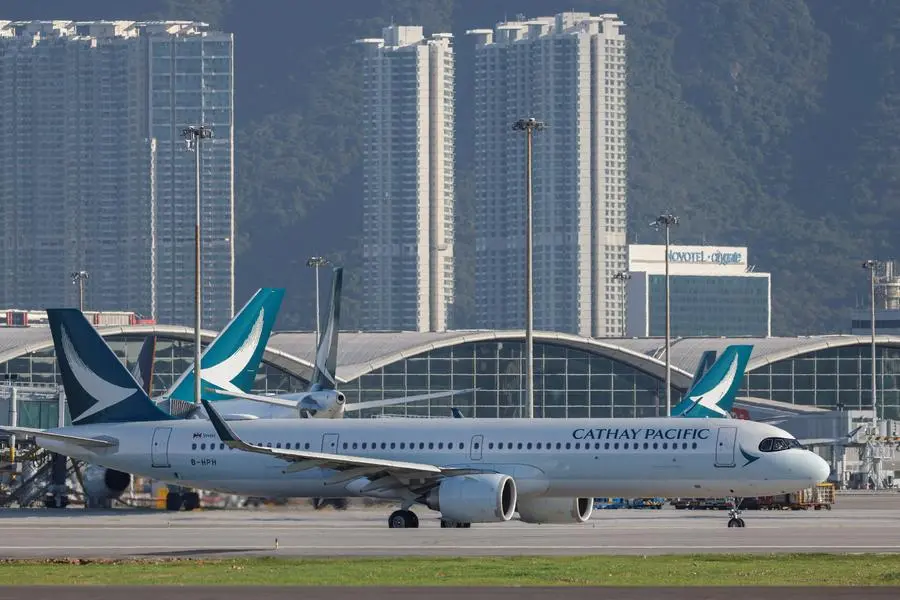
SEATTLE - Cathay Pacific Airways is for now sticking with its plan to expand passenger capacity by 10% this year even as the conflict in the Middle East drives jet fuel prices higher, but that could change if demand declines, its CEO said on Monday.
So far, the Hong Kong-based airline has seen higher demand for its long-haul flights to North America, Europe and Australia since the U.S.-Israeli conflict with Iran began last month and significantly reduced traffic through the Middle East, Cathay CEO Ronald Lam told Reuters.
But he said passenger and cargo demand was not going to be in a "sustainable situation" if the jet fuel price remained double its pre-conflict levels for too long.
"If demand falls off and our (cost mitigation) is not enough, we might need to consider cutting back some capacity," Lam said at an event in Seattle celebrating the airline's new Seattle-Hong Kong service.
"We should try all the means to keep our flights going, and cutting back on capacity will be the last resort, and so far, we haven't resorted to that yet," he added.
Carriers including United Airlines, Scandinavia's SAS and Air New Zealand have announced capacity cuts since the Middle East conflict led to a surge in jet fuel prices.
Cathay has reacted to higher oil prices by lifting fuel surcharges twice this month, and from Wednesday a return trip from Sydney to London will attract an $800 fuel surcharge, a significant addition to the ticket price.
Analysts have said low-cost carriers could struggle the most with high fuel prices given their passengers are more price-sensitive and could cut back on flying as higher oil prices hit household budgets.
But Lam said it was too early to tell whether raising ticket prices would hurt demand at Cathay's budget airline HK Express.
Cathay is growing capacity in part by taking deliveries of new planes. It has orders for 100 aircraft, including 65 Airbus passenger and cargo jets and 35 Boeing 777-9 widebody jets.
The Hong Kong airline is the third-largest customer for the 777X model, which is six years behind schedule with the first delivery slated for next year.
U.S. regulators approved the plane moving into the fourth phase of certification testing on March 18.
"When Boeing finally delivers our 777-9 in 2027, I believe, I hope, that aircraft will be our flagship aircraft," Lam told attendees at Monday's event.
Mention of the 2027 target date drew light laughter from the crowd.
(Reporting by Dan Catchpole in Seattle; Additional reporting by Mrinmay Dey in Mexico City; Editing by Jamie Freed)