The list of the largest financial institutions in MENA based on The Banker data reveal a tough year for regional banks and how they still lag in many areas compared to their global peers.
The number of Middle East banks in the 2011 edition of The Banker Top 1,000 World Banks 2011 slipped to 83 from 90 in the 2010 rankings.
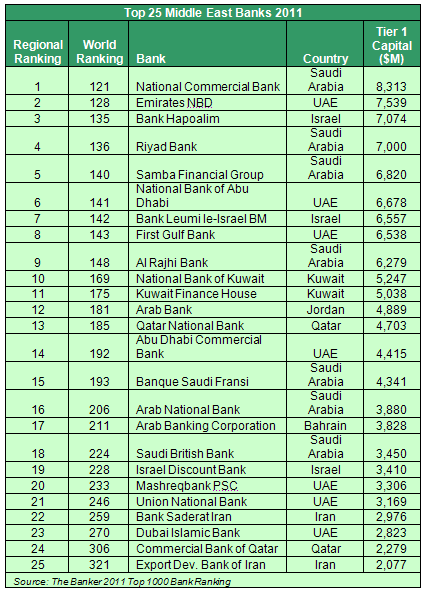
Saudi Arabia's National Commercial Bank retained its position as the region's biggest bank in terms of Tier 1 Capital with $8.313 billion, but it is only the 121st biggest bank in the world, according to The Banker rankings. Still, NCB improved its overall position of 126th last year.The Banker uses Tier 1 Capital as a measure of a bank's ability to lend on a large scale and endure shocks.
The UAE's Emirates NBD was second in the region, maintaining its position as the second biggest bank in the region in terms of Tier 1 Capital.
The UAE had the largest number of banks within the region in the survey, reflecting its status as a regional financial hub with 15 entries. However, seven of the 10 Saudi banks in the survey were in the Top 25 Ranked Banks In the Middle East region. The 2011 Top 1,000 banks only includes banks for which The Banker held 2010/2011 year-end data by its deadline of May 31, 2011.
Globally, the region now accounts for 3.32% of total Tier 1 capital for the 1000 banks in this year's rankings, down from 3.58%, says The Banker.
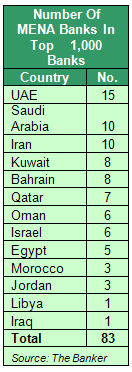
Banks based in the GCC accounted for 54 of the total Middle Eastern banks in the overall ranking and, 19 of the regional top 25, the ranking shows.
"With an increase in Tier 1 capital of 45.32%, Bank of Beirut was the Middle East's highest mover, reflecting strong growth in the Lebanese banking sector," The Banker report says. "By contrast, Abu Dhabi Commercial Bank suffered the most severe drop in Tier 1 capital among all Middle East banks. It fell 5.18% to the current figure of $4.41bn and dragged the bank down to 192nd position in the Top 1000 ranking, from last year's 167."
An Iraqi bank made its debut for the first time in the yearly ranking - Trade Bank of Iraq came in at number 418, suggesting how the country is slowly coming back into the international fold.
Egypt emerged as the fourth most profitable country in the world for banks. Meanwhile, Qatar emerged as the fifteenth most profitable country in the world for banks.
Lebanon topped the list for ultra-low loan-to-deposit ratios, while Egypt emerged second among all countries.
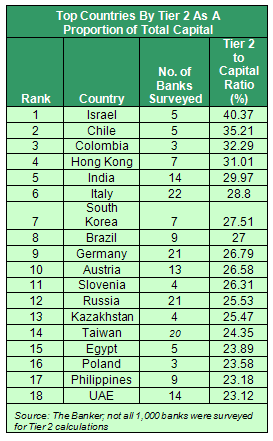
Interestingly, Egypt had the highest Tier 2 Capital as a proportion of total capital in the region, with the UAE not far behind. Both countries are in the 'top' 20 in this category with Egypt at number 15 and the UAE at 18th.
New entrants from the Middle East in the Top 1000 declined from five in 2010 to only two this year, although the Trade Bank of Iraq makes an appearance. The Baghdad-based bank, which was not included in last year's Top 1000, debuted in at 418th in the overall ranking, having grown to be the country's largest financial institution since its US-sponsored establishment in 2003.
"While Middle Eastern banks are hardly experiencing explosive growth, there are some reasons to be positive," notes The Banker. "Qatar, UAE, Jordan and Kuwait are all safely within the top 10 cost-to-income ratios by country. Similarly, the regional average climbed just 0.04% (from 41.33% to 41.37%) despite operating costs increasing by an average of 9.41%, indicating substantial increases in profits."
Global Dominance
Globally, Bank of America was the world's largest bank according to The Banker ranking, which dramatically, also endured the fourth largest loss last year among the banks ranked.
But other American banks saw massive improvements, With Citigroup, Bank of New York Mellon, State Street and other returning to profit.
Overall, JP Morgan was second, HSBC third and Citigroup was ranked as fourth largest bank in the world in terms of Tier Capital 1.
However, figures from the Eurozone paint a worrying picture.
Profits in the EU rose 84%, and non-performing loans (NPLs) jumped by 54% - compared with less than 20% in the US.
"Of the 10 countries where the largest declines in total assets took place, all were in the EU except Andorra, and all but three were in the eurozone. Meanwhile, in the UK Tier 1 capital and assets both fell. Among the top 25 banks worldwide, all UK and eurozone banks slipped in this year's ranking, except for the heavily Asia-focused HSBC - with Société Générale and Intesa Sanpaolo sliding out of the top 25 altogether."
At the other end of the spectrum Chinese banks saw their assets grow by 44% in 2010, and had 101 banks in the Top 1,000 Banks ranking, showing their rising dominance in global financial circles.
© alifarabia.com 2011