Private equity, sovereign wealth funds and governments of food-importing countries are buying up land to secure food supplies. For good reason: farmland could generate returns of up to 30% annually.
At the height of the global economic boom in 2005, when regional and local stock markets were booming and Dubai real estate and leveraged buyouts were in fashion, this writer asked a senior official of one of the world's largest bank: where should one invest in?
"Agricultural land," he answered without hesitation.
Indeed investment banks have been advising their regional sovereign wealth fund, private equity and corporate clients to buy up land for some time now.
And their clients have taken the advice to heart, especially as food prices have been rallying and that has led to revolt and unrest in many Arab countries.
Regional governments are worried about the impact of food prices on stability in their countries, as some estimates show that over a billion people across the world go hungry at night. Such a statistic could only lead to trouble and a restive population.
While countries such as Egypt and Tunisia are struggling to meet their citizens rising food demands, the richer Gulf states are buying up land in other countries to secure food supplies and gain agricultural exposure.
It is estimated that 445 million hectares of land are uncultivated and available for farming, compared with about 1.5 billion hectares already under cultivation, oh which about 201 million hectares are in sub-Saharan Africa, 123 million in Latin America, and 52 million in Eastern Europe.
"In 2009 alone deals finalized or under negotiation involved at least 56.6 million hectares," write Rabah Arezki, Klaud Deininger and Harris Selod in a study for the World Bank. "Most were in Africa, where deals totaled 39.7 million hectares--more than the combined agriculturally cultivated areas of Belgium, Denmark, France, Germany, the Netherlands, and Switzerland."
Compared to an average annual expansion of global agricultural land of less than 4 million hectares before 2008, approximately 56 million hectares worth of large-scale farmland deals were announced even before the end of 2009. More than 70% of such demand has been in Africa; countries such as Ethiopia, Mozambique, and Sudan have transferred millions of hectares to investors in recent years.
BUT IS IT LAND GRAB?
There are hundreds of studies proclaiming that the investment of foreign countries in poorer countries' agricultural resources is nothing but a land grab that encourage short-term profits at the expense of small farmers and environmental sustainability.
In Madagascar the government fell in 2009 after news reports that it intended to transfer 1.3 million hectares to a South Korean company for free.
Recent press and other reports about actual or proposed large farmland acquisition by big investors have raised serious concerns about the danger of neglecting local rights and other problems. They have also raised questions about the extent to which such transactions can provide long-term benefits to local populations and contribute to poverty reduction and sustainable development, notes the authors.
But it does not present the full picture.
Foreign investors could help the country in many ways. The countries with sizable agricultural sectors with many rural poor, better access to technology and markets, as well as improved institutions to improve productivity on existing land and help judiciously expand cultivated area, could have big poverty impacts.
"Governments can help to promote this agenda by identifying strategic priorities to assess ways to bring productivity closer to the potential and to identify whether, given available resources and necessary trade-offs, large-scale investment could help generate employment, improve food security, and foster technology transfer and local development," notes the World Bank study.
This could include identification of public infrastructure or technology investments that could complement private sector efforts through a participatory process of land use planning. Such a process would also provide valuable information to landholders when deciding whether they want to transfer land to investors.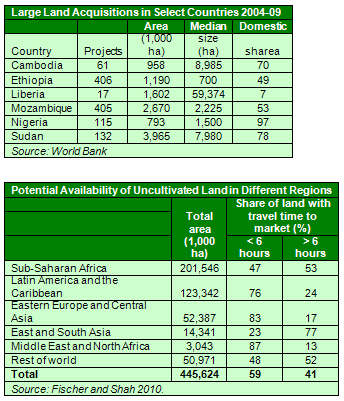
DECLINING ARABLE LAND
With sustainable, respectful and transparent dealings in agricultural lands, Gulf investors can participate in a fertile investment area.
The statistics are surely compelling: as the global population rises from 7 billion today to 8.3 billion by 2030, the world's arable land is dwindling fast.
The average person consumes 2,780 kcal per day but the average masks a significant gap between the developed and the developing world. Whereas people in developed countries consume 3,420 kcal per day, people in developing countries consume no more than 2,630 kcal per day. By 2030 the average calorie intake is expected to have risen to 3,050 kcal per day, driven primarily by rising living standards in developing countries, notes Niels C. Jensen in the Absolute Return.
"Should investors be exposed to agriculture in the first place? - is an unequivocal 'YES'. Arable land is a finite resource and so is water," says Jensen. "Demand on existing resources will be immense over the next few decades as living standards increase around the world. In the long run it is very hard to be pessimistic on grain prices."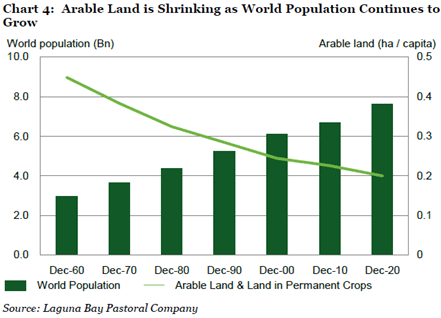
Growth from places like China, India, and other emerging markets will make huge demands on existing agricultural lands.
"If you can stomach the cyclical nature of this asset class, I find it hard to envisage an environment where the returns do not comfortably outpace returns on bonds and equities when looked upon over the next 5-10 years," says Jensen.
The investment advisor recommends taking a 10-year view.
"Importantly, farmland prices do not need to appreciate for this to be a good investment. The best farmers in Australia generate cash returns in excess of 10% at current crop prices and we hear anecdotal reports of 25-30% annual returns in some countries in Africa. That is obviously very attractive when compared to more traditional commercial property investments."
alifarabia.com 2012