Natural gas importer UAE is working on a number of projects that could boost the country's natural gas production significantly over the next several years, according to a new report by the Energy Information Administration (EIA), the research and statistical arm of the US Department of Energy.
The UAE has the seventh largest proven natural gas reserves in the world, at 215 trillion cubic feet and remains a significant natural gas producer of 1.9 trillion cubic feet last year. But rapid economic development meant the country has been a natural gas importer since 2008.
While dry natural gas production in the country has risen at an annual rate of 1.6% over the past decade, demand rose at a staggering 5.3% during the same period.
"The UAE's natural gas has a relatively high sulfur content that makes it highly corrosive and difficult to process," said the EIA, noting that for decades, the country simply flared the gas from its oil fields rather than undertake the extensive - and expensive - processes associated with separating the sulfur from the gas.
"The technical difficulties of producing the country's sulfur-rich (sour) gas once posed a great impediment to the development of the UAE's reserves, but advances in technology and the growing domestic demand for natural gas make the country's vast reserves an enticing alternative to Qatari imports."
IN THE PIPELINE
Among the projects that could substantially raise UAE natural gas production include the Bab field which could potentially take output from its current level of 1.2 billion cubic feet per day (bcfd) to 2.4 bcfd by 2018.
The Integrated Gas Development (IGD) project, featuring GASCO, ADGAS and ADNOC and foreign partners Royal Dutch Shell, Total SA and Partex Oil & Gas are working to develop the Habshan-5 project that could produce 1 billion cubic feet per day.
"The USD 10 billion IGD project includes plans for a 1 billion cfd pipeline to bring non-associated gas from Khuff reservoirs beneath Umm Shaif and Abu al-Bukhoosh oil fields to the Habshan gas complex," the EIA said. "Habshan's units 1-4 can currently provide approximately 2.4 bcfd of natural gas for reinjection and 1.3 bcfd of marketable natural gas. The Habshan-5 facility should be operational by the end of 2013."
Two new gas processing plants offshore on Das Island could also produce 200 million cubic feet per day of associated gas.
ADNOC is also venturing boldly to develop sour-gas Shah field, which has been technically a problematic enterprise. But the arrival of Occidental Petroleum has raised the project's prospects and the field may start producing 540 million cubic feet per day of natural gas and 500,0000 barrels per day of natural gas liquids by 2015.
"Beyond the Shah development, ADNOC is working with US-based Occidental Petroleum on new developments at the Jarn Yaphour and Ramhan fields. That concession was the first in Abu Dhabi in nearly 50 years and could produce more than 100 Mcf of natural gas per day."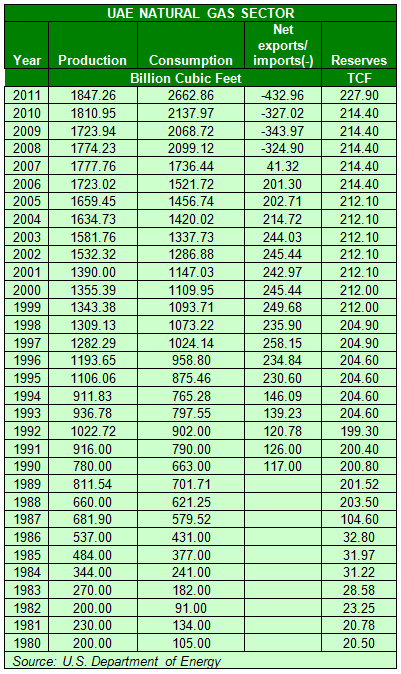
LNG EXPORTER
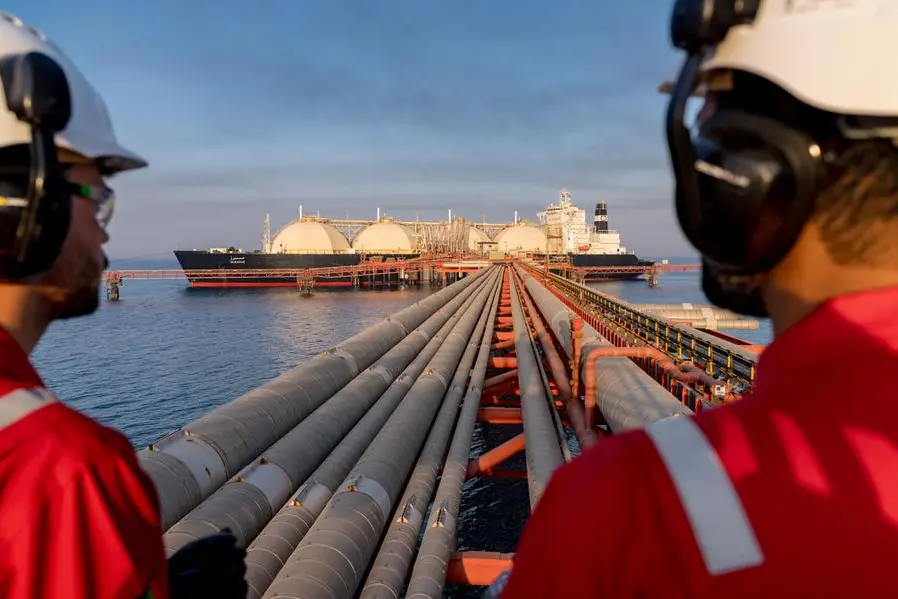
The UAE had the proud distinction of being the first Gulf state to export liquefied natural gas (LNG) with its first export heading to Tokyo Power Company as early as 1977.
The country has since substantially raised LNG exports to Japan, and the terminal at Das Island has a current capacity of 6 million tons per year of LNG, 2.7 million tons per year of liquefied petroleum gas and nearly 1 million tons per year of associated products.
"Plans are moving forward to increase the capacity of the first two LNG trains substantially - reportedly by up to 10 million tons per year (788 MMcf) - and they should come on line around the same time the contract with TEPCO expires (2019)," the EIA said.
However, the International Energy Agency notes that rapid domestic demand may curtail many Middle East nations' desire to export LNG.
"Among some of the existing exporters, there are already signs of rapidly increasing domestic demand limiting supply for export. The United Arab Emirates will need to decide whether to do likewise when the current contract to supply LNG to Japan from a plant in Abu Dhabi terminates in 2019."
The UAE is also moving quickly from hydrocarbon-based electricity to renewable and alternative energy. Construction is already under way on two of four nuclear units planned, and the country is also focused on developing solar and wind projects, which has the potential of freeing up oil and natural gas products for export purposes.
OIL PRODUCTION
The US Department of Energy is less bullish on the UAE's oil production growth. 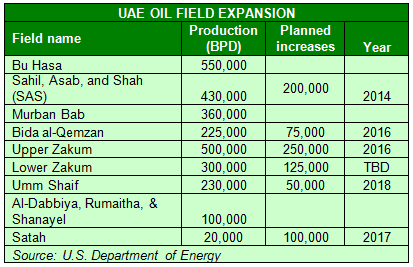
"The United Arab Emirates appears unlikely to meet a three-million-barrel-per-day crude oil production target by the end of 2013," the report noted. "Further, the country may push back a longer-term 3.5-million-barrel-per-day target until the end of the decade."
The International Energy Agency agrees, estimating a 3.3 million bpd production capacity for the UAE by 2020. The agency believes the UAE, like Saudi Arabia and Qatar, may slow investments in hydrocarbon sector due to the US shale revolution, at least in this decade.
While the UAE has had limited success in major discoveries in recent years, hopes are pegged on the Zakum Petroleum System, which energy consultant IHS believes could contain as much as 65 billion barrels of recoverable oil.
ADNOC, Exxon Mobil and Japan Oil Development operate the 550,000 bpd project, and the parties are working to expand its production to 750,000 bpd by 2016.
Abu Dhabi remains the center for reserves and new production, while other emirates further falling behind in development of their already small contribution to the hydrocarbons' sector.
"Exploration and production in the other emirates is limited, with reserves nearly exhausted and the cost of recovery continuing to climb," the EIA noted.
© alifarabia.com 2013