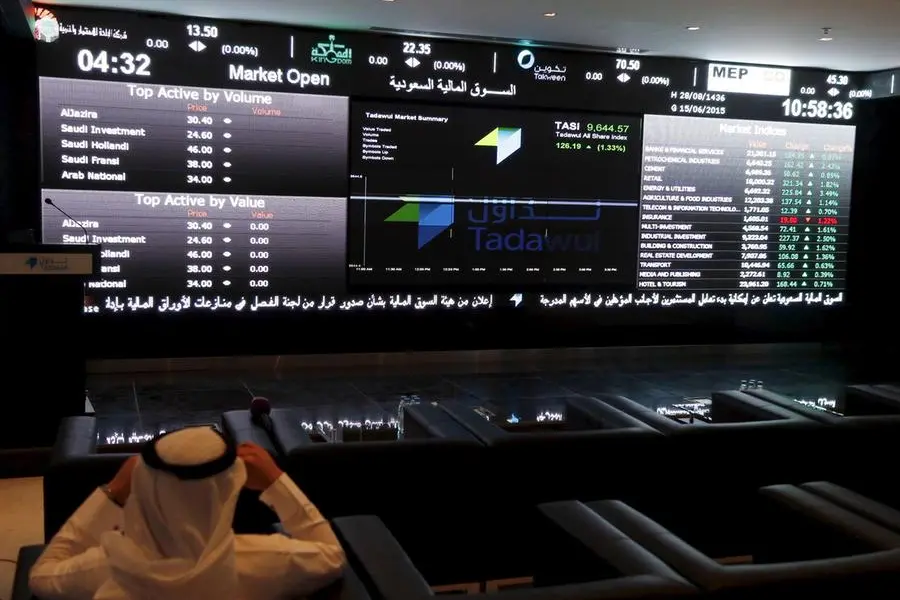
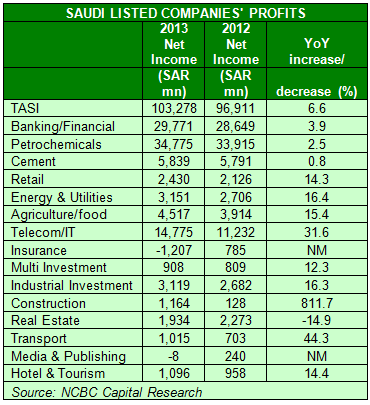
Profits of Saudi companies exceeded SAR 100 billion (USD 27 billion) for the first time ever last year, according to National Commercial Bank data.
Petrochemicals giant Sabic accounted for around a quarter of profits among Saudi companies listed on the Tadawul, and the petrochemicals sector as a whole accounted for around 33% of total profits.
The banking sector contributed around 28% of profits last year, while telecom sector was a distant third with around 14% of total TASI profits.
Even as overall profits grew by 6.6% compared with the same period last year, construction sector posted a mammoth 811.7% improvement in profits.
The Saudi economy grew by a comfortable 3.8% last year, although lower than the 5.8% growth rate achieved in 2012. The 2013 performance is impressive as it was primarily driven by the non-oil sector, which rose 5.1%, compared to a slight contraction in the oil sector.
Overall though, growth has pared from the heady days of 2012 and 2011 when oil prices were rising and the authorities announced a raft of new projects.
Saudi bank Samba expects the non-oil sector to also see a decline in capital spending.
"2013 data have not yet been disaggregated between current and capital spending, but we think that capital spending probably shrank again, this time by a more modest 2% (the fact that the authorities are projecting a balanced budget in 2014, rather than a surplus as in recent years might also be indicative of a more cautious approach to public spending," James Reeve, an analyst at Samba, wrote in a report on the kingdom.
PROFITABILITY SET TO DWINDLE
While no one is suggesting a dramatic fall in growth, the slower spending spree is also set to lower profitability of Saudi corporations in 2014.
The Saudi petrochemicals sector, which had seen prices decline last year, now has to contend with falling growth in key emerging markets such as China and India.
NCB expects prices to increase marginally year-on-year in 2014 with higher demand the key driver of revenue growth in the sector.
"This coupled with contribution from the start-ups of Sahara, Tasnee and Sipchem as well as improved operational efficiencies at existing plants are expected to drive earnings," wrote NCB analyst Iyad Ghulam.
"However, fertilizer prices are expected to decline due to rising supply from China and the MENA region in addition to the Russia-Ukraine gas agreement."
The Saudi banking sector enjoyed moderate profit growth of just under 4% last year, but may also see lower growth as higher provisioning eat into profits.
"Credit growth slowed down in 2013 after growing at a faster pace in 2012," noted Al Rajhi Bank. "The total credit grew by 12.5% year-to-date through November as compared to 16.4%. Sectors such as electricity witnessed a decline in credit in year-to-date terms, whereas credit to services sector witnessed only a marginal gain in 2013. Credit to the construction sector also moderated."
Analysts are cautious as credit growth is set to moderate even further.
REAL ESTATE WOES
The promising real estate sector, which was widely expected to boom as housing became the number one priority, saw overall net income decline 15% year-on-year, as key corporation Dar Al Arkan saw its earnings decline 31%.
However, NCB believes recent government initiatives such as "Ejaar" and "Land and Loan" programs, would trigger a surge in activity.
The cement sector also disappointed, rising up 0.8% last year, but is poised for strong progress as new projects get under way in the New Year.
"Our main concern for the sector in the short term is the slowdown in construction due to labor shortages," said NCB.
"This has negatively impacted 4Q13 results and we expect a similar impact on 1Q14, although less pronounced. Thus, we expect 1Q14 to be relatively weak vs. the usual trend of the first quarter of the year being the strongest. Based on our discussions with various market players, we believe this situation will noticeably improve from 2Q14 onwards."
Saudi corporations are expected to see moderate growth this year, although events could take a turn for the worse if emerging market woes weighs down crude prices, or dampens global business sentiment.
The Saudi authorities will also be keeping a sharp eye on oil breakeven prices, which would determine their pace of investments, and influence the profitability of the Saudi corporate sector.
PRUDENCE IS NAME OF THE GAME
Bank of America Merrill Lynch estimates that Saudi Arabia's current budgetary breakeven oil price stands at USD 85 per barrel.
"This assumes production of 9.5 million bpd, broadly flat to last year. Based on that, we estimate production could drop as low as 7.8 million bpd before expenditures overtake revenues at current Brent prices," said Shin Kim, analyst at BAML. This would be the lowest level of annual production since 2002."
While such a dramatic production cut is unlikely, it does showcase the wriggle room Saudi authorities have before lower prices start to hurt the economy.
Regardless, the government is becoming increasingly prudent, after spending heavily on large wage increases, perks and bonuses in recent years.
"Barring an unlikely sustained upward shift in oil prices, the lavish government outlays that marked the past decade are unlikely to be repeated in the next few years," Samba economists noted.
"This is hardly a time of austerity, but public spending is set to be more restrained and better sequenced and targeted. At the very least, this should help to improve the efficiency of public spending, while helping to set the country on a path of long-term fiscal sustainability."
The tightening of the purse strings will no doubt be felt by Saudi corporations, all of whom rise and fall depending on the spending trajectories of the government.
The feature was produced by alifarabia.com exclusively for zawya.com.
© Zawya 2014