A project to connect eight landlocked Central Asian states to the rest of Asia and Europe is renewing Cold War rivals between the United States and Russia.
The Central Asia Regional Economic Cooperation (CAREC) program, supported by the United States and other institutions, aim to facilitate transportation links and economic trade between Central Asia and its neighbors on all sides.
"Increasing integration between the People's Republic of China (PRC) and Japan to the east, the Russian Federation to the north, and India and Pakistan to the south, is leading to unprecedented opportunities for Central Asian countries to grow," a CAREC report boasts. "CAREC is helping make that growth happen by facilitating regional transport, trade, and energy infrastructure, as well as by coordinating trade policy."
Six trade corridors are in various stages of completion, which expands Central Asia's reach to as far away as the Gulf States via Iran, the energy-hungry countries of Europe, Asian giants China and India and Gwadar Port in Pakistan.
"The deepening regional trade links are also opening up previously unexploited resources, including huge energy resources. Infrastructure rollout has increased the mobility of people and goods, and laid the foundation for ongoing improvements in living standards of 300 million people across Central Asia's vast geography," CAREC states in a report.
More than USD 19.6 billion has been invested in multilaterals effort to link Afghanistan, Azerbaijan, China, Kazakhstan, Kyrgyz Republic, Mongolia, Pakistan, Tajikistan, Turkmenistan and Uzbekistan. More than 4,000 kilometers of roads and 3,200 kilometers of rail has been built or revamped. In addition, more than 2,300 kilometers of power transmission lines have been built, CAREC notes.
The program has some serious backers such as the Asian Development Bank, European Bank for Reconstruction and Development, the International Monetary Fund, World Bank, Islamic Development and the United Nations Development Programme.
A notable absentee from this program is Russia, which fears that a robust trade corridor will liberate Central Asia from its clutches, and Moscow will lose its influence, especially as China is also looking to build railway links to Central Asia.
"According to analysts at the Moscow Strategic Culture Foundation, these overlapping transportation development projects threaten to spark a new "railroad war" in the Central Asian region--one that in the absence of counter-efforts by the Russian Federation is likely to result in a sharp reduction of Moscow's influence over the countries there," wrote Paul Goble, an analyst at the Jamestown Foundation, in a note.
Bolstering regional trade ties
Regardless, the projects are moving ahead, as funds pour in from the six multilateral institutions. The Asian Development Bank recently approved a USD125 million loan to rehabilitate an important road link that connects Kazakhstan's industrial city of Shymkent and Tashkent, the city capital of Uzbekistan.
"Expected to be finished in late 2016, the whole Shymkent-Tashkent road will help promote closer regional cooperation and increased trade along CAREC Corridor 3," CAREC said in a statement.
"This corridor runs from the Russian Federation through Afghanistan, Kazakhstan, the Kyrgyz Republic, Tajikistan, and Uzbekistan, to the Middle East and South Asia. It intersects with Corridor 1, which links Europe to the People's Republic of China and East Asia."
The United States is also working with Afghanistan authorities to link the battle-ravaged country to the regional corridor.
An Afghan Rail Authority was set up in September 2012 and the US Central Command is helping develop a National Rail Plan.
"Recent estimates suggest that if Central Asia were to carry out basic improvements in transport systems heading south to Afghanistan, overall trade would increase by up to USD 12 billion, reflecting growth of 80%," the Asian Development Bank said in a report on the program.
"The volume of inland transported cargo replacing sea transported cargo via the Suez Canal is expected to double between 2002 and 2015... the United Nations estimates that GDP will be 50% higher across all Central Asia within a decade of continued cooperation. These prospective benefits are far too significant to ignore."
"Toktogul Kakchekeyev, a Bishkek security analyst, argues that China and the United States are already cooperating to a certain extent, a clear indication in his mind that the two are working against Russian interests in the region," said Jamestown's Goble. "'For the Americans,' he insists, 'a railway network in Afghanistan is a political instrument for isolating Central Asia from Russia.' To counter that, he suggests, Moscow must develop its own rail links with the region."
Either way, for once it appears that Central Asia may benefit from the global powers' battle for influence in the region.
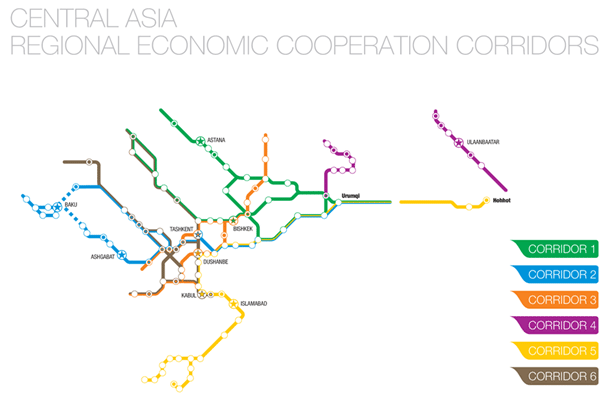
CAREC 1: Europe-East Asia (Kazakhstan, Kyrgyz Republic, and Xinjiang Ugur Autonomous Region of China)
CAREC 2: Mediterranean-East Asia (Azerbaijan, Kazakhstan, Kyrgyz Republic, Tajikistan, Uzbekistan and Xinjiang Ugur Autonomous Region of China)
CAREC 3: Russian Federation-Middle East and South Asia (Afghanistan, Kazakhstan, Kyrgyz Republic, Tajikistan, Uzbekistan)
CAREC 4: Russian Federation-East Asia (Mongolia, Xinjiang Ugur, and Eurasia)
CAREC 5: East Asia-Middle East and South Asia (Afghanistan, Kyrgyz Republic, Tajikistan, and Xinjiang Ugur Autonomous Region of China)
CAREC 6: Europe-Middle East and South Asia (Afghanistan, Kazakhstan, Tajikistan and Uzbekistan)
© alifarabia.com 2013