Oil prices will rise higher as global economy prospects improve over time. However, dramatic shifts and spikes could upset the fragile recovery and have unintended consequences which could lead to greater demand destruction for fossil fuels altogether, much to the dismay of oil exporters who are investing heavily in fossil fuels.
The world could experience a period of significant volatility, with oil prices leaping upward and oscillating between $125 and $175 a barrel for some time.
But don't get the Saudi champagne out just yet as it may not translate into petrodollars flowing into the Gulf coffers.
Global consultancy firm McKinsey notes that once of the prospects of the global economy improve, oil prices will shoot up dramatically.
"The resulting economic pain would be significant. Economic modeling by our colleagues suggests that by 2020, global GDP would be about $1.5 trillion smaller than expected, if oil prices spiked and stayed high for several years," notes McKinsey Tom Janssens, Scott Nyquist, and Occo Roelofsen.
If crude-oil prices rose to $125 or $150 a barrel and stayed there long enough--for years, not months -- global growth would undoubtedly suffer.
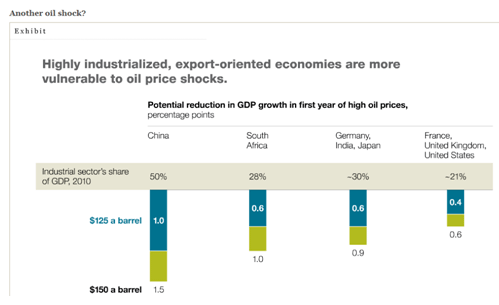
Indeed, McKinsey estimates that this type of shock would drive down global growth by 0.6 to 0.9 percentage points in the first year. Over time, as economies adjusted to the new higher prices (and shifted to different types of fuel, technologies, and production techniques) the impact would diminish. But the rate of global GDP growth would be affected for years. By 2020, the global economy would be between $1.1 trillion and $1.7 trillion smaller than the baseline outlook: the equivalent of losing Spain's or Italy's output for a year.
"A sustained growth drag of that magnitude would be serious, particularly for Europe and the United States, which are already suffering from sluggish recoveries and lingering unemployment. It could contribute to a double-dip recession in those markets and to trouble in the global economy as a whole, which also is fragile and faces other potential shocks, including sovereign-debt defaults, inflation in emerging markets, and problems in the Chinese financial sector."
Some of the biggest economies will get hurt in the process: Crude at $150 could shave off 1.5% in GDP growth in China, and nearly a per cent of India, Germany and Japan. In the United States, it would wipe out 0.6% of the GDP.In such a scenario, expect many consuming countries to be innovative and put in place legislation that leads to greater energy efficiency. Technological innovations are already evidenced in transportation.
"The automotive industry, boxed in by fierce global competition and flat prices, has responded in the past by pushing design improvements and productivity gains that make room for costly new content, including technology required for meeting regulatory standards," notes McKinsey.
For example, if you adjust for inflation the cost of a 2001 Toyota Camry, you see that by 2010, the price of the car to US consumers had actually dropped by $2,500 in real terms--although the 2010 Camry was better equipped and 10 percent more fuel efficient.
Driven to despair
Stricter regulatory standards will also play a key role. The EU's carbon emissions rules, for example, require annual improvements of 6% a year between 2015 and 2020. This implies that new cars driving on European roads will consume 40% to 50% less fuel in 2020 than they did in 2010. Regulators in China, Japan, and the United States are also eyeing ambitious rates of improvement, albeit from different starting points. US fuel economy levels in 2020--at around 40 miles a gallon--would lag behind China's in that year and simply match Europe's 2010 levels.
HSBC, the global bank which did an extensive study on the world's energy needs by 2050, argues that transportation is a matter of choice and consumer behaviour.
"Areas of the developed world where the population is just as widely spread as towns in the U.S. still use considerable less energy for transport.
"Australia provides a clear example. It is entirely clear why this is the case although the social 'acceptability' of public transport probably plays an important role. It might be a little less comfortable, but it is absolutely possible."
Here in the Gulf, we are all too familiar with expatriates and nationals shunning the perfectly reliable Dubai Metro and prefer their own private vehicle.
"There is also the possibility of moving away from the combustion engine and electrifying the car fleet," HSBC says. "Electric vehicles (EVs) themselves are more energy efficient than traditional cars. Of 100 units of energy put into a car, only 14 of them are used to propel the car in motion. For electric vehicles this doubles to 28. We expect EVs to play a major role in decarbonising the economy but at present there are two major problems with widespread implementation of EVs - cost and network infrastructure."
Still, there has to be a quick and sustained move towards electric vehicles. Opec's World Oil Outlook estimates that there will be 1.66 billion cars in the world, double than the 845 million in 2008.
In line with recent developments, and its huge growth potential, China sees the most dramatic rise, from just 27 cars per 1,000 in 2008 to 194 per 1,000 by 2035, similar to the rate seen in Western Europe in 1974, and the OECD Pacific in 1982, notes OPEC.
"Transition economies see a rapid rise in car ownership too, from 125 per 1,000 in 2008 to 379 per 1,000 in 2035. Latin America and Southeast Asia also rise to considerably higher ownership rates but ownership in South Asia and Africa will still only be around one car per 20 people in 2035. The OPEC car ownership rate almost doubles, from 68 to 128 per 1,000."
SHRINKING BUFFER
While oil prices have typically remain contained at three to four million barrels per day, if that buffer shrinks, prices can rise--sometimes dramatically.
"That's what happened prior to the 2008-09 financial crisis as surging emerging-market demand strained production capacity and prices approached $150 a barrel. This fly-up was short lived because the ensuing deep recession wiped out between three million and four million barrels a day of demand, sending oil prices sharply down," McKinsey warns.
Similarly, the Libyan oil shutdown saw prices shoot back up to $120 despite fears of a recession. Imagine, how prices would react when the global economy starts to rebound.
CAN DEMAND MEET SUPPLY?
It's not that we are running out of oil. Studies show there is at least a trillion barrels of conventional oil beneath the earth's surface, apart from the several trillion more barrels of oil or gas that could be extracted through unconventional sources, such as oil sands.
But it's becoming harder to produce oil cheaply and new explorations are in inconvenient locations - deep under the sea, landlocked areas and inaccessible places in the Arctic and the hinterlands of Russia and Canada.
"Our current projections suggest that in a "business as usual" scenario, the world could reach a realistic supply capacity of around 100 million barrels a day by 2020, up from 91 million or 92 million today," notes McKinsey. "That, however, would barely suffice to meet the roughly 100 million barrels of liquids the world would consume each day in such a scenario, up from 88 million or 89 million today."
GRIM SCENARIO
While a steady rise in crude prices would result in greater legislative changes and acceleration in development of new alternatives, a ferocious spike could send the global economy in a tailspin:
1 It would hit global growth, which would curtail oil demand.
2 People will change the way they use car, sea, air and sea travel. This has already entered the corporate psyche where video-conferencing has replaced face-to-face and business executives have been asked to downgrade to economy class or take fewer but slightly longer trips to cram more meetings.
3 If the spike lasted longer, it could cause several more structural shifts, such as prompting individuals to use different modes of transport or even to look for work closer to home, encouraging companies to reverse offshoring trends and bring supply chains closer to home, accelerating the substitution of videoconferences for air travel, and pushing the freight transport industry to adopt less oil-intensive modes.
4 A price spike of one to three years could be long enough to make governments raise standards for fuel efficiency at an accelerated pace and prompt automakers, reacting to regulatory changes, to modify their product-development road maps. Ultimately, all this would lead to more rapid efficiency gains and potentially to faster electric-vehicle penetration.
5 A prolonged price spike also could prompt investments in infrastructure needed to support the use of electric vehicles or other alternatives (such as natural gas and hydrogen) to traditional fuel sources. Such investments could have an impact on oil demand for trucking, light vehicles, and shipping.
6 Very high oil prices would intensify energy efficiency efforts up and down the supply chain and reduce the amount of plastics used in packaging, thus shrinking demand for oil in chemicals. Additional government action, in the form of either more stringent regulation on the use of plastics or subsidized financing that reduced the up-front cost to consumers of switching away from fuel oil in residential heating, could play an important role in this transition.
7 Expanded supply would also play a role in pushing prices down. From now to 2020, OPEC could increase its capacity by, say, two million barrels a day above currently assumed increases, and new investments in mature assets could slow decline rates, leading to an additional one million to two million barrels of daily production.
8 Additional investments in unconventional oil sources, such as oil sands, could increase supply by, say, one million to two million barrels a day. Biofuels, too, would have room to grow. But given the time it would take to pursue some of the available opportunities--and the danger that they could quickly become uneconomic once oil prices fell--the supply response is likely to be slower and more muted than that of demand.
"In the end, once all the efficiency gains and supply expansions described above kicked in, the world could again wind up in balance and with significant excess capacity, so that eventually--perhaps by 2020, perhaps later--prices fell below the $80 to $100 range. Until then, however, given how slowly many of the demand changes would unfold, it's only prudent to imagine the possibility that the world could experience a prolonged period of both significant volatility and generally much higher prices," notes McKinsey.
CONCLUSION
The prospects of a surge in not just oil, but other commodities is real. With western countries distracted with their economic woes and emerging economies reluctant to put the brakes on their growth, we appear to be heading for years of great imbalances leading to more shocks, spike, booms and busts in a very volatile way.
© alifarabia.com 2011