Oil and gas workers in some Middle Eastern countries have some of the lowest wages compared with energy sector salaries around the world.
Libya, a member of the Organization of the Petroleum Exporting Countries (OPEC), paid an annual salary of USD 36,000 -- the lowest among major producers.
Bahrain, which produces around 140,000 bpd, but is not an OPEC producer, paid local workers even less -- USD 34,000 per annum, according to Hays Oil & Gas survey.
Even OPEC stalwarts Saudi Arabia, Kuwait and the UAE paid workers less than their counterparts in places like Brazil, Brunei and Colombia.
Of course, salaries are a function of a number of factors -- including political risk, working conditions and taxation regimes in each country.
And some Middle East and OPEC countries paid foreign workers two times more in some cases. A foreign worker in Iraq could expect to net USD 114,500 per year, compared to his local colleague who would fetch USD 49,100. In the UAE, a foreign oil and gas worker made USD 80,000 per year, compared to USD 65,100 for a local hire.
"We have seen strong business activity in 2013, and as planned projects come on-line, we expect the Middle East to be a hive of recruitment of activity over the next year," said Gary Ward, a director at Hays Oil & Gas.
"The labor market is forecast to remain stable for local candidates but increase for imported talent, as employers look to overseas to source the skills needed to support major projects planned for 2014."
IMPORTED LABOR
The Middle East will need to create a more attractive working environment to pull in skilled oil and gas labor which is in high demand across the world. There is a massive shortage of skilled oil and gas workers, as countries as diverse as China, Brazil, Canada, Angola, United States and Australia seek talent.
Last year saw a pause as oil and natural gas prices remained flat and global oil majors such as Royal Dutch Shell Plc and Exxon Mobil Corp cut back on investments. The Middle East also saw a pullback as unrest in Libya, Iraq, Sudan and other OPEC countries saw modest production growth.
But that's about to change. Given the number of infrastructure and field development projects that are now under way, the expectation for 2014 is for much greater activity, Hays noted.
Some of the national oil firms have launched worldwide recruitment campaigns for the thousands of engineers they expect to require in the near future.
"Growing interest in the Middle East in unconventional resources underlines the general view that the days of easy oil are over. These skills will largely be imported internationally," Hays noted.
Saudi Arabia, Oman and Algeria are experimenting with unconventional resources, and that may require more imported labor, as those skillsets currently do not exist.
"While the Middle East will rely on imported workers for the foreseeable future, there have been government and company efforts to increase the local labor content of the workforce," Hays said.
Hays identified Iran as an area that may attract attention if/once the Western sanctions are lifted. In addition, production ramp up in Libya, Iraq, South Sudan and new regions such as Lebanon may also require more skills.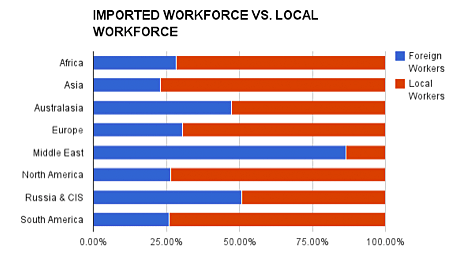
THE GREAT SKILLS SHORTAGE
The Middle East is dependent on imported labor, with foreign workers accounting for 86.5% of the workforce -- the highest level in the world.
The Arab Petroleum Investment Corporation (APICORP) believes MENA's energy investments requirement equals USD 765 billion till 2018, with Saudi Arabia and the United Arab Emirates leading the investment spree.
But these project plans will clash with equally impressive scale of projects elsewhere in the world. The revolutionary unconventional resource production in North America is attracting labor, while Australia, South America and African projects will also require thousands of workers.
"The world's energy demand is expected to increase by 50% in the next three decades, primarily caused by increased requirements in developing nations," said Hays. "Only 50% of the reserves have been developed, which suggests that massive ongoing capital investments will be required in increasingly challenging operating environments."
The demand comes at a time when a new generation of science and technology students prefers to work for software and hardware companies, rather than remote locations on oil and gas rigs.
The worldwide demand for scarce labor is bound to delay projects and raise costs for companies. A third of the oil and gas companies surveyed by Hays said skills shortage was their number one problem.
Just over 30% of Middle East executives also felt that lack of skilled labor was their biggest concern, while only 21% felt economic instability was their top challenge.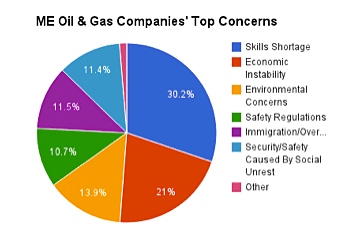
In the Middle East, Qatar and the UAE are still considered to be positive destinations for expats, offering high quality of life, competitive rates, tax breaks "and long-tenured placements to lure expertise out of design hubs like London and Houston," according to a report by Oilcareers.com.
"The concerns over a mass exodus out of the Middle East to LNG hotspots in Australia and Asia Pacific seem to have subsided, with a natural filtering-out of onshore versus offshore LNG expertise. The region continues to attract foreign investment dollars and rates have remained consistent throughout."
But other places such as Iraq, Libya and South Sudan may struggle due to the inhospitable environments and lower pay checks.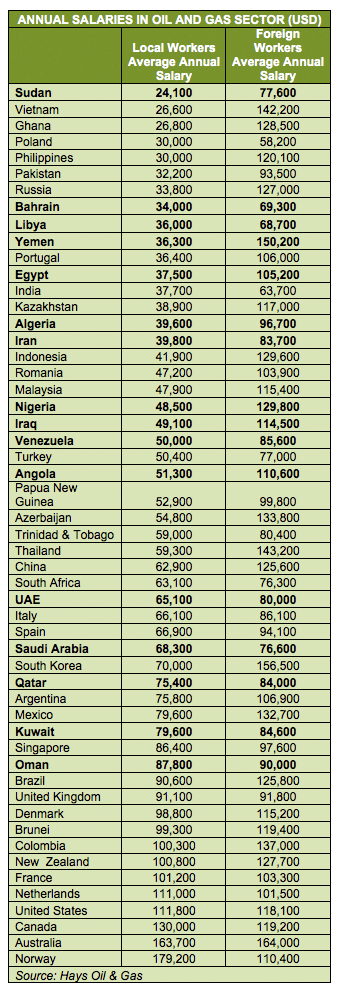
The feature was produced by alifarabia.com exclusively for zawya.com.
© Zawya 2014