Unifies the customs system and gives the Egyptian currency the required stability
Several experts and economic circles in Egypt rely on the correctness of the news and reports, as well as the leaks from some GCC members, that Egypt may be successful in joining the Gulf Cooperation Council, which will hold great benefits for the country.
The news that Egypt may soon join the GCC has increased recently, and more specifically few months after the January 2011 revolution. The latest leak was by the Minister of Foreign Affairs of Bahrain, a member of the GCC, who expressed the welcoming of all GCC countries to the accession of Egypt, as this will be for the common interest of both sides.
Trade Exchange
An economic report issued by the Egyptian Commercial Representation of the Ministry of Trade, confirmed that the volume of trade between Egypt and the GCC countries amounted to more than USD 2.5 billion during the first six months of 2011. The Kingdom of Saudi Arabia ranked first with a total trade exchange amounting to USD 1.4 billion, of which USD 728 million are Egyptian exports to KSA and USD 672 million Saudi imports to Egypt.
The report noted that the total trade exchange between Egypt and three Gulf countries (UAE, Bahrain and Qatar), achieved a surplus in favor of Egypt during the first half of 2011, amounting to USD 1 billion, representing more than 72% of the volume of trade exchange with these countries.
According to the report, the total volume of trade exchange between Egypt and Qatar was of USD 173 million, while the Egyptian exports to Qatar reached USD 146 million, the most important exchange was that of copper cables at USD 61 million.
The value of Egypt's imports from Qatar amounted to USD 27 million; most of it is polymers and gases such as helium, while the total trade exchange with Bahrain amounted to USD 61 million, of which USD 25 million are Egyptian exports.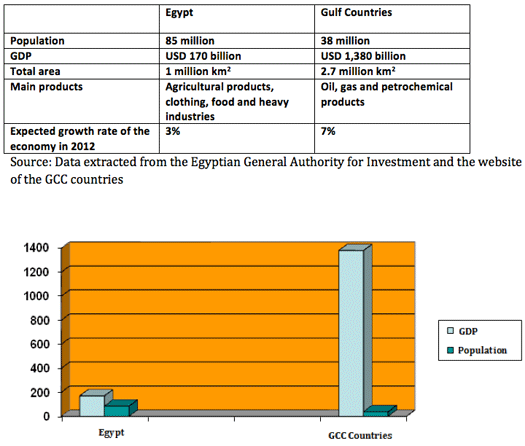
Ambassador Gamal Bayoumi, Secretary General of the Federation of Arab Investors, stated that the news concerning Egypt's accession to the GCC are not the first nor the last, as these news started fifteen years ago when Egypt requested to be a member in the early nineties, even as an observer in the GCC meetings. However, its membership request was rejected at the time.
He also added that Egypt's accession to the GCC will hold several benefits to the economic and political situation in Egypt, if the requirements of joining the GCC are met. The most important benefit would be the reduction of customs duties within the GCC Customs Union.
He pointed out that there is some risk related to the reduction of the customs duties on the Egyptian imports, ranging mostly between 25% and 30%, to an extent less than 5% in the requirements of the GCC, which will make this issue subject to an intensive study by the decision-makers in Egypt.
He added that one of the requirements of the GCC countries for the accession of any new member is to unify the customs duties with the rest of the members, which represents a severe challenge to Egypt at this time. He confirmed that Egypt's accession to the Gulf Common Market would be a great opportunity to promote and market the Egyptian products with a larger competitiveness.
The Secretary General of the Federation of Arab Investors added that Egypt fears as well the method of manufacturing products in the "country of origin" used by many Gulf countries, where some plants in these countries import products from low-priced markets, make simple additions to them then export them as Emirati or Bahraini products.
Opportunity
Mohamed El-Masry, Senior Vice President of the Federation of the Egyptian Chambers of Commerce, and Chairman of Henkel Detergents plant at Port Said, stated that joining the Arab Common Market is the goal of all Arab countries. The GCC is considered a microcosm of this market, in which the members have an agreement on a common customs and economic understanding.
He pointed out that Egypt is characterized by a large productive base as a result of the presence of thousands of plants and a good infrastructure, in addition to millions of workers trained to a certain extent. Egypt also has an export power to the Gulf markets that mostly import from other non-Arab countries, such as China, India, Pakistan, Bangladesh and Thailand.
He noted that Egypt is most suitable to cooperate with the GCC countries in terms of common interests, after the invitation of Jordan and Morocco and the experience of Yemen's participation in several Gulf establishments. He stressed that the current need and conditions increased the importance of the Egyptian role on the Arab level in general and in the Gulf in particular.
Egyptian Banks
Fouad Shaker, former Secretary General of the Union of Arab Banks, stated that the accession to the GCC will help the Egyptian banks integrate in the international banks system, as the Gulf banks have high credit levels, which will definitely reflect positively on the standard and amount of funding provided by the banks.
He emphasized that this accession will change the investment system in the market, where the requirements of the GCC are formed of several conditions, such as opening the door for foreign investment and allowing more projects to be implemented by the private sector, which will reassure the foreign investors before entering the banking market.
He explained that the GCC guarantees also to its members an international commitment that is difficult to revoke, which is feared by dozens of investors from entering the Egyptian market at the moment. He pointed out that the accession of Egypt to the GCC will make a comprehensive change to the followed systems and will let Egypt obtain major commercial benefits, and a high potential to enter the GCC market, in addition to the facilitation of movement of funds and the deregulation of investment and financing. This will allow the Egyptians to obtain GCC funding for their projects, and vice-versa.
Mutual Benefits
Dr. Hamdi Abdel Azim, Professor of Economics and former Dean of the Sadat Academy for Management Sciences, believes that the success of Egypt to join the GCC will bring economic benefits for both sides. He pointed out that Egypt will undoubtedly benefit from the experience of the GCC in achieving economic integration and a common market, by removing the trade barriers, restrictions and constraints and by unifying the customs formalities.
He added that Egypt will benefit from the monetary integration and the launching of a unified Gulf currency, noting that this will bring stability and balance to the Egyptian Pound that is unstable these days, despite the support of the Central Bank of Egypt.
© Zawya 2011