A number of ME markets are trading at valuations below their BRIC counterparts, says NBK Capital. With a few potential catalysts such as an MSCI upgrade and Saudi opening up, there may even be hope for the unthinkable: a rally.
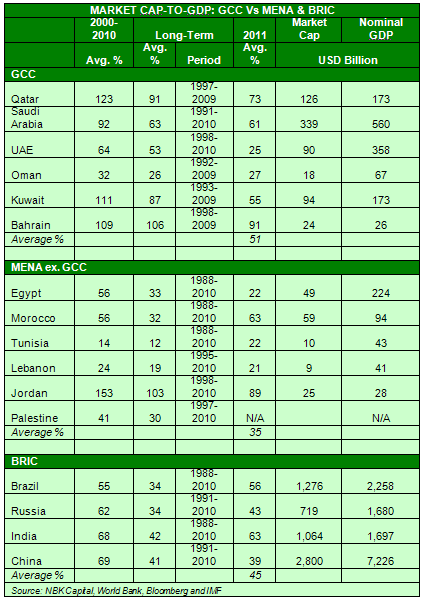
A number of Middle East markets are trading below their historic market cap-to-GDP compared to BRIC - Brazil, Russia, Indian and China, according to new research.
With the exception of Egypt - which fell by a whopping 49% last year, other MENA markets fared much better than most of the BRIC countries.
On the other hand, the Saudi Tadawul - the largest in the region in terms of market capitalization - saw a mere 3% drop in a year of extreme regional volatility and economic implosion in EU and the United States.
Qatar, the nat-gas machine, eked out a 1% gain and was the only market across MENA and BRIC to keep its head above water.
NBK Capital analysts Munira Mukadam and Sara Kanaan have conducted an interesting exercise by examining the market-capitalisation-to-GDP ratios across the two emerging regions.
"In our sample, at the end of 2011, the weighted average ratio for the GCC countries stood at 51% compared with 25% for their MENA peers and 45% for the BRIC countries," said the analysts in a note.
While the average for the MENA peers seem low at first glance, but if Egypt is excluded, the average rises to 50%. And even though GCC appears to have a high ratio, the UAE and Oman have really low ratios.
"In fact, Oman has historically traded at similar low market cap-to-GDP ratio of around 26%. However, the UAE's long-term average stood close to 53%, indicating there is room for growth," said the NBK Capital analysts.
Egypt, UAE, Bahrain, Brazil and Oman - in that order - had the lowest price-to-earnings ratios (after excluding companies with negative trailing earnings), suggesting more growth in MENA rather than BRIC economies.
But the analysts' favourite pick is Qatar.
"With a relatively low PE combined with high real GDP growth, Qatar looks the most attractive in the MENA," say NBK Capital analysts.
While the BRIC-MENA comparison is interesting, it is important to understand the vastly different dynamics of the two regions. One group is powered by a large and strong population base and economic strength spread across a wide variety of sector, and the other relies heavily on fossil fuel and government spending.
A Templeton analyst puts the power of the world's second largest economy in perspective: "We would expect Chinese growth moderate over the next three to five years from that double‐digit 10, 12% growth rate that we kind of were used to expect over the last decade to something more 7% to 8%," Michael Hasenstab, Portfolio Manager, Templeton Global Bond Fund.
"But still, given the size of China's economy, China growing at 7% is going to continue to be a cornerstone of global economic activity.
That growth is formidable and overshadows blistering growth in market such as Saudi Arabi and Qatar.
EFG'S VIEW
While NBK Capital analysts pored over excel sheets, Egyptian investment bank EFG-Hermes says it spoke to 53 investors in January to gauge investor sentiment.
Its conclusion: investors are cautious.
"Interest in MENA from GEM-dedicated investors was muted. They see little reason to enter MENA (ex-Egypt) without either a valuation discount or a trigger event, such as an MSCI EM upgrade for the UAE and/or Qatar."
EFG-Hermes, however, is not holding its breath for the MSCI to make its move.
Global Investment House, on the other hand, is leaning towards an upgrade. "
"Re-rating is still possible. Possible MSCI upgrade of UAE and Qatar in 2012 would trigger sizeable interest followed by inflows into these markets. Regulatory changes, like those relating to increasing of foreign ownership limits (case in point: UAE and Qatar) and opening the market to foreign owners (case in point: KSA) will lead to significant inflows into the market."
Analysts expect at least a trickle of the liquidity from the $3-trillion emerging market funds flow into Qatari and UAE markets, especially as MSCI is also looking to bump up South Korea and Taiwan to developed market status. The reshuffling of funds in global markets could see a surge in the two regional markets.
SAUDI IMPACT
What would improve EFG-Hermes' negative sentiment?
"Investors agreed with our view that trading activity would only see a muted short-term impact from Saudi Arabia opening up to foreigners," says the Egyptian bank, which remains overweight on the Kingdom's market.
"However, opinions differed on the likelihood and timing of an announcement. In our view, the full impact will be realised over a three- to five-year horizon rather than a six- to twelve-month one. Nevertheless, opening up the market would support investor sentiment in the short term."
The bank, however is less enamoured by Qatar which has seen an increase in valuation compared to its regional peers.
Gas-rich Qatar was the darling of investors and seen as a safe haven in the regional shamal of last year. The Doha market rewarded investor with a 1% gain as all regional markets were knee-deep in red.
NBK Capital still believes Qatar's valuations remain robust.
"The Qatar Exchange outperformed all of its MENA and BRIC peers by continues to display a market capitalization-to-GDP ratio below its long-term historical average. Although the covered Qatari companies have slightly higher PEG ratios than their GCC peers, they offer some of the highest dividend yields in the group."
The Kuwaiti analysts are less bullish on UAE markets despite its attractive valuations, partly because of the financial woes of Dubai, a depressed real estate market and possible impact of an escalation of conflict with Iran.
"While UAE offers the highest growth potential, especially after the poor performance in 2011 we believe that the country also has the highest probability to be bogged down by negative news," says Global.
"We believe that given highly uncertain times and expected market volatility, investors should stick to safe stocks (stocks with acceptable recommendations to curtail downside risk) that offer good dividend yield."
WHAT ABOUT EGYPT?
Egyptian Stock Exchange's performance will remain 'hostage' to changes in the political scene and social unrest which will impact on the macroeconomic environment, says Cairo-based CI Capital Research.
The investment bank expects uncertainty to continue till June 30 when, hopefully, a new president is elected.
"So, despite the EGX 30 currently trading at a discount of 45.3% vs. MSCI Emerging Markets on a F12m PER, the elevated political risk will - in the main - continue to dampen investor sentiment. Equally, uncertainties on the domestic front and the prospects of weaker global economic recovery mean that market volatility is likely to remain high as well," says the bank.
Not everybody is as pessimistic. Pharos Research reversed its ultra conservative view on Egyptian equities on Christmas Day and has reiterated that position after the successful, if rocky, completion of parliamentary elections.
"Since our first call, Egyptian equities ranked the best performing amongst MSCI EM peers (+27.6% in US$ terms) and sovereign 5 ¾ 2020 Eurobonds rallied 7.3%. Going forward, our style bias will be based on three systematic risk factors, namely; 1) Iran tensions, 2) domestic political stability and 3) relief of domestic liquidity strains."
CONCLUSION
The Gulf markets have lagged behind the growth of their respective economies. Despite raking in petrodollars, Gulf markets are bogged down by regional unrest and now the renewed concern of yet another war near the Strait of Hormuz.
"If we were to somehow escape the list of risk factors affecting our valuation, KSA and Qatar should stand out as the best performing markets in the GCC in 2012," notes Global. "We would put more weight on KSA because of its size, its recent under-performance."
After wallowing at decade lows, MENA markets are long overdue for another spirited performance that shakes up the lethargy and lures retail investors back.
A combination of Saudi Arabia opening up its market to foreign investors and MSCI upgrading UAE and/or Qatar could do the trick. It would greatly help if the war of words and indeed between Iran and the western world also subsides.
The conditions, then, would be ripe for a rally. MENA indices might even outperform BRIC markets again.
© alifarabia.com 2012