PHOTO
US political party conventions are traditionally a celebration of the country’s democratic traditions, accompanied by razzmatazz and over-the-top speeches to rally the party faithful in a show of unity before they go back to their communities and begin campaigning with a spring in their step.
This year’s events were affected, as everything is, by the constraints of the coronavirus pandemic, and conducted virtually with almost no audience, serving as a reminder that the world is in the midst of one of the worst health crises, and consequently one of the worst economic crises, in recent history. The need to hold the party conventions in virtual mode benefited the Democrats most, as it brought home, literally as well as figuratively, the magnitude of the crisis the country is enduring while the blame for its mishandling lies clearly at the door of the Trump administration.
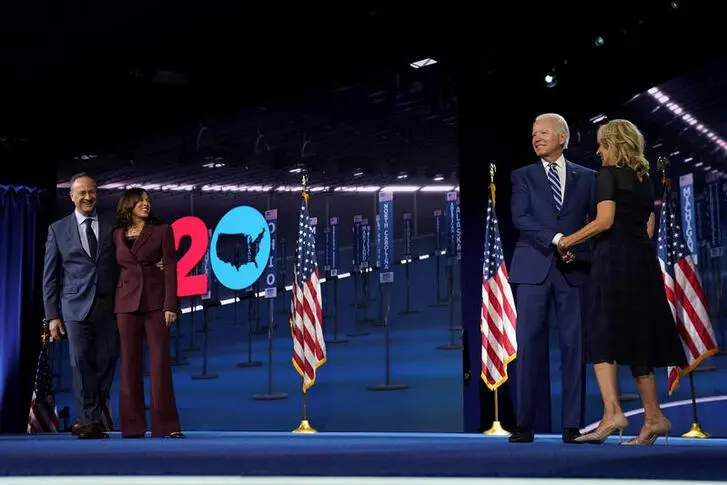
While it is generally acknowledged that Joe Biden is a decent human being and a person of integrity, who with nearly 50 years’ political experience at the highest level has the advantage of knowing the ins and outs of the Washington scene as few others do, he is nevertheless not known for his vision, his charisma, or his oratorial skills. It was therefore a great relief to campaign managers and the party faithful that he saved one of his best speeches for his nomination acceptance at the end of the convention, and with it hit all the right chords. He was authoritative; he was personable as he talked about his experiences of losing loved ones, as so many Americans are currently undergoing; and although he is no visionary, he has left the impression of someone who cares, who is experienced, and who is happy to roll up his sleeves and deal with the mammoth challenges his country is facing.
He summed up his administration’s priorities, should he win in November, by reminding his compatriots that “history has delivered us to one of the most difficult moments America has ever faced.” It was, he said, “the worst pandemic in over 100 years. The worst economic crisis since the Great Depression. The most compelling call for racial justice since the sixties.” And in case we should forget, he also highlighted “the undeniable realities and accelerating threats of climate change.” Biden not only set out the main priorities for his presidency, but he also established clear blue water between himself and President Trump.
As the two parties dominating American politics, Republicans and Democrats by nature represent a wide range of opinion on almost every key issue, while sharing a thin layer of common values and an ideology that holds them together, each with a tent that is big enough for a critical mass of voters to hand it victory in elections.
Last week’s Democratic convention exemplified this as it presented something for almost every variety of American, and united the left and the centrists to ensure that Biden would receive the blessing of all. However, if there was an overriding strapline for this Democratic Party gathering it was “Anything But Trump.” Only a few months ago the Democrats didn’t expect to arrive at their convention with a solid lead in the polls, but even in traditionally Republican states like Arizona and North Carolina the Biden–Harris partnership is leading. To win, they need to protect this lead, and for that, unity is paramount.
Coming to the convention as favorites to win the White House and retain their majority in the House of Representatives, and even with a chance of overturning the Republicans’ Senate majority, has changed the Democrats’ calculus of how to approach the convention. It has become more about consolidating their lead, and as most speeches have revealed, from the party’s grandees to the rank and file, the Democrats’ greatest asset is the current occupant of the White House. All speakers were on message, with various degrees of zest and robustness as they made it clear that the US can’t afford another four years of a divisive Trump. The combination of a presidency unparalleled in its bizarre appetite for aggression and friction, both at home and abroad; its lack of strategy and sheer incoherence on every major issue; and topping it all, the unprecedented vulgarity of its conduct, is enabling the Democratic party to pursue a campaign which emphasises the opposition’s weaknesses and failures rather than its own strengths.
Unusual times lead to unconventional approaches to fighting elections, and these are extremely unusual times. Departing from the protocol that former presidents never criticize their successors by name, Barack Obama’s speech to the convention went for the jugular. It was not only what he said, but the location of his speech at the Museum of the American Revolution in Philadelphia, the city where the US constitution was written, that made it a powerful statement of the irrevocable damage President Trump is causing to the very foundations of American values. It was a blistering attack on a president who Obama described as lazy, divisive, selfish and self-centerd, living in a reality show instead of in reality, to serve his craving for attention. And should anyone still harbor the illusion that Trump might eventually grow into his role as president, Obama’s verdict was that “Donald Trump hasn’t grown into the job because he can’t.”
The nominee for vice-president, Kamala Harris, spoke after Obama, which was symbolic. Similar to Obama’s nomination 12 years ago, hers is another step in the direction of breaking the glass ceiling for people from ethnic minorities, and in her case for women too. As successful as the Democratic convention was, nominating Kamala Harris in advance set the tone, and made clear where the party is heading and what values it represents.
The convention is over, and the real door-to-door work is beginning. The Democrats have entrusted Biden to be the transitional leader he has promised to be, and the convention did what it set out to do; it has rallied its base, empowered its leadership, instilled hope for a better future, and made it clear to the incumbents that they are in for a real fight.
- Yossi Mekelberg is professor of international relations at Regent’s University London, where he is head of the International Relations and Social Sciences Program. He is also an associate fellow of the MENA Program at Chatham House. He is a regular contributor to the international written and electronic media. Twitter: @YMekelberg
Copyright: Arab News © 2020 All rights reserved. Provided by SyndiGate Media Inc. (Syndigate.info).