PHOTO
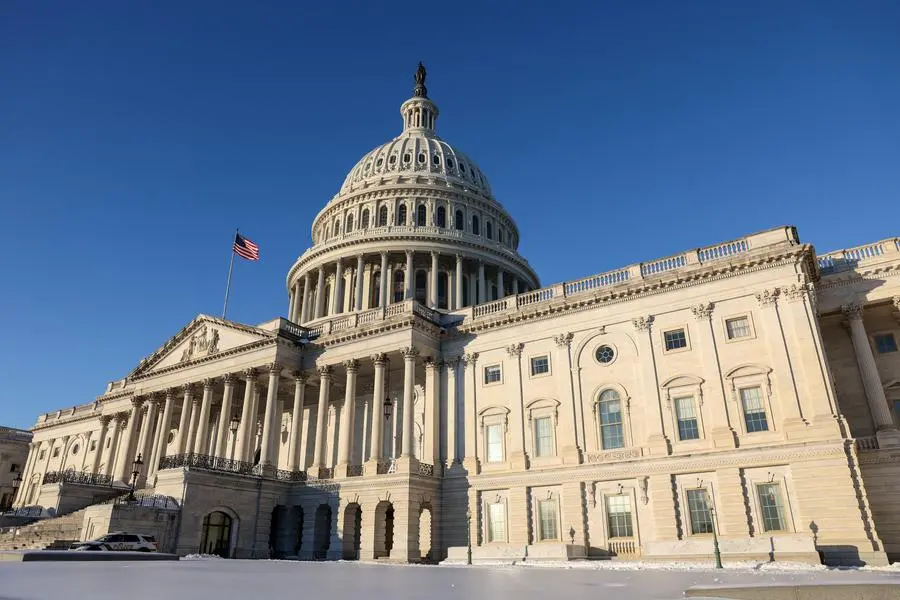
WASHINGTON: The U.S. House of Representatives on Wednesday narrowly backed a measure disapproving of President Donald Trump's tariffs on Canada, a rare rebuke of the president and leaders of his party in the Republican-majority House.
Lawmakers voted 219 to 211 in favor of a resolution to terminate Trump's use of a national emergency to put punitive trade measures on Canadian goods, as six Republicans joined all but one Democrat in favor.
It was an important symbolic vote in the chamber, where Trump's Republicans hold a slim 218-214 majority. The resolution stands a good chance of passage in the Senate, which has voted twice to block Trump from imposing tariffs on Canada despite his Republicans holding more seats.
However, it is unlikely to become law, as it would take two-thirds majorities in both chambers to overcome an expected Trump veto. Most Republicans have been unwilling to oppose Trump's policies.
The House approved the resolution a day after three Republicans joined Democrats to narrowly defeat an effort by Republican leaders to block legislative challenges to Trump's tariffs.
Members of Congress have been expressing frustration over rising costs for U.S. consumers as well as the impact of the tariffs on businesses involved in international trade.
'CANADA ISN'T A THREAT'
Representative Gregory Meeks of New York, who introduced the resolution, said it was about lowering the cost of living for American families, disputing claims that there was a drug-related national emergency as Trump had claimed to justify tariffs against Canada.
"Canada isn't a threat. Canada is our friend. Canada is our ally," Meeks, the top Democrat on the House Foreign Affairs Committee, said in a House speech before the vote.
Trump warned that any Republican in the House or Senate who voted against the tariffs would "seriously suffer the consequences come Election time."
He also took a shot at Canada, saying it had taken advantage of the United States on trade. "They are among the worst in the World to deal with, especially as it relates to our Northern Border," he wrote on social media.
Some members of Congress have also objected to Trump's repeated use of executive orders to set tariffs, especially on close allies like Canada, noting that the U.S. Constitution gives that right to Congress, not the president.
Last month, the Yale Budget Lab said the annual median cost of the Trump administration's tariffs stands around $1,400 for each U.S. household. The nonpartisan Tax Foundation estimated the cost at $1,000 per household in 2025, rising to $1,300 this year, in a report last week.
Trump initiated a tariff war with Canada shortly after beginning his second term in January 2025. He ordered 25% tariffs on imports from Canada in February 2025, and in August signed an executive order increasing tariffs on Canadian goods to 35% for all products not covered by the U.S.-Mexico-Canada trade agreement.
The move was linked to what his administration said was Canada's failure to stop smuggling of the dangerous drug fentanyl. But both Canada's government and the U.S. Drug Enforcement Administration say smuggling from Canada accounts for less than 1% of fentanyl on U.S. streets. (Reporting by Patricia Zengerle; Editing by Don Durfee and Edmund Klamann)