PHOTO
The launch of the NMDC Coastal and Hydrodynamic Centre in Abu Dhabi marks a paradigm shift for regional maritime engineering, positioning the UAE as a hub for advanced engineering and innovation.
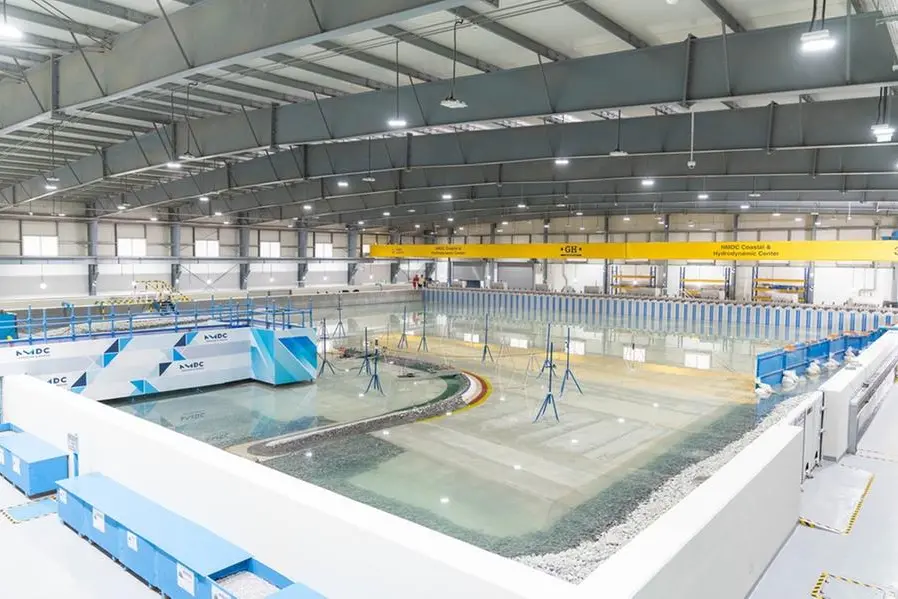
The massive facility, which is operated by NMDC Dredging & Marine, a subsidiary of ADX-listed NMDC Group, spans 60 metres by 50 metres with a height of 10 metres, and is designed to conduct physical model tests for marine and coastal structures, as well as advanced hydraulic studies.
As one of only 20 commercial laboratories of its kind worldwide -and the first hydraulic physical modelling centre globally to be owned by a contractor - the facility will enable complex coastal and offshore structures to be modelled, validated, and optimised locally.
The centre will compress project timelines and reduce costs for regional marine infrastructure projects, according to Niels de Bruijn, CEO, NMDC Dredging & Marine.
“Previously, testing abroad meant limited control over schedules and additional travel costs for our engineers, and sometimes, even our clients. Now, with the facility in the UAE, NMDC gains full control over access, schedules, and collaboration, reducing costs and improving efficiency in the long run.”
Controlled tests
The facility in Musaffah houses a 3D wave basin, a 2D wave flume, wave generation systems, instrumentation for monitoring and data acquisition as well as laboratories and offices.
Typical marine structures such as breakwaters, revetments, coastal defences, and quay walls are scaled down for controlled laboratory testing. These models are then subjected to waves, currents, and varying water levels to validate and optimise designs before construction.
“This process significantly reduces the technical uncertainties associated with complex marine phenomena and provides greater confidence in the solutions we deliver,” said Alessandro Gallus, engineering manager, NMDC Dredging & Marine.
The centre also supports research initiatives in areas such as renewable energy infrastructure, nature-based engineering solutions, and hybrid coastal defence concepts.
Coinciding with its launch, NMDC demonstrated the centre’s capabilities through its first project, the hydraulic testing of the physical breakwater model for the Salalah Marine Development Project.
“This facility will play a pivotal role in supporting regional projects and elevating standards in maritime engineering and services. Our first project reflects exactly what this facility stands for: delivering practical engineering, supporting real-world projects, and creating tangible impact,” de Bruijn said.
Why physical modelling matters
Physical modelling retains its edge over computational fluid dynamics (CFD) because numerical simulations cannot fully replicate the complexity of real marine environments.
“Sometimes, a design seems perfect on a computer, but physical testing reveals weaknesses that require redesign. This is why physical modelling is integral to the process,” de Bruijn said.
Gallus added that large scale numerical simulations require enormous processing power and can only test a limited range of conditions.
Physical modelling allows engineers to observe real behaviour, validate assumptions, and understand interactions that software cannot simulate with full reliability. By scaling down real structures and reproducing conditions in a controlled environment, very large systems can be modelled with high accuracy.
Gallus elaborated: “In the 3D basin, for example, we can replicate hundreds of metres of real structures within a space only 35 metres wide. Even though we don’t use seawater, the accuracy is not affected. Differences in water density or material density are accounted for in the scaling process. As a result, the scaled model, when exposed to the same environmental forces, behaves exactly as the real structure would.”
Structures are also tested against conditions beyond their expected life cycles, such as the return period of waves.
“If a structure has a design life of 50 years, meaning it must remain stable and functional for that period, we test it against wave conditions with a 50-year and 100-year return period,” he explained. “Once we define the design wave conditions, whether they represent a 100-year return period or even a 1-year return period, we reproduce those exact conditions here in the facility.”
Faster turnaround
The facility serves both NMDC Group’s internal teams and external stakeholders. Its strategic advantage lies in offering a one-stop, end-to-end solution: design, testing, and construction, all in-house.
“Clients in the UAE and the wider region can visit the facility, witness testing firsthand, and engage directly with our team, making the entire process more convenient, efficient, collaborative, and fully under our control,” said de Bruijn.
“This also allows NMDC to prioritise urgent projects. Instead of waiting months for availability at commercial laboratories abroad, the testing schedule is now entirely in house, enabling rapid turnaround when needed,” he said.
Project timelines vary depending on complexity, according to Gallus. A standard project in the 3D basin typically requires three to four months, covering design, construction of the physical model, testing, validation, and client approval. On the other hand, projects in the smaller 2D flume are completed more quickly, with one month considered as fast-track, while two months is the standard duration.
"The testing itself takes only a couple of weeks; the most time intensive phase is building the model and bathymetry, which alone requires at least two months,” he noted.
While the facility primarily supports NMDC’s Dredging and Marine division, it has potential applications across other business units of NMDC Group. The centre will be open to third party clients, academic and research institutions, and also operate as a commercial service similar to international testing laboratories, the two officials confirmed.
(Reporting by Dennis Daniel; Editing by Anoop Menon)
(anoop.menon@lseg.com)
Subscribe to our Projects' PULSE newsletter that brings you trustworthy news, updates and insights on project activities, developments, and partnerships across sectors in the Middle East and Africa.