PHOTO
Morocco has inaugurated the Mohammed VI Tower, the country’s tallest building and a flagship component of the Bouregreg Valley Development Project in Rabat.
The tower, which was inaugurated on Monday by Crown Prince Moulay El Hassan, forms part of Rabat’s transformation into the “City of Light.”
Standing at 250 metres with 55 floors, the Mohammed VI Tower is second tallest in Africa after Egypt’s almost 400-metre Iconic Tower, located in the New Administrative Capital’s business district.
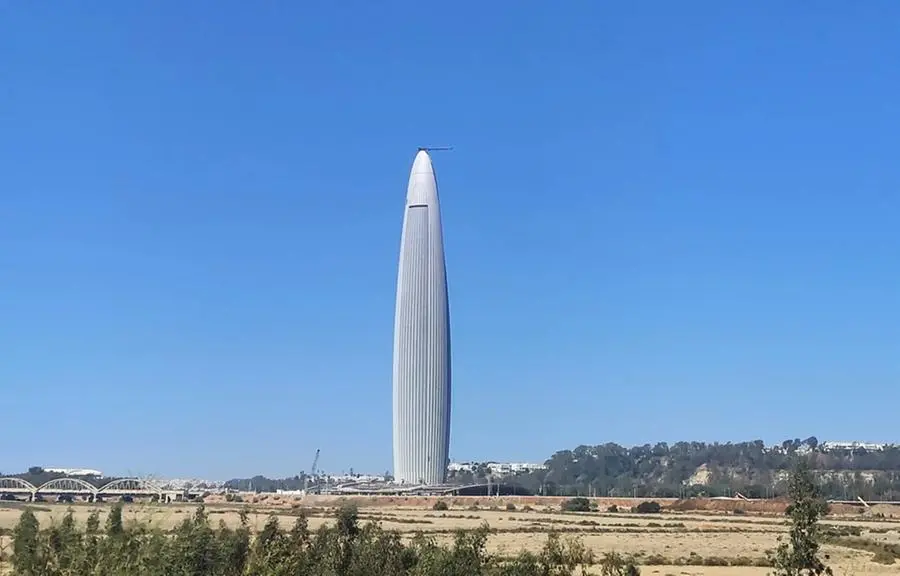
The development spans approximately 102,800 square metres and includes a luxury Waldorf Astoria, premium office space, high-end residential units and a panoramic observation deck.The tower is supported by a four-level podium and serviced by 36 elevators.
It is designed to be visible within a 50 km radius and serves as a focal point for the redevelopment of the Bouregreg riverfront.
Construction and delivery
The project was delivered by Belgium-based BESIX in joint venture with Moroccan contractor TGCC under a design-and-build contract awarded in 2018 by O Tower, part of O Capital Group.
The scope included design, engineering, procurement and construction, covering structural works, façades, advanced electro-mechanical systems and interior finishes.
Construction began in the fourth quarter of 2018 and was completed by the end of March 2026.
The Bank of Africa-financed project is estimated to have cost around 4 billion Moroccan dirhams ($432 million), according to government agency Rabat Invest.
Sustainable design features
The tower is designed to achieve LEED Gold and HQE certification, incorporating multiple sustainability features.
Its façade, spanning more than 70,000 sqm, integrates photovoltaic panels to reduce solar heat gain and cooling demand.
Additional measures include rainwater harvesting, wastewater recycling and energy recovery systems, alongside a 2,200 sqm photovoltaic installation on the podium roof.
The project was designed by architects Rafael de la Hoz and Hakim Benjelloun, with structural engineering by Ney & Partners. Interior design was developed by FLAMANT.
Earlier this month, CSCEC Egypt, the main contractor of Iconic Tower, had posted that final works are underway.
(Writing by Majda Muhsen; Editing by Anoop Menon)
Subscribe to our Projects' PULSE newsletter that brings you trustworthy news, updates and insights on project activities, developments, and partnerships across sectors in the Middle East and Africa.