PHOTO
- A new report and data sheet from Population Reference Bureau highlights the urgent need to address risk behaviors among youth that can lead to noncommunicable diseases (NCDs).
- NCDs accounted for 74 percent of all deaths in the Middle East and North Africa (MENA) in 2015, claiming the lives of 1.6 million people.
- Societal and cultural changes related to globalization, urbanization, and economic growth are driving a rise in NCD risk behavior among MENA countries’ large and growing population of young people.
- Addressing NCD risk factors with effective interventions is critical for building human capital and will allow young people to better contribute to economic growth and sustainable development.
Dubai, United Arab Emirates – Preventing risk behaviors among young people is key to curbing the noncommunicable disease (NCD) epidemic in the Middle East and North Africa (MENA), according to a new report by the private, nonprofit Population Reference Bureau (PRB).
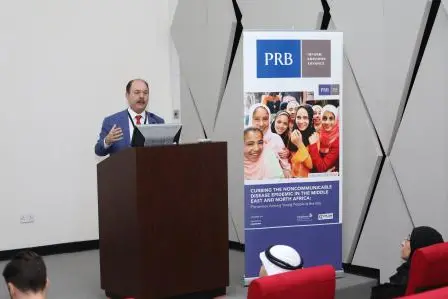
PRB released the report and a data sheet on the challenges of the NCD epidemic, as well as opportunities to combat it, at a recent Regional Publications Launch event at the American University of Sharjah.
“NCDs pose a significant threat to the health and well-being of populations, economic growth, and sustainable development throughout the [MENA] region. Their prevention among young people is crucial,” said Toshiko Kaneda, senior research associate at PRB and co-author of “Curbing the Noncommunicable Disease Epidemic in the Middle East and North Africa: Prevention Among Young People is the Key.”
“NCD awareness initiatives need to be driven from government and policy levels to tackle this rising issue and to address the risk behaviors among young people. If left unchecked, NCDs will continue to place a growing burden on health care systems and put many young people at risk of developing these diseases prematurely, during the height of their productive years,” Kaneda said.
A noncommunicable disease is a noninfectious, chronic disease that lasts for a long period of time and progresses at a slow rate. NCDs, including the four principle ones—cardiovascular diseases, cancers, diabetes, and chronic respiratory diseases—are the leading cause of death globally; in the MENA region, they accounted for 74 percent of all deaths in 2015. Risk factors associated with the four principle NCDs include tobacco use, physical inactivity, poor diet, and harmful use of alcohol, all of which are modifiable behaviors typically established during adolescence or young adulthood.
NCDs in lower-income countries generally claim lives at younger ages—often at the peak of individuals’ economic productivity. The likelihood of dying prematurely (between ages 30 and 70) from any of the four principle NCDs in 2015 was 12 percent in high-income countries globally, but it was 19 percent in MENA overall—20 percent in MENA’s middle-income countries and 16 percent in the region’s high-income countries.
All 19 countries evaluated in PRB’s report have experienced large increases in their youth population—from a total of 59 million in 1980 to 136 million in 2017 for the region—and an opportunity exists now to modify the risk behaviors of this young cohort and change the trajectory of NCDs in MENA. Addressing NCD risk factors in youth is critical for building human capital. Healthier young people have better cognitive skills, allowing them to improve performance in school, achieve higher levels of education, and contribute more to economic growth and sustainable development.
PRB’s “Curbing the Noncommunicable Disease Epidemic in the Middle East and North Africa: Prevention Among Young People is the Key” presents an analysis of the epidemic and its risk factors in MENA. It outlines how MENA countries can act to curb the epidemic through strategies to address behavioral risk factors among young people, implementation of policy and structural measures, and development of strategic interventions to increase knowledge and improve awareness about NCD risks. Sameh El-Saharty, program leader for the Gulf Cooperation Council Countries at the World Bank and co-author of the report, noted, “The key approach is to mobilize and promote collaboration of different sectors on implementing evidence-based and cost-effective risk-reduction strategies, which would create a powerful synergy to support healthy, productive lives for young people and curb the growing health and economic burden of NCDs for individuals, families, and societies.”
AstraZeneca’s Young Health Programme supported this report and the event. Helen Seibel, Associate Director of Global Community Investment at AstraZeneca, commented: “We are committed to improving the lives of patients with cancer, cardiovascular and metabolic diseases and respiratory conditions through innovative medicines as well as investment in disease prevention. The AstraZeneca Young Health Programme focuses entirely on youth and their risk behaviours to address the growing burden of NCDs worldwide with educational programmes, advocacy and research. This report provides critical information that reinforces the need for targeted, adolescent-friendly interventions to make a sustainable impact on the NCD epidemic.”
“Curbing the Noncommunicable Disease Epidemic in the Middle East and North Africa: Prevention Among Young People is the Key” is available at www.prb.org/Publications/Datasheets/2017/ncd-risk-youth-mena.aspx
-Ends-
The Population Reference Bureau informs people around the world about population, health, and the environment, and empowers them to use that information to advance the well-being of current and future generations.
For more information contact:
Yasmin Hilmi
Account Manager | Healthcare Practice
FleishmanHillard United Arab Emirates
T: +971 4450 2600
Yasmin.Hilmi@fleishmaneurope.com