PHOTO
Manila: In a bid to strengthen its reach in the ASEAN countries, Lulu Group International, a highly diversified entity based in the United Arab Emirates (UAE) has begun their operations in the Philippines by setting up its state-of-art- logistics and export center in Laguna near capital Manila.
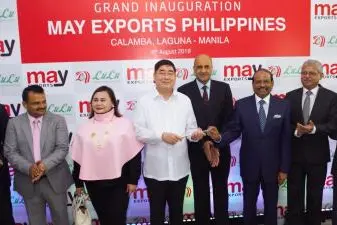
MAY Exports Philippines Inc was officially inaugurated by Jose Gabriel Lavina, Under Secretary, Dept of Agriculture in the presence of Ramil L. Hernandez, Governor of Laguna province, Timmy Chipeco, Mayor of Calamba, Ambassador Amable Aguiluz, Philippine President’s Special envoy to GCC countries, Hamad Saeed Al Zaabi, UAE Ambassador, Jaideep Mazumdar, Indian Ambassador, Yusuff Ali MA, Chairman of LULU, Salim MA, Lulu Director and other dignitaries.
Ideally located at Calamba Premiere International Park, the new center will be primarily engaged in sourcing, storing, packing and exporting fruit, vegetables and other commodities from the Philippines to its more than 150 Hypermarkets spread across GCC countries & Egypt. This move by the Lulu Group will further boost its sourcing operations and help bring quality Filipino products for its large customer base across many countries.
“It is part of our ongoing strategy to set up own sourcing and food processing units around the world to ensure uninterrupted supply and maintain competitive pricing by eliminating third parties. The Philippines has a vast variety of Fruits, Vegetables, Ethnic Filipino Food products, Frozen food and an extensive range of other commodities like health & beauty, garments, footwear etc”, said Yusuff Ali MA, Chairman of Lulu Group.
Earlier Yusuffali MA along with the management team had called upon President Rodrigo Duterte at Malacanang Palace and updated him about the group’s investment plans in the Philippines. President Duterte has assured Yusuffali, all possible support for the future expansion.
“We are working closely with the Philippine Economic Zone Authority (PEZA) to boost export of these products from the Philippines to our Hypermarkets spread across Middle East & North Africa (MENA) region, Malaysia and Indonesia”, he said.
“We are already directly importing about US$10 million worth of fruits, vegetables and other commodities from the Philippines, which will be increased to US$30 million within a year”, added Yusuffali. At present, Lulu Group’s total trade volume of Filipino products stands at US$ 35 Million which includes Import and Local purchase.
Elaborating about his association with Philipines, Yusuffali said “currently, we employs more than 9,600 Filipinos in our Hypermarkets across the GCC and they have been a very integral part of our growth and are known for their hard work, dedication & efficiency”.
© Press Release 2018Disclaimer: The contents of this press release was provided from an external third party provider. This website is not responsible for, and does not control, such external content. This content is provided on an “as is” and “as available” basis and has not been edited in any way. Neither this website nor our affiliates guarantee the accuracy of or endorse the views or opinions expressed in this press release.
The press release is provided for informational purposes only. The content does not provide tax, legal or investment advice or opinion regarding the suitability, value or profitability of any particular security, portfolio or investment strategy. Neither this website nor our affiliates shall be liable for any errors or inaccuracies in the content, or for any actions taken by you in reliance thereon. You expressly agree that your use of the information within this article is at your sole risk.
To the fullest extent permitted by applicable law, this website, its parent company, its subsidiaries, its affiliates and the respective shareholders, directors, officers, employees, agents, advertisers, content providers and licensors will not be liable (jointly or severally) to you for any direct, indirect, consequential, special, incidental, punitive or exemplary damages, including without limitation, lost profits, lost savings and lost revenues, whether in negligence, tort, contract or any other theory of liability, even if the parties have been advised of the possibility or could have foreseen any such damages.