PHOTO
- First Laser-Matter interaction images from laboratory unveiled
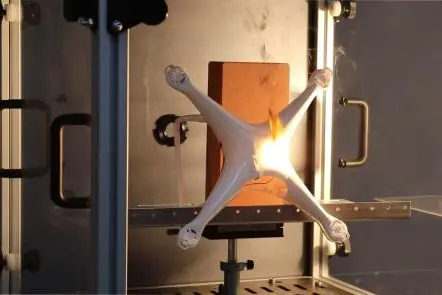
Abu Dhabi-UAE : Technology Innovation Institute (TII), the applied research pillar of Abu Dhabi’s Advanced Technology Research Council (ATRC) today announced that its Directed Energy Research Centre (DERC) has become the first entity in the GCC region to operate a Laser-Matter Interaction Laboratory (LMI Lab) capability.
The LMI Laboratory is part of the Laser, Photonics, and Optoelectronics (LPO) Division, which investigates the physical processes involved in the interactions of a broad range of lasers with matter. In doing so, the division develops new methodologies in different fields, such as laser materials processing, plasma physics, nanotechnology, and non-linear optics.
The mobile laser laboratory provides unique opportunities to perform innovative and experimental testing in both indoor and outdoor environments. The laboratory offers critical infrastructures, service providers and research institutions in the UAE and the wider GCC region enhanced access to laser-matter interaction capabilities – a function that previously, was outsourced abroad.
The availability of the capabilities in the region also paves the way for a higher uptake of lasers in multiple applications across diverse industries.
Dr. Ray O. Johnson, CEO of Technology Innovation Institute (TII), said: “We are encouraged by the work accomplished by DERC’s researchers in getting this sophisticated lab operational in a very short time. At this fundamental research lab, we plan to investigate two closely-related topics – one is the interaction of matter with a strong laser field, i.e., at high power densities. The second is to study matter at very high energy densities, i.e., hot dense plasmas. The outcomes of such experiments will further enhance DERC’s and TII’s credibility as regional leaders in high-energy physics.”
Speaking on the breakthrough, Dr. Chaouki Kasmi, Chief Researcher, Directed Energy Research Centre (DERC), said: “The launch of the Laser-Matter Interaction Laboratory is a significant addition to DERC’s growing portfolio of cutting-edge technological solutions that are shaping our future. While established technology leaders including the USA, the UK, France, Germany, and many others already possess this tech solution, it is unique to the GCC region and much like our electromagnetic compatibility labs, is expected to have wide-ranging implications in scientific testing as well as commercial and industrial applications.”
DERC and our partners are working on innovations in domains such as laser materials processing - welding, cutting, drilling, sintering, hardening, cladding, surface treatment, plasma technologies, electromagnetic pulse generation, plasma waveguiding, remote sensing, laser communication, and nanomaterials.
Dr Kasmi added: “Lasers are used in an extraordinarily wide range of applications. One area that is increasingly important is the manufacturing sector, where the level of precision at which a laser can operate is far greater than that of the equivalent physical tool. With this laboratory, we will be able to support the manufacturing sector – among the priority industries for countries in the region. Apart from this, the lab will enable new scientific research and development capabilities and support other industrial applications – such as the next generation of telecommunication technologies.”
DERC’s future capabilities will comprise an ISO class 7 cleanroom and a mobile laser laboratory with environment simulation chambers (environmental, turbulences, and vibration) and different laser systems, such as multi-kilowatt lasers in continuous wave (CW) and multi-terawatt lasers (TW) in pulsed mode.
In addition, the LMI Laboratory will further theoretical and experimental advances in different fields that rely on light-matter interactions, including atomic, molecular and optical physics, photonics, chemistry, and optoelectronics, among others.
The laboratory is set to study the heating, melting, and evaporation mechanisms induced in laser-matter interaction, according to a broad range of laser parameters on various solid materials. The investigations at the laboratory will be helpful in optimising the process parameters in laser materials processing to facilitate products of the desired quality.
Furthermore, high-speed imaging and spectroscopy research can lead to the development of low-cost, compact online monitoring tools for quality control in production, thereby enabling cost and time savings in the post-mortem analysis for quality assurance. To observe the fast phenomena taking place during the laser-materials interaction process, the lab will also leverage several diagnostics tools such as high-speed camera, streak camera, picosecond gated intensified charge coupled device camera and spectrometers.
Another key capability at the laboratory will be thermal blooming, caused due to the nonlinear interaction of the high-power laser beam with atmosphere in which certain molecules and particulates absorb a fraction of the laser radiation. To study this effect, the team at DERC will deploy outdoor laser sources and different sensors to investigate the physical processes involved in the interaction of different lasers (CW & pulsed) in the GCC environment.
-Ends-
About Technology Innovation Institute (TII)
Technology Innovation Institute (TII) is the dedicated ‘applied research’ pillar of Advanced Technology Research Council (ATRC). TII is a pioneering global research and development centre that focuses on applied research and new-age technology capabilities. The Institute has seven initial dedicated research centres in quantum, autonomous robotics, cryptography, advanced materials, digital security, directed energy, and secure systems. By working with exceptional talent, universities, research institutions and industry partners from all over the world, the Institute connects an intellectual community and contributes to building an R&D ecosystem reinforcing Abu Dhabi and the UAE’s status as a global hub for innovation.
For more information, visit www.tii.ae
Connect with us on social media:
LinkedIn: https://www.linkedin.com/company/tiiuae/
Twitter: https://twitter.com/TIIuae
Instagram: https://www.instagram.com/tiiuae/
About Directed Energy Research Centre (DERC)
Directed Energy Research Centre (DERC) – at Technology Innovation Institute (TII) – plays a leading role in understanding and harnessing the physics behind high energy. The Centre is dedicated to innovation in areas such as electromagnetics, lasers, plasma physics and beyond for the benefit of society.
For more information, visit https://directedenergy.tii.ae
© Press Release 2021
Disclaimer: The contents of this press release was provided from an external third party provider. This website is not responsible for, and does not control, such external content. This content is provided on an “as is” and “as available” basis and has not been edited in any way. Neither this website nor our affiliates guarantee the accuracy of or endorse the views or opinions expressed in this press release.
The press release is provided for informational purposes only. The content does not provide tax, legal or investment advice or opinion regarding the suitability, value or profitability of any particular security, portfolio or investment strategy. Neither this website nor our affiliates shall be liable for any errors or inaccuracies in the content, or for any actions taken by you in reliance thereon. You expressly agree that your use of the information within this article is at your sole risk.
To the fullest extent permitted by applicable law, this website, its parent company, its subsidiaries, its affiliates and the respective shareholders, directors, officers, employees, agents, advertisers, content providers and licensors will not be liable (jointly or severally) to you for any direct, indirect, consequential, special, incidental, punitive or exemplary damages, including without limitation, lost profits, lost savings and lost revenues, whether in negligence, tort, contract or any other theory of liability, even if the parties have been advised of the possibility or could have foreseen any such damages.