PHOTO
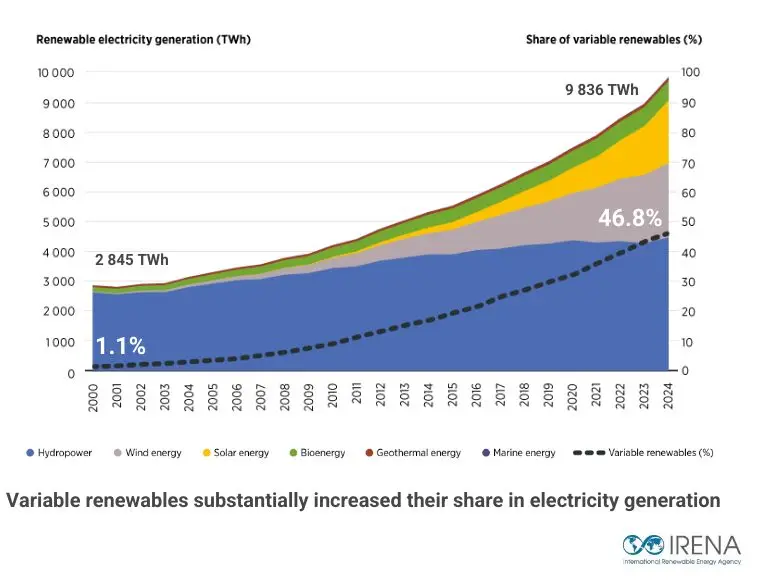
Abu Dhabi, United Arab Emirates - The Renewable Energy Statistics 2026 released by the International Renewable Energy Agency (IRENA) today shows that renewable electricity generation grew by 9.8% in 2024 — significantly higher than the growth rate recorded in 2023.
Non-renewables continued to fall behind with an increase of 1.4% over the same period. Overall, renewables accounted for 31.7% of the electricity generation globally in 2024, totaling 9 836 terawatt hours (TWh).
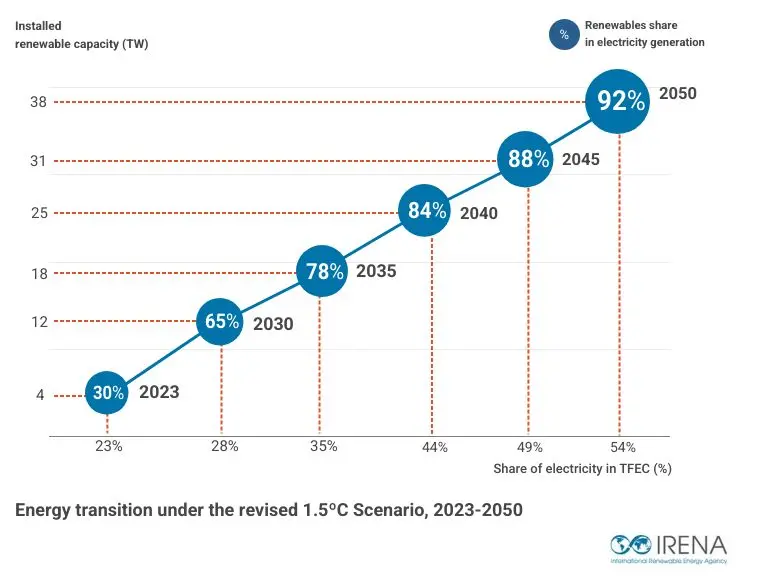
Drawing on IRENA’s roadmap, the incoming COP31 Presidency of Türkiye has announced a global electrification target of 35% of final energy demand by 2035 as part of its Action Agenda. The newly released power generation data clearly show that achieving this ambition would require renewables to increase their share in global electricity generation from 31.7% in 2024 to 78% by 2035 — around 2.5 times today’s level.
Commenting on the new dataset, IRENA Director-General Francesco La Camera said: “The world is rallying behind electrification as a cornerstone of the energy transition, with renewable electricity as its driving force. Growing support for global electrification reflects a shared recognition that clean electricity strengthens energy security, resilience and competitiveness. This will require renewable electricity generation to expand at an unprecedented pace over the next decade —around 2.5 times today's level. Technologies are available, the economics are compelling. Now we must swiftly shift from fossil fuels to clean electricity across buildings, transport and industry.”
Simon Stiell, the Executive Secretary of the United Nations Framework Convention on Climate Change (UNFCCC) added: “Every nation at COP30 agreed unanimously that the global transition is now ‘irreversible’ and this new data is powerful new evidence. With renewable power generation clocking its fastest growth ever, the shift to clean energy is charging ahead, because it’s now cheaper, safer and faster-to-market, in stark contrast to this year’s ongoing fossil fuel cost chaos – driving inflation painfully higher for every economy, millions of businesses and billions of households. But despite this vast progress, the shift to clean energy is still far from fast or inclusive enough, and many vulnerable nations need significant support, making full and timely delivery of all climate finance pledges essential.”
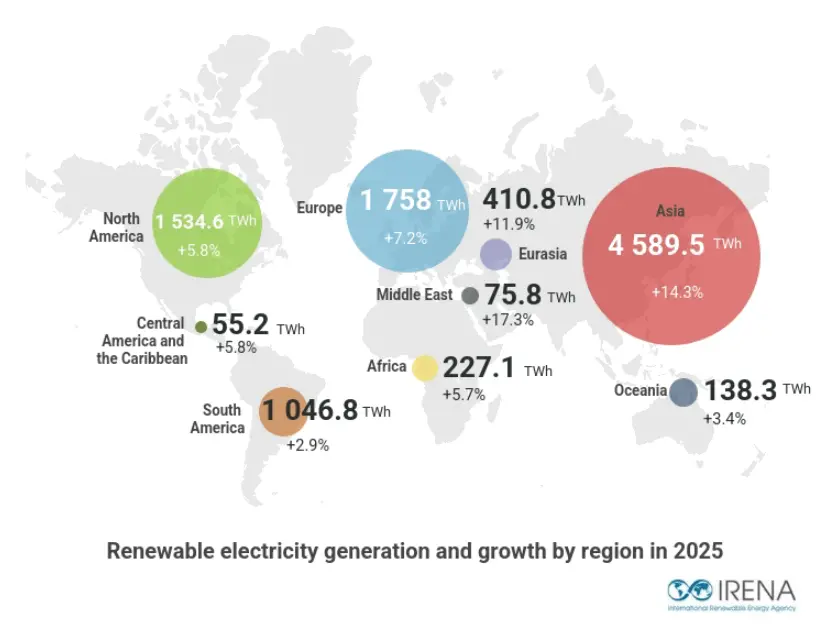
Today’s renewable generation data also confirms the dominance of solar and wind power. In absolute terms, Asia led the world in renewable electricity generation in 2024, producing 4 589 TWh (14.3% increase) driven by all technologies with growth being particularly strong across solar and wind.
Europe produced 1 758 TWh (up by 7.2%), driven by increases in solar and hydropower. North America generated 1 535 TWh (5.8% increase), and South America generated 1 047 TWh (2.9% increase) reflecting increases across all technologies.
Eurasia produced 411 TWh (up by 11.9%). Africa generated 227 TWh (5.7% increase) across all sources except for geothermal energy. Oceania generated 138 TWh (3.4% increase). The Middle East followed with 76 TWh, representing the highest regional growth rate of 17.3%. Lastly, Central America and the Caribbean generated 55 TWh (5.8% increase).
IRENA’s latest statistics also include some minor revisions to the 2025 installed renewable capacities reported in March 2026.
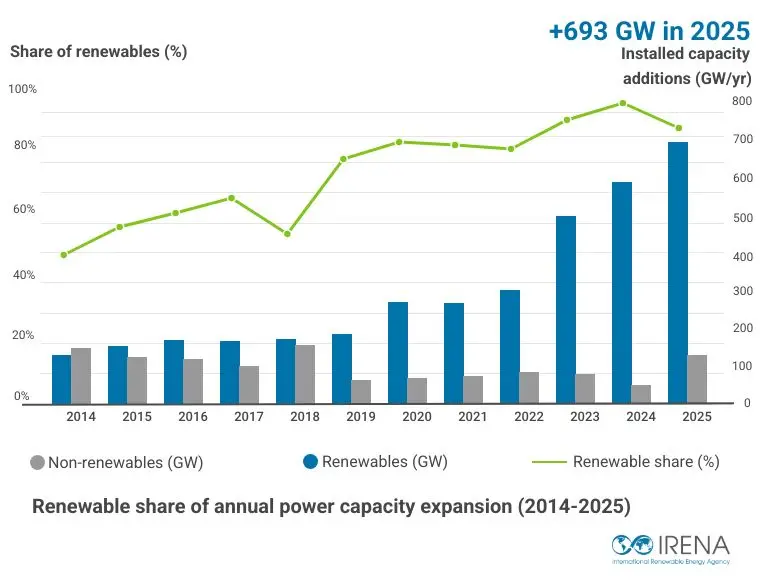
Annual renewable capacity additions have increased notably over the past 25 years, reaching an unprecedented peak of 693 GW in 2025. The revised figures show that at the end of 2025, renewable capacity accounted for 5.2 TW, or 49.5% of the global total.
The share of renewables in total capacity expansion in 2025 was 85.7%, down from 92.7% in 2024. Despite a decrease in the share of renewables in total capacity expansion, the overall positive trend in installed capacity confirms that renewable deployment continues to outpace non-renewable growth.
About the International Renewable Energy Agency (IRENA)
IRENA is the lead intergovernmental agency for the renewables-based energy transition in pursuit of a systemic change across the energy sectors. A global energy agency comprised of 172 members, with 13 additional countries in accession, IRENA provides knowledge, technical assistance and capacity building, project and investment facilitation. The Agency enables international cooperation and partnerships to fight climate change and promote sustainable development, energy access, energy security and resilient economies and societies.
Contact information:
Nicole Bockstaller, Chief, Communications Officer, IRENA, nbockstaller@irena.org