PHOTO
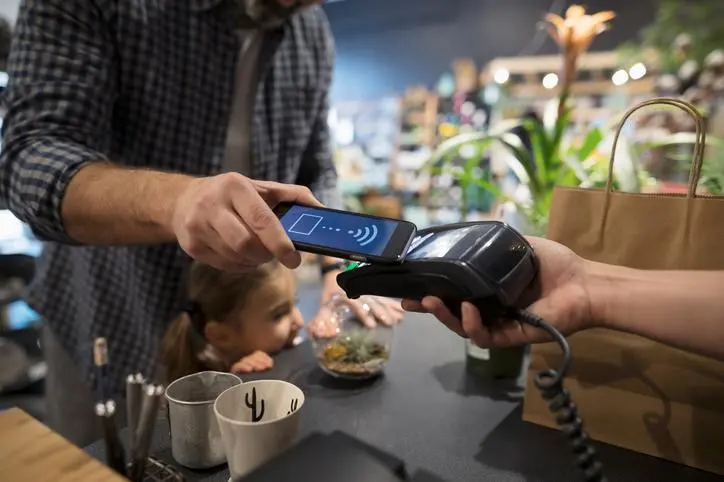
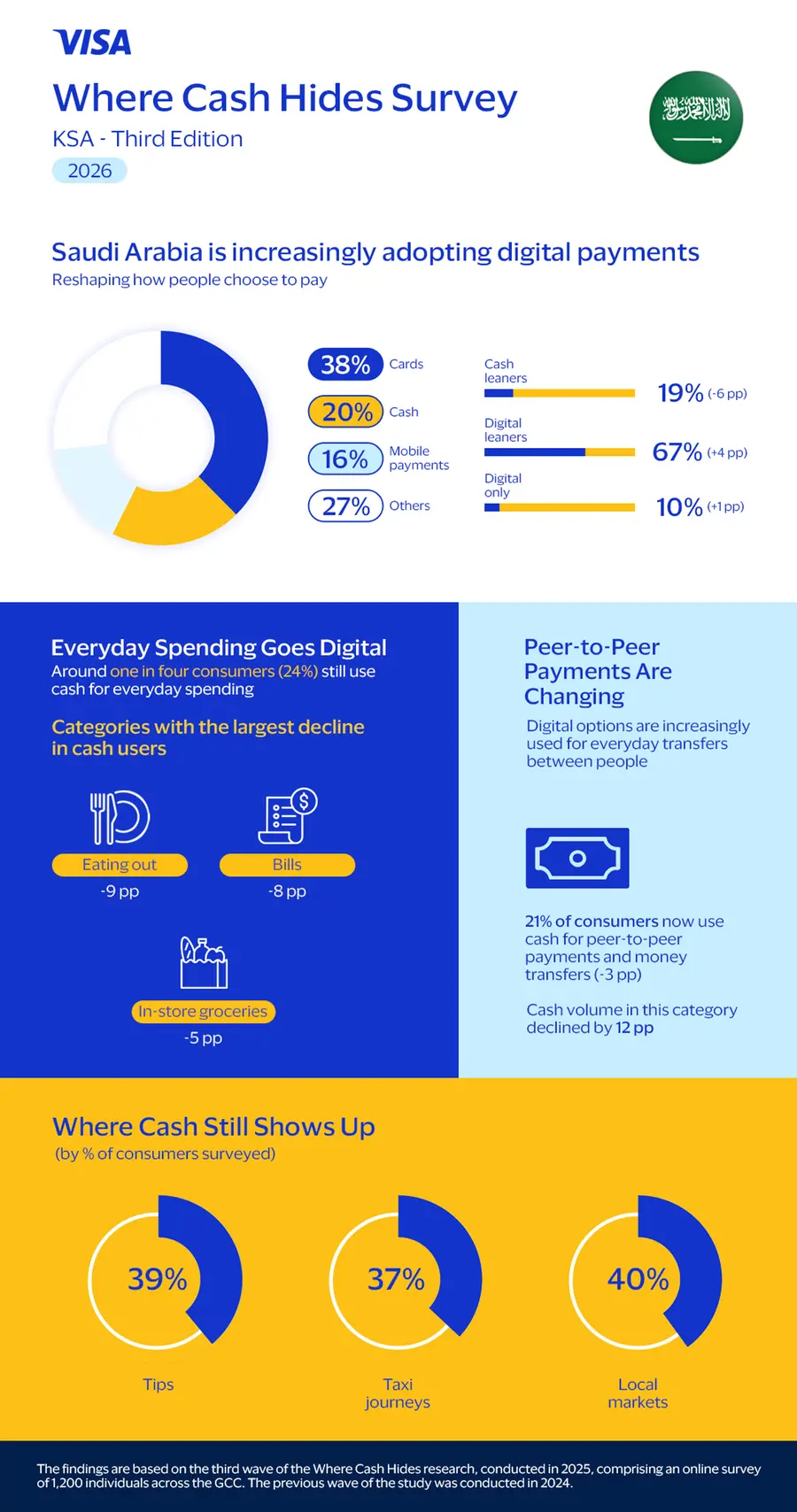
- Mobile payments are growing steadily, representing 16% of all transactions
Riyadh, Saudi Arabia: Digital payments are continuing to reshape how people choose to pay in Saudi Arabia, with more consumers embracing faster, more secure digital experiences. Visa’s third edition of ‘Where Cash Hides’ report[1] shows 67% of KSA consumers are largely non-cash users, making most of their payments with payments cards or mobile devices. This is an increase of 4% compared with last year, highlighting a clear move away from cash.
Digital Payments Break into Cash-Heavy Categories
The appeal of cash is also decreasing in day-to-day purchases. Nearly one in four KSA consumers surveyed still use it for everyday purchases. The downward trend is visible across all major categories where cash remains popular, including eating out (-9%) and bills (-8%).
For everyday spending such as eating out, bill payments, and in-store groceries, cash and mobile payments are the payment method of choice. In making payments to another person (or peer-to-peer (P2P) payments), tips are still paid in cash by 39% of KSA consumers, the most common remaining cash use. Cash is also widely used for peer-to-peer services (28%) and for property rent payments (14%).
“The data shows a steady move toward digital payments in Saudi Arabia. Such progress is possible only because banks, fintechs, merchants and technology partners are pushing together in the same direction, in line with the Kingdom’s Vision 2030,” said Ali Bailoun, Visa’s Senior Vice President, Group Country Manager for Saudi Arabia, Bahrain, and Oman. “As more people try mobile and card payments in their daily lives and their expectations evolve, too. Consumers want payment options that are quick, convenient, and safe. When digital solutions meet these expectations, they naturally become the preferred choice."
The findings of Visa’s Where Cash Hides research suggest KSA consumers’ growing reliance on digital payments because they are more convenient, secure and rewarding. Compared to cash, debit and credit cards offer consumers greater security, convenience, and transparency. They eliminate the risks of carrying physical money, enable seamless online and in-store purchases, and provide instant transaction records for better budgeting. Mobile payments offer enhanced convenience and security through tokenization, which replaces sensitive card details with unique digital identifiers so the actual card number is never shared.
Credit cards also come with rewards programs, cashback offers, and travel or lifestyle benefits, value benefits that consumers have come to expect when they spend at home or travel abroad.
About Visa Inc.
Visa (NYSE: V) is a world leader in digital payments, facilitating transactions between consumers, sellers, financial institutions and government entities across more than 200 countries and territories. Our mission is to connect the world through the most innovative, convenient, reliable and secure payments network, enabling individuals, businesses and economies to thrive. We believe that economies that include everyone everywhere, uplift everyone everywhere and see access as foundational to the future of money movement. Learn more at Visa.com.
[1] The research is based on an online survey of 1,200 individuals across GCC in 2025. The second wave was conducted in 2024.