PHOTO
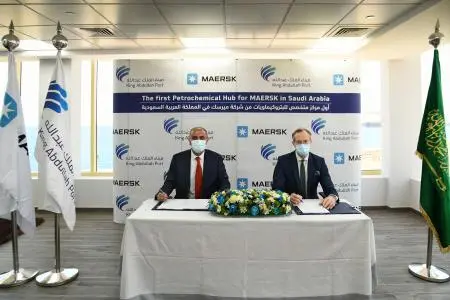
King Abdullah Economic City: Maersk Saudi Arabia, an integrator of container logistics, announced that it has entered into a strategic partnership with King Abdullah Port, the region’s first privately owned, developed, and operated port, to enhance the Kingdom’s logistics capabilities by adding state-of-the-art services and technologies to the port’s offerings. As part of the partnership, both the entities signed a deal to set up Maersk Integrated Logistics Hub, a non-bonded warehouse, to provide comprehensive logistics services and benefit local petrochemical exporters. The agreement was signed by Mohammad Shihab, Managing Director of Maersk Saudi Arabia, and Jay New, CEO of King Abdullah Port, in a ceremony held at King Abdullah Port. The signing ceremony was attended virtually by Richard Morgan, Regional Managing Director for Maersk West & Central Asia.
The Maersk Integrated Logistics Hub at King Abdullah Port will cover an important logistical requirement of exporters who already have access to Maersk’s solutions such as landside movement of cargo, customs clearance, and ocean logistics, thus ensuring a truly integrated logistics offering. The hub will serve as the focal supply chain solution, primarily for Saudi Arabia’s petrochemical exporters, through the large space allocated for handling and storing cargo. It will play an important role in facilitating the storage of export cargo and enable pallet handling, stuffing, and shuttling.
The establishment of the hub is part of a major initiative aimed at increasing the performance efficiencies and competitiveness of Saudi Arabia’s logistics sector. It is also in line with the objectives of Vision 2030, which include transforming the Kingdom into a top global logistics hub connecting Asia, Europe, and Africa, increasing the non-oil exports, and improving the Kingdom’s global ranking on the Logistics Performance Index from 49 to 25.
Located within a two-kilometer radius from the terminal yard and directly adjacent to the customs inspection zone, this hub’s strategic location will greatly benefit the exporters by saving time. Furthermore, exporters based out of the manufacturing hub of Yanbu will now have to truck their cargo only 200 km for loading onto vessels, compared to the almost 350 km to Jeddah, earlier. This will also contribute towards environmental sustainability through reduced emissions. Also, the hub has reduced the timespan from receiving the booking to loading the material on the vessel to six to eight days, compared to the earlier duration of 14 to 18 days, thus decreasing the turnaround time, increasing efficiency, and improving the competitive advantage through reduced logistics costs.
Maersk is initially investing in 100,000 m2 of warehousing space during the first two years of operations at the hub and the annual throughput is expected to reach 1 million metric tons by the third year as the demand from exporters grows over the years.
Shihab commented: “The Maersk Integrated Logistics Hub at the King Abdullah Port is an important milestone on our journey of providing integrated logistics solutions for our customers in Saudi Arabia. The multi-carrier origin hub for petrochemical exporters is an affirmation of our commitment to serving Saudi Arabia’s trade and simplifying our customers’ supply chains.” He added, “At Maersk, we are integrating logistics and providing our customers with single-window access to multiple solutions that will solve their supply chain challenges. We are really excited about bringing our strategy to life and looking forward to serving more and more customers in the future.”
Commenting on the partnership and the agreement to establish Maersk Integrated Container Logistics Hub, New said: “The strategic partnership between Maersk and King Abdullah Port is an important step in raising the efficiency of the Kingdom’s logistics sector and boosting our capabilities in logistics and trade in line with the Vision 2030 objectives. We are delighted to partner with the world’s leading integrated container logistics company to establish their first petrochemical hub in the kingdom. We are confident that this will significantly enhance the port’s outstanding operational capabilities by enabling us to provide sophisticated services seamlessly, amid the challenges of the current economic situation and the rapid changes in the industry. The hub will also help our exporters to achieve considerable savings in terms of time and costs besides significantly reducing risks, helping them serve international customers better.”
Owned by the Ports Development Company, King Abdullah Port is the region’s first port to be owned, developed, and operated by the private sector. Ranked as the world’s second most efficient port by The World Bank in 2020, the port emerged as one of the world’s top 100 ports within four years of operation. With its strategic location in King Abdullah Economic City – a modern city with a pro-business ecosystem and infrastructure – King Abdullah Port leverages the city’s advanced facilities and services, particularly the Industrial Valley, which has attracted many logistics projects as well as light and medium industries.
-Ends-
About King Abdullah Port
Strategically located on the Red Sea coast in King Abdullah Economic City, King Abdullah Port, ranked by The World Bank as the world’s second most efficient port in 2020, is the Middle East’s first privately owned, developed and operated port. Occupying an area of 17.4 km2, and enjoying close proximity to the key Saudi cities of Jeddah, Holy Makkah, Al Madinah and Yanbu, as well as its direct access to extensive transportation networks that facilitates the cargo transport through the kingdom and the rest of the region, the port is making an increasingly important contribution to the Kingdom’s global role in maritime trade and logistics. Once fully completed, King Abdullah Port will be capable of handling 25 million TEU, 1.5 million CEU and 25 million tons of clean bulk cargo annually.
With state-of-the-art infrastructure and processing facilities, the world’s deepest 18-m berths, multi-level expanding operations, in addition to a fully-integrated Port Community System, the Smart Gate system and multipurpose bonded and re-export zones, King Abdullah Port reflects the important role of the private sector in realizing Vision 2030.
About A.P. Moller – Maersk
A.P. Moller - Maersk is an integrated container logistics company working to connect and simplify its customers’ supply chains. As the global leader in shipping services, the company operates in 130 countries and employs roughly 80,000 people.
For more information: www.maersk.com
© Press Release 2021
Disclaimer: The contents of this press release was provided from an external third party provider. This website is not responsible for, and does not control, such external content. This content is provided on an “as is” and “as available” basis and has not been edited in any way. Neither this website nor our affiliates guarantee the accuracy of or endorse the views or opinions expressed in this press release.
The press release is provided for informational purposes only. The content does not provide tax, legal or investment advice or opinion regarding the suitability, value or profitability of any particular security, portfolio or investment strategy. Neither this website nor our affiliates shall be liable for any errors or inaccuracies in the content, or for any actions taken by you in reliance thereon. You expressly agree that your use of the information within this article is at your sole risk.
To the fullest extent permitted by applicable law, this website, its parent company, its subsidiaries, its affiliates and the respective shareholders, directors, officers, employees, agents, advertisers, content providers and licensors will not be liable (jointly or severally) to you for any direct, indirect, consequential, special, incidental, punitive or exemplary damages, including without limitation, lost profits, lost savings and lost revenues, whether in negligence, tort, contract or any other theory of liability, even if the parties have been advised of the possibility or could have foreseen any such damages.