PHOTO
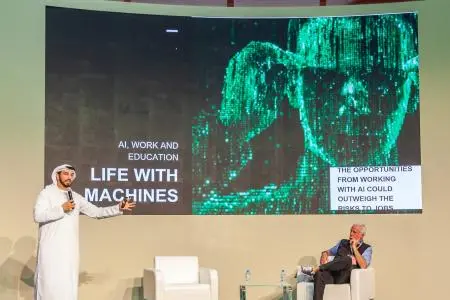
Abu Dhabi: A fascinating session at the Abu Dhabi International Book Fair yesterday revealed that the great possibilities and conundrums facing the world today are being pondered and studied right here in the UAE, as part of the work of the Dubai Future Foundation.
The academy’s work was outlined in a talk called In the Year 2050..., helmed by Saeed Al Gergawi, Director of the Dubai Future Academy, an initiative of the Dubai Future Foundation. The implications of projected growth in artificial intelligence, climate and social change, quantum biotechnology and space exploration are under consideration at the Dubai Future Foundation that is tasked with making enabling the future and working with other government enitites government for action.
Climate change is front and centre on the academy’s agenda. The number of floods quadrupled between 1980 and 2004, global hunger is on the rise for the first time in 10 years, and there is a 95% chance that global temperatures will rise by more than two degrees by 2100, said Al Gergawi.
Culturally, there is still a long way to go for people in the UAE to react faster and more effectively to environmental challenges, he said. If we don’t, some estimates say that the country’s coastline could encroach by up to six or seven kilometres. “The issue is, it comes down to cultural aspects,” he said. “Should I buy the new Nissan to go dune bashing? It’s easy for technology to move forward but people move forward much slower.”
There are many innovations happening in the UAE, with Al Gergawi pointing to work at the International Center for Biosaline Agriculture on growing salt-tolerant quinoa. “The research is happening… but it isn’t happening fast enough for it to be deployed into market for use” he said.
Social change and its interaction with technology is another international area the Dubai Future Foundation is studying. That means they are asking questions about the rise of “third-culture kids”, those who grow up in at least four countries.
As far as technological advancements are concerned, they require a thoughtful approach to practical application. For example, said Al Gergawi, the demand for prosthetic limbs – now produced more easily than ever due to the proliferation of 3D printing – is projected to rise by 50% by 2050.
Although humans want to engage and benefit from all this progress and innovation, there are limits to their interest. For example, 64 per cent of adults surveyed in the US said they do not want a brain implant that improves memory, said Al Gergawi.
The Dubai Future Foundation is also pondering mind-bending issues raised by the fields of quantum computing, space exploration and artificial intelligence (AI).
Should AI be in the school curriculum? asked Al Gergawi. What are the implications of the rise in biotech startups, and those focusing on the microscopic level, such as “nano robots that can go in your bloodstream”? How will the growth in nano satellites, to the tune of 2,000 owned by the private sector by 2030, be managed? What will the impact on financial markets be in the pursuit of plans to mine near Earth asteroids for the kind of precious minerals – gold, platinum – that are badly needed but in short supply on earth? These are the topics that Al Gergawi considers on a daily basis, among the mega trends that the foundation is keeping an eye on.
In response to a question from the audience about human relevance down the line, Al Gergawi stressed that the human aspect is always going to be relevant. “I would recommend jobs that are immune to automation and AI,” he said, pointing to the example of nursing as a ‘future-proof’ field. “When we look at that job and what that job caters to, it’s more nurturing than robots are capable of. The human aspect will always be there, it’s just that it will be playing a more collaborative role with machines.”
-Ends-
About Department of Culture and Tourism – Abu Dhabi
The Department of Culture and Tourism conserves and promotes the heritage and culture of Abu Dhabi emirate and leverages them in the development of a world-class, sustainable destination of distinction, which enriches the lives of visitors and residents alike. The organization manages the emirate’s tourism sector and markets the destination internationally through a wide range of activities aimed at attracting visitors and investment. Its policies, plans and programs relate to the preservation of heritage and culture, including protecting archaeological and historical sites and to developing museums, including Zayed National Museum, Guggenheim Abu Dhabi, and the Louvre Abu Dhabi. DCT - Abu Dhabi supports intellectual and artistic activities and cultural events to nurture a rich cultural environment and honor the emirate’s heritage. A key role is to create synergy in the destination’s development through close co-ordination with its wide-ranging stakeholder base.
Disclaimer: The contents of this press release was provided from an external third party provider. This website is not responsible for, and does not control, such external content. This content is provided on an “as is” and “as available” basis and has not been edited in any way. Neither this website nor our affiliates guarantee the accuracy of or endorse the views or opinions expressed in this press release.
The press release is provided for informational purposes only. The content does not provide tax, legal or investment advice or opinion regarding the suitability, value or profitability of any particular security, portfolio or investment strategy. Neither this website nor our affiliates shall be liable for any errors or inaccuracies in the content, or for any actions taken by you in reliance thereon. You expressly agree that your use of the information within this article is at your sole risk.
To the fullest extent permitted by applicable law, this website, its parent company, its subsidiaries, its affiliates and the respective shareholders, directors, officers, employees, agents, advertisers, content providers and licensors will not be liable (jointly or severally) to you for any direct, indirect, consequential, special, incidental, punitive or exemplary damages, including without limitation, lost profits, lost savings and lost revenues, whether in negligence, tort, contract or any other theory of liability, even if the parties have been advised of the possibility or could have foreseen any such damages.