PHOTO
Doha – Fifty-five pre-med 1 students from Weill Cornell Medicine-Qatar (WCM-Q) presented the findings of their biology lab research projects on the antimicrobial effect of natural substances at this year’s poster session.
Working in small groups of two and three, the students conducted literature reviews of existing research, produced research proposals with guidance from teaching faculty, conducted experiments in the lab, and then presented and discussed their findings with peers and faculty members at a poster session. The research projects were conducted over the course of two semesters and resulted in 19 poster presentations.
Students Yaqoub Jassim Al-Jaidah, Ubaida Al-Aani, and Myra Abbasi presented a poster on the inhibitory effect of Cambodian agarwood oud oil on two species of bacteria—Staphylococcus aureus and Corynebacterium amycolatum.
Al-Jaidah said: “We tested Cambodian agarwood oud oil against Staphylococcus aureus and Corynebacterium amycolatum bacteria found on the skin and respiratory tract, respectively. Our results showed that Cambodian agarwood oud oil has molecules that inhibit the growth of the bacteria. Overall, this was a very educational learning process because people in the Gulf commonly use Cambodian agarwood oud oil on special occasions, yet, only a few know that it can inhibit the growth of bacteria. We are excited to share this finding.”
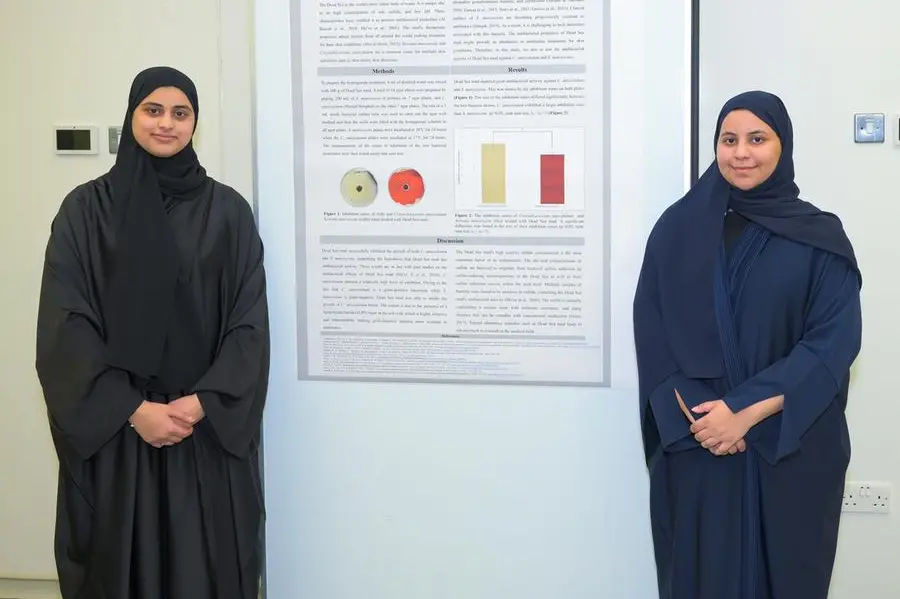
Noor Alnaimi and Alyaa Altamimi presented their poster, titled ‘The Antibacterial Activity of Dead Sea Mud Against Corynebacterium amycolatum and Serratia marcescens.’ Altamimi said: “We started working on our project during the first semester, and I enjoyed every moment of my experience. Literature has indicated that Dead Sea mud has three unique properties—high salinity, low pH, and high sulfide content—so we tested the mud against Gram positive and Gram negative bacteria to see if there was a difference between the inhibition zone. We concluded that there was a difference in the inhibition between the two bacteria.”
Other projects investigated the antimicrobial effects of coriander, clove, cinnamon, henna, dried figs, hibiscus, manuka honey, eucalyptus oil, and yerba mate, among others.
Dr. Kuei-Chiu Chen, professor of biology, said: “Our annual research project gives pre-med 1 students hands-on experience of conducting research experiments, starting with the conceptualization of a research question, formulation of a hypothesis, conducting experiments in the lab, collecting and analyzing data, and creating posters to communicate their findings. All the students worked extremely hard on their projects and did exceptionally well, producing some extremely impressive and well-thought-out research projects.”
The student projects are educational assignments and the findings should not be considered clinical trials or medical guidance on the effectiveness of various remedies.
-Ends-
About Weill Cornell Medicine-Qatar
Weill Cornell Medicine-Qatar is a partnership between Cornell University and Qatar Foundation. It offers a comprehensive six-year medical program leading to the Cornell University M.D. degree with teaching by Cornell and Weill Cornell faculty and by physicians at Hamad Medical Corporation (HMC), Aspetar Orthopedic and Sports Medicine Hospital, the Primary Health Care Corporation, the Feto Maternal Center, and Sidra Medicine, who hold Weill Cornell appointments. Through its biomedical research program, WCM-Q is building a sustainable research community in Qatar while advancing basic science and clinical research. Through its medical college, WCM-Q seeks to provide the finest education possible for medical students, to improve health care both now and for future generations, and to provide high quality health care to the Qatari population.
For more info, please contact:
Hanan Lakkis
Associate Director, Media and Publications
Weill Cornell Medicine - Qatar
hyl2004@qatar-med.cornell.edu